Everyone Has The Right To Generous Provision For Old Age!

Date: October 4, 2020
Categories: Party News
Saturday, 11 July 2026

Self-Determination is a human right













Date: October 4, 2020
Categories: Party News
Date: October 2, 2020
Categories: Party News
WE NATIONAL LIBERAL TRADE UNIONISTS – NLTU – are neither of the ‘left’ or the ‘right’. In addition to this, we are equally opposed to both capitalism and modern-day socialism. Indeed, we believe that there is very little true difference between both systems. Whilst we believe that ordinary working folks are the backbone of any nation, we regard ourselves as ‘beyond class’. As the NLTU Facebook site – https://www.facebook.com/ groups/277840098977231 – notes:
The National Liberal Trade Unionist aims to promote a non-socialist trade unionism i.e. building employee protections rather than class revolution. The group will support the principles of liberty e.g. the protection of all individual employees, and patriotism e.g. the defence of workers from globalisation, and promote a liberal e.g. supporting greater employee share ownership, agenda.
From this, it follows that we’re particularly interested in alternative economic systems that offer both security & betterment for ordinary working folks. Thus some of our ‘points of reference’ include Distributism, Social Credit, the Co-Operative movement and Syndicalism. We’re also interested in Guild Socialism (as advocated by the likes of William Morris, GDH Cole and Arthur Penty). With this in mind, the NLTU recently came across a thoughtprovoking article in the Plough Quarterly, a US-based ‘magazine of stories, ideas, and culture to inspire faith and action’. Written by Gary Dorrien, the article – https://www.plough.com/en/topics/justice/social-justice/ economic-justice/restore-the-guilds – provides an excellent history of Guild Socialism (referred to as ‘Christian socialism’ in the article).
We invite our readers to share their thoughts when this article is reproduced on the NLTU Facebook site https://www.facebook.com/groups/277840098977231/ – or the National Liberals Facebook site https://www.facebook.com/groups/52739504313/ It goes without saying that there are no links between Gary Dorrien, Plough Quarterly, the NLTU and the National Liberal Party. We’d also like to point out that whilst the article is written from a Christian perspective, the NLTU and NLP welcome members & supporters from all religions and none. Please note that the NLTU has kept the original US spellings and phrases as they are.
.
Restore The Guilds – What today’s labor unions, democratic socialists, and mutual aid societies might learn from the colorful history of Christian socialism in Britain.
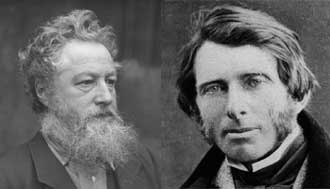
(Left) William Morris (24th March 1834 – 3rd October 1896) was a British textile designer, craftsman, poet, novelist, translator, and socialist activist. His designs for furniture, fabrics, stained glass, wallpaper, and other decorative arts are associated with the British Arts and Crafts Movement. (Right) John Ruskin (8th February 1819 – 20th January 1900) was the leading English art critic of the Victorian era. He was also a draughtsman, philosopher, prominent social critic, reformer and philanthropist. Ruskin was a major influence on Morris – especially his views on the social and moral basis of architecture.
IN 1906, a British Christian socialist named Arthur J. Penty had a straw-that-broke-the-camel’s-back moment. Penty loved the decentralized economic democracy envisioned by two Victorian literary icons, Oxford art critic John Ruskin and radical novelist William Morris, but there was no organization devoted to these ideas. Ruskin and Morris had passed on, and the dominant movement for socialism in England was the Fabian Society, which promoted a centralized government collectivism that nationalized all means of production, exchange, and distribution. Penty, a reluctant Fabian, did his best to stifle his revulsion at Fabian meetings and admonished himself to be realistic – after all, Fabians undeniably prevailed on the British left and were the most politically viable option. But when Fabian Society leader Sidney Webb hired a utilitarian architect to design the buildings for the school he founded, the London School of Economics, that was more than Penty could stomach – he couldn’t work with philistines. Fabian collectivism, he fumed, was socialism without a soul. Somehow the ethical, human-scale socialism of Ruskin and Morris had to be renewed in a twentieth-century form. The movement he sparked would call it guild socialism.
More than a century later, with capitalism run amok and several purportedly socialist states spectacularly come and gone, guild socialism might be just what we need. The cry for an alternative to corporate capitalism is certainly getting very strong. Decades of letting big banks and corporations do whatever they want have yielded a revulsion against neoliberalism from many sides. Americans are losing their tolerance for extreme inequality, an ecological crisis is pressing upon us, and an overdue reckoning for America’s long history of racism has come. The convention that Americans have nothing to learn from the history of socialism has become unsettled, to put it mildly. Democratic socialism has made a dramatic comeback as the name for a different kind of society in which freedom and equality strengthen each other and no group dominates any other.
But democratic socialism has a complex and problematic history of its own. The name registers that socialists who were committed to democracy had to distinguish themselves from socialists who were not. Democratic socialists ran for office, appealed to socialist ethical values, and achieved progressive reforms through coalition governments. Their socialist values should have made them principled feminists, anti-racists, anti-militarists, and anti-imperialists, but many settled for weak gestures toward these causes. They should have welcomed Christian socialists into the parties they created, but only in England, select British colonies, and Switzerland did that happen.
Democratic socialists never achieved democratic socialism anywhere. Instead, they built Social Democratic parties, enacted progressive reforms, and built advanced welfare states, which came to be called, revising the meaning of a distinguished name, social democracy. Democratic socialism has a predominant legacy of state socialist aspirations inspiring campaigns for progressive reform. I do not say this to slight social democracy. Only social democracy has come close to fulfilling the doctrine of human rights expounded in Christian social ethics, by establishing nationwide policies of universal health care, a living wage, generous parental leave, and free higher education. In Germany, social democracy has reached into the management of corporate enterprises, creating supervisory boards in which 50 percent of the board members represent workers.
But democratic socialism is not inevitably about aspiring to state socialism and settling for social democracy. The deepest impulse in it is the original socialist vision of cooperative community. Christian socialists championed this idea long before German Marxists (against their intention), Continental neo-Marxists (ambiguously), and British Fabians (very intentionally) made socialism a project of the state. “State socialism” was an oxymoron to the radical democrats, communitarians, Marxists, anarchists, and Christian socialists of the early socialist movements. Karl Marx himself envisioned a revolutionary order featuring collective ownership, no classes, and no state. The Marxian fantasy of a stateless communist utopia was a major problem for every socialist party that competed for votes and sought to take the reins of the state. Even as the Social Democratic parties drifted toward state socialism, equating socialism with nationalization, dissenters within these parties resisted this trend or tried to bend it in the direction of worker guilds, guild networks, and other forms of decentralized economic democracy. In Britain, guild socialism was the leading resistance movement. It was loaded with Christian socialists and secular ethical socialists who renewed a politics of radical democracy that is still worth reviving today.
• FIND out more about National Liberal Trade Unionism:
Liberal Trade Unionism
–
Once upon a time the Trade Union movement in Britain was largely part of the Liberal movement. The majority of officials were even members of the Liberal Party. This continued from when the first unions were formed up until the turn of the century. The, then new, ideology of socialism took hold amongst many officials who believed that the future of politics was a class struggle and that only a working class party could represent or even deliver power to that class. Thus the Labour party was formed and Trade Unions became synonymous with the party.
–
In the present day workers still require the services of a union, whether as individuals or as a collective. In the short run, jobs are under threat and employee rights are under attack. In the medium term, workers face the negative effects of globalisation e.g. wage depression or unemployment.
–
Many however feel that those unions in the TUC, wedded to a confrontational class-based politics, are ill-equipped to respond to these problems.
–
For example, socialism is no longer popular. The TUC’s ‘workers of the world unite’ slogan rings hollow to British workers losing jobs overseas. Class politics is the exception to the rule and the ‘working-class’ no longer automatically regard the Labour party to be their natural representatives.
–
Non-Socialist Trade Unionism
In Europe there has always been an alternative trade unionism, either ‘Christian’ or Liberal, and this often resulted in separate unions that reflected their ethos. In the UK such groups failed to found their own unions and slowly shrank in importance within existing ones.
We believe in a non-socialist unionism that seeks to protect the interests of its’ members at work rather than as an arm of political or class revolution. In this way unions can focus their energies in the workplace rather than frittered away trying to control the Labour party. A separate liberal union could effectively influence ALL political parties to adopt policies to protect employees in the workplace.
A sensible alternative
Whether via its’ own union or within another our supporters will be support the principles of liberty (putting the individual member first) and patriotism (defending workers from globalisation), and be liberal (increasing employee share ownership) and economic (focusing activity in the workplace) in practice.
If you want to help us promote a sensible non-socialist trade unionism please contact us via natliberal@aol.com and/or visit our Facebook group http://www.facebook.com/groups/277840098977231
Date: September 28, 2020
Categories: Articles, Liberty Wall

• TAKE ACTION! Don’t forget to viral out the original Scrap Universal Credit! posters out via Social Media:
Caledonian Voice Says Scrap Universal Credit! http://nationalliberal.org/caledonian-voice-says-scrap-universal-credit
English Voice Says Scrap Universal Credit! http://nationalliberal.org/english-voice-says-scrap-universal-credit
Ulster Voice Says Scrap Universal Credit! https://nationalliberal.org/ulster-voice-says-scrap-universal-credit
Welsh Voice Says Scrap Universal Credit! http://nationalliberal.org/welsh-voice-says-scrap-universal-credit
• CHECK out: Caledonian Voice & English Voice Say … Scrap Universal Credit! http://nationalliberal.org/caledonian-voice-english-voice-say-…-scrap-universal-credit
• ALSO check out: Caledonian Voice, English Voice & Ulster Voice Say … Scrap Universal Credit! http://nationalliberal.org/caledonian-voice-english-voice-ulster-voice-say-…-scrap-universal-credit
• FOLLOW the National Liberal Party @ Twitter/National Liberal
Date: September 26, 2020
Categories: Party News
THE NATIONAL LIBERAL PARTY has several key objectives. One of the most important is to build the infrastructure of an alternative mass media of news, views, information and entertainment. So far we’ve produced a UK-wide publication – Liberty & Nation – two national publications – Caledonian Voice and English Voice – and several borough, city and county-based publications.
Although these publications have been produced on an irregular basis, they’ve always attracted a positive response. We’re well aware that we need to produce them on more regularly – and we desperately need to produce lots of ward-based publications. We hope to do this as & when we attract more activists.
In the meantime, we’d like to promote the circulation of our existing publications. One way of doing this is to reproduce the lead articles from them & then encourage NLP members and supporters to viral them out via Social Media. We’ve already done this with several publications (see list below) and this time it’s the turn of Essex Voice. Once it appears here it’ll also be reproduced on our National Liberals Facebook site – https://www.facebook.com/groups/52739504313/ – and National Liberal Party Facebook site – https://www.facebook.com/NationalLiberalParty/ In order to bring Essex Voice to a wider audience we’d appreciate it if you’d like & share our post on both Facebook sites
.
A Vision For Essex

To get your FREE pdf copy of issue 1 of Essex Voice simply e-mail natliberal@aol.com
READERS of Essex Voice – EV – who have studied local history will know that Essex used to be the kingdom of the East Saxons. Sometimes referred to as the Kingdom of Essex, it was one of the seven traditional kingdoms of the Anglo Saxon Heptarchy. Essex and the other Anglo-Saxon kingdoms – East Anglia, Kent, Mercia, Northumbria, Sussex and Wessex – eventually unified into the Kingdom of England.
Founded in the 6th century, the Kingdom of Essex covered a vast territory – later occupied by the counties of Essex, Hertfordshire, Middlesex and (for a brief period in the 8th century) Kent. Although now vastly reduced in size, not many modern counties can boast that they once included the remains of two provincial Roman capitals: Colchester and London!
Essex has a rich and varied history and EV feels that our ancient flag, featuring three white seaxes (short Saxon swords) tends to illustrate this. Sadly, however, any mention or depiction of modern Essex is usually derogatory or stereotypical in nature.
POSITIVE
So how do we promote a positive identity and vision for Essex? How do we promote a ‘localist’ agenda for Essex and how do we dispel the notion that we’re simply just the ‘dumping ground’ for London’s overspill? In addition, how do we fight this strange form of Essexphobia – where the establishment seems to portray any pride in Essex & its people in a wholly negative and derogatory manner. We feel that – to some degree – this Essexphobia can be countered by some form of autonomy. We feel that historic areas like ours should have more powers – indeed, we believe in decentralisation down to the lowest possible common denominator. But how can this be achieved? Essex Voice believes that part of the solution may be found in the establishment of an English Parliament.
However, before we even look in any depth at the idea of an English Parliament, we must first make a clear distinction between the English nation and the British state. We must also realise that Westminster is not an English Parliament. We know that it’s situated in London, the capital of our nation. However, in no way, shape or form does Westminster represent ordinary English working folks. Indeed, EV currently views Westminster (and the politicians who inhabit it) as merely the plaything of British representatives of globalism – a superrich elite without loyalty to any of the nations of these isles.
ESSEX
These globalists – as their description suggests – have no interest or loyalty to their nation or people. Thus they have no true feelings for England or its citizens. All they’re interested in is profit margins. Therefore, if folks in Essex – or anywhere else in England for that matter – won’t work for a pittance they’ll think nothing of shafting the workforce. They’ll do this either by exporting jobs or importing cheap foreign labour. Both methods throw ordinary working folks onto the scrapheap. In addition, the second method simply hastens a race to the bottom between indigenous and immigrant workers. It’s a race that can only end in recriminations.
One way of countering the actions of the British super-rich elite is the establishment of an English Parliament. However, it must be an English Parliament that really reflects the wishes, hopes, fears and desires of ordinary English folks. We have no desire to establish another debating chamber for ex-Public schoolboys.
Therefore, we’ll look at the call for the establishment of an English Parliament – and what it could mean for our county – in the next issue of Essex Voice.
• ALSO CHECK OUT the following:
Building Our Media Infrastructure http://nationalliberal.org/building-our-media-infrastructure
Building Caledonian Voice https://nationalliberal.org/building-caledonian-voice
Build Caledonian Voice (2) https://nationalliberal.org/build-caledonian-voice-2
Building English Voice http://nationalliberal.org/building-english-voice
Building The Isle Of Wight Voice http://nationalliberal.org/building-the-isle-of-wight-voice
Building Kent Voice http://nationalliberal.org/building-kent-voice
Building Liberty & Nation http://nationalliberal.org/building-liberty-nation
Date: September 20, 2020
Categories: Articles, Party News
By continuing to use the site, you agree to the use of cookies. more information
The cookie settings on this website are set to "allow cookies" to give you the best browsing experience possible. If you continue to use this website without changing your cookie settings or you click "Accept" below then you are consenting to this.