.
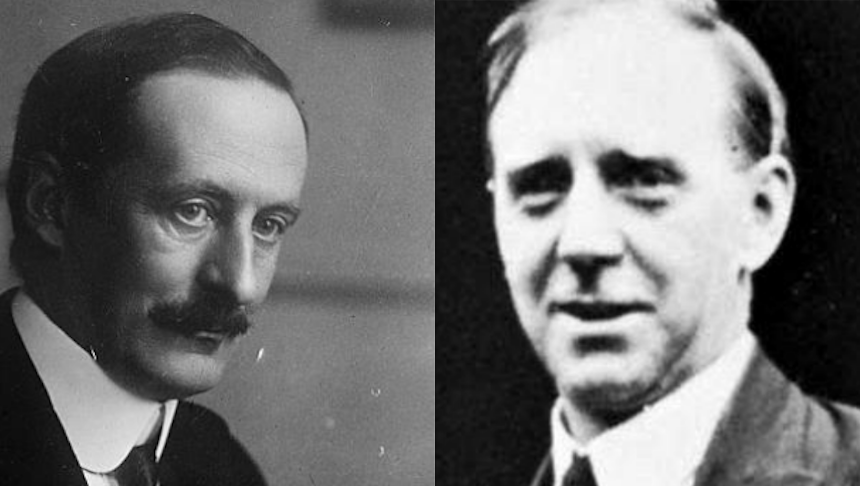
Baldwin’s Conservative government successfully framed the 1926 UK General Strike as a revolutionary threat to the constitution and democracy – as opposed to a labour dispute relating to longer working hours & and significant pay cuts. This led to thousands of middle- and upper-class volunteers joining the Organisation for the Maintenance of Supplies. It was chaired by Lord Hardinge (left). Arthur James Smith (right), General Secretary of the Miners’ Federation of Great Britain is thought to have coined the slogan “Not a penny off the pay, not a minute on the day.”
AT THE START of this month we outlined the background to (and causes of) the UK General Strike of 1926. Taking place from 4th to 12th May 1926, it involved up to 1.75 million workers.
.
The catalyst for the strike was the dire situation of the coal industry. The remedy favoured by mine owners involved cutting wages & increasing working hours. Obviously, the Miners’ Federation of Great Britain – the MFGB was active from the late 19th century until it formed part of the National Union of Mineworkers on 1st January 1945 – totally opposed the idea.
.
They campaigned under the slogan “Not a penny off the pay, not a minute on the day” to express the resistance to this proposed idea. (It’s widely believed that Arthur James Cook, General Secretary of the MFGB coined the slogan). The scene was therefore set for industrial action.
.
As we’ve previously noted, the strike brought much of Britain to a standstill. The events of 4th to 12th May 1926 remain one of the largest coordinated labour-related actions in UK history. These nine days also represent the only general strike in UK history.
.
GOVERNMENT RESPONSE
.
So, what was the government response to the strike?
.
The UK government, led by Conservative Prime Minister Stanley Baldwin, appears to have anticipated the strike. Therefore, they were well-prepared for widespread industrial action.
.
As we noted in the first part of this series there had been earlier disputes in 1921 and a near-strike in 1925 (sometimes known as ‘Red Friday’).
.
In response to these events, the government provided a nine-month subsidy to maintain miners’ wages. A Royal Commission (Samuel Commission, chaired by Sir Herbert Samuel, who later became leader of the Liberal Party) was also appointed to investigate the coal industry.
.
The Commission – which started work on 15th October 1925 & ended on 14th January 1926 – reported in March 1926. This gave the government adequate time to prepare for any future strike action.
.
GOVERNMENT PREPARATIONS
These preparations included building up around five months’ supply of coal stocks, the creation of the Organisation for the Maintenance of Supplies (OMS), the recruitment of special constables, and planning in respect of transport and essential services.
.
Baldwin’s government also declared a state of emergency – which came into effect from 30th April 1926 – under the Emergency Powers Act 1920. This allowed regulations to secure food, fuel, transport, and public safety.
.
Essential services were kept going by hundreds of thousands of middle- and upper-class volunteers. They ran trains, buses, docks, and other services. Many drove vehicles or acted as special constables.
.
The military (in the form of the army & navy) protected key sites like docks and power stations. (However, troops were used sparingly to avoid provocation.) Food distribution was also organized centrally with armed convoys where needed.
.
The Trades Union Council – TUC – produced 11 issues of British Worker, which had a daily peak circulation of one million copies.
.
THE BRITISH GAZETTE
.
To counter this, the government published The British Gazette, which was edited by Winston Churchill. At its height, two million copies were produced a day. It sold for one penny, but given government resources, many copies given out for free.
.
The British Gazette also successfully described the strike as a revolutionary threat to the constitution and democracy – as opposed to a labour dispute relating to longer working hours & and significant pay cuts. (Framing the strike in these terms no doubt led to the huge numbers of middle- and upper-class volunteers who flocked to the government’s ranks.)
.
Baldwin’s government also had a propaganda advantage in that it controlled paper supplies which significantly hindered production of the TUC’s British Worker.
.
Baldwin himself used radio broadcasts to appeal for calm and frame the strike as an unconstitutional challenge. This echoed the message & reinforced the stance taken by The British Gazette.
.
LEGALITY
.
The government were also able to question the legality of the strike. However, it was never formally ruled illegal. Police & volunteers from the Organisation for the Maintenance of Supplies (chaired by Lord Hardinge) helped to maintain order. There were limited instances of violence, but the TUC were more than keen to avoid trouble. Indeed, as we noted in our previous article, strikers organised community efforts like volunteer services and football matches with police.
.
The government also took an extremely hard line when it came to negotiations. Here, they refused to talk (about the miners’ issues) until the TUC unconditionally ended the strike.
.
• In part 3 we will look at the overall impact of the 1926 UK General Strike.
.
Picture Credits:
.
Arthur James Smith (Fair Use)
Lord Hardinge