



Liberal Future Says … English Youth – Fight For National Freedom & Social Justice!

Date: July 31, 2019
Categories: Liberty Wall, Party News
Saturday, 17 October 2026

Self-Determination is a human right













Date: July 31, 2019
Categories: Liberty Wall, Party News
WELCOME TO the sixth debate hosted by Liberal Future – LF – the youth wing of the National Liberal Party. This debate relates to an article written by Kevin Albertson (who is Professor of Economics, Manchester Metropolitan University, in Lancashire, England) it appeared in The Conversation, which describes itself as ‘an independent source of news, analysis and expert opinion, written by academics and researchers, and delivered direct to the public.’
Originally called Hate Globalisation? Try Localism, Not Nationalism, Professor Albertson wrote his article a little while ago – see the original here: https://theconversation.com/hate-globalisation-try-localism-not-nationalism-86870 – although it’s only recently been brought to our attention. Despite this, we thought that it was very thought-provoking and should form the basis of this debate.
LF doesn’t agree with all of his extremely well referenced article. For instance, we get the impression that Professor Albertson is happy enough with capitalism whereas we’d like to get rid of it completely! We believe that it’s a cruel dog-eat-dog system that it obsessed with centralisation, control and gigantic profits. We’d like to overthrow capitalism and replace it with Distributism & Social Credit.
LF also questions his rather one-dimensional view of nationalism. Not all forms of nationalism are bad. Indeed, there’s probably as many varieties of nationalism as there are varieties of communism, socialism, liberalism, anarchism – and every other ‘ism’ that one can think of! It all depends how one defines nationalism and it’s important not to conflate nationalism – a love of one’s people & nation – with imperialism.
That said, we agree with Professor Albertson’s view that localism is an effective antidote to the misery and exploitation of globalism. For localism supports the local production, distribution and consumption of goods and services. In short, it puts the local economy, community and environment first.
Whilst his article concentrates on the theory of localism, we’re interested in the practicalities of disengaging from capitalism and promoting localism. Simply put – How Do We Keep It Local?
We invite our readers to share their thoughts when this article is reproduced on the Liberal Future Facebook site – https://www.facebook.com/groups/706779429376233/?epa=SEARCH_BOX – and the NLP Facebook site – https://www.facebook.com/NationalLiberalParty/ It goes without saying that there are no official links between Professor Albertson, The Conversation, Liberal Future and the National Liberal Party.
Hate Globalisation? Try Localism, Not Nationalism
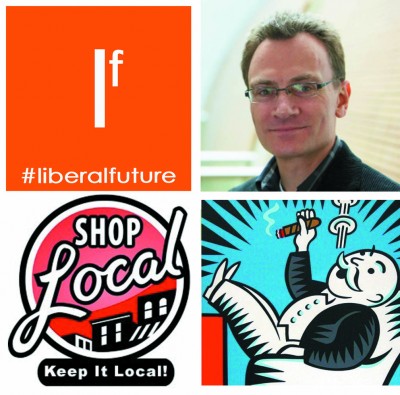
IT HARDLY needs saying, but there are changes afoot in the political economy of the world. Where there is globalisation (1), there are globalisation protestors (2). This is nothing new (3), but it is becoming mainstream.
The antithesis of globalisation, nationalism (4), and the pursuit of your own country’s interests over those of everyone else, has bubbled back up in Europe (5). And it’s not just Europe, of course. In the US, president Donald Trump (6) is (among other initiatives) rethinking the American commitment to free trade (7).
In the rest of the world (8), the experience of globalisation shows it creates some winners (9) and some losers (10). This varies geographically (11) and in different economic fields (12), and is shown in different aspects of our lives (13).
And so, someone in London might find their house is worth more. As foreign capital flows in to buy up large swaths of the capital (14) it increases their wealth, while others might be priced out of the market. In some sectors of the market, wages might be declining (15) as a result of global competition, migration, casualisation (16) or automation (17). In the final analysis, however, it is not a matter of whether globalisation causes these changes (18), it is rather more that people feel that it does (19).
Globalisation is not, however, merely a matter of trade (20), migration (21) and foreign outsourcing (22). To many it seems Britain itself is for sale (23) as an increasing proportion of UK businesses and assets answer to foreign owners (24).
Economic theory suggests, therefore, the nation will increasingly be run for the benefit of foreign capital (25), rather than the citizens (26). On top of this, there is the danger that inflows of foreign capital will cause the exchange rate to appreciate, making it more difficult to export (27), reducing manufacturing output and reducing employment in those sectors affected.
To protect them from forces beyond their control, citizens across the world are increasingly looking to the nation state for protection, hence the rise of what is often called nationalism. As Abraham Lincoln (28) noted:
The legitimate object of government is to do for a community of people whatever they need to have done, but can not do at all, or can not so well do, for themselves – in their separate, and individual capacities.
It is clear, no individual or community can stand against the forces of global capital (29), and Western governments appear averse to giving the workforce the means to protect itself (30), through, for example, increasing employment rights (31) and unionisation (32). However, in their search for a strong government to protect them, citizens are in danger of giving the state too much power over their lives (33).
It is by no means assured that the policies which suit a strong domestic government will be better than those which suit foreign owned multi-national corporations. Also, history indicates the fear of global capital may be coopted by unscrupulous politicians into a fear of other nations or fear of other peoples.
Rather than nationalism, therefore, we might turn to localism (34). In the UK context, this might be devolution (35) with real (financial) localised power, and that power realised through local government and local business.
An economy of big businesses (operated for the benefit of global owners) is less than ideal for the individual and society. In contrast, a society of many small local businesses is more resilient, more empowering (36) and more in keeping with the spirit of capitalism and of the market (37). We must also bear in mind that increasing business concentration (fewer, but larger firms) is a driver of increasing inequality (38). If a business is too big to (be allowed to) fall (39), then the government has failed in its duty to keep business small.
The government might likewise consider how we might prevent those who do not even live in the country from driving up house prices (44).
Local protection from exploitation by global interests requires the right mix of global and local policies. And local government policies require adequate financing. By local financial power, I don’t mean local taxes. That has the potential to fragment the nation, as it has, to some extent, in the EU (45) (whether perceived rightly (46) or wrongly (47)).
If we fund education or social care out of local taxes, for example, there will tend to be a race to the bottom as local authorities will be motivated to underperform to encourage vulnerable families to go and live elsewhere (48). It follows taxes should be collected nationally, and shared proportionally (on the basis of demographic profile) to the devolved authorities.
There is no space here to discuss in detail other possible localism policies here, but there are many ways to promote local ownership and local empowerment. That could include local currencies, boosts to council housing, local authority ownership of utilities or support for locally-owned high street shops. However, it is not a policy mix I suggest, rather it is an emphasis.
Ultimately, the only viable alternative to the choice currently on offer, the choice of Big State or Big Business (49), is Small State and Small Business, or more appropriately Local Government and Local Business. To pursue localism will require a systemic shift in how the national government goes about shaping society, but I suggest it is possible to promote social justice in a capitalist context in no other way.
• CHECK out Liberal Future here: http://nationalliberal.org/liberty-wall-3/liberal-future
• ALSO check out previous Liberal Future debates here:
Liberal Future Debate (1) – Should We Lower The Voting Age Throughout the UK? http://nationalliberal.org/liberal-future-debate-1-%e2%80%93-should-we-lower-the-voting-age-throughout-the-uk
.
Liberal Future Debate (2) – Must The Earth Die Screaming? http://nationalliberal.org/liberal-future-debate-2-must-the-earth-die-screaming
.
Liberal Future Debate (3) – Do Sport And Politics Mix? http://nationalliberal.org/liberal-future-debate-3-%E2%80%93-do-sport-and-politics-mix
Liberal Future Debate (4) – Is Tony Blair A War Criminal? http://nationalliberal.org/liberal-future-debate-3-–-is-tony-blair-a-war-criminal
Liberal Future Debate (5) – Is It Racist To Highlight The Sexual Abuse In Rotherham & Telford? http://nationalliberal.org/liberal-future-debate-4-is-it-racist-to-highlight-the-sexual-abuse-in-rotherham
Date: June 24, 2019
Categories: Liberty Wall, Party News





Date: June 21, 2019
Categories: Liberty Wall

Date: June 11, 2019
Categories: Liberty Wall
THIS IS the fourth part of a series entitled Trade Unionists Against Mass Immigration. It should be read directly on from part 1 http://nationalliberal.org/from-the-liberty-wall-–-national-liberal-trade-unionists-–-trade-unionists-against-mass-immigration-part-1 part 2 http://nationalliberal.org/from-the-liberty-wall-–-national-liberal-trade-unionists-–-trade-unionists-against-mass-immigration-part-2 and part 3 http://nationalliberal.org/from-the-liberty-wall-–-national-liberal-trade-unionists-–-trade-unionists-against-mass-immigration-part-3 Originally called The Left Case Against Open Borders – https://americanaffairsjournal.org/2018/11/the-left-case-against-open-borders/– it was written by Angela Nagle for American Affairs, a ‘quarterly journal of public policy and political thought.’ Angela Nagle is a graduate from Dublin City University (DCU) in Éire.
We feel that it’s important to stress that the NLTU is not a socialist trade union. But that doesn’t mean that we’re in favour of capitalism – in fact, we hate it with a vengeance! We are interested in (and promote) social and economic ideas like distributism and social credit which are neither capitalist or socialist. Indeed, we feel that capitalism and socialism are merely different sides of the same coin. National Liberal Trade Unionists are interested in distributism and social credit as they go way beyond capitalism and socialism. We seek economic self-determination, personal sovereignty and individual liberty for everyone. We’re not in favour of either big business or big business micro-managing how we lead our lives – and that includes what we can think and say. In short, we want freedom.
The NLTU might not agree with everything Angela Nagle writes. However, in the spirit of comradeship, free thought, free speech and open debate, we feature her article below. We invite our readers to share their thoughts when this article is reproduced on the NLTU Facebook site – https://www.facebook.com/groups/277840098977231/ – and the NLP Facebook site – https://www.facebook.com/NationalLiberalParty/ It goes without saying that there are no official links between Angela Nagle, American Affairs, the NLTU and the National Liberal Party. Please note that the NLTU has kept the original US spelling and phrases as they are.
.

Angela Nagle (left) notes that the policy of open borders has no public mandate. And as the poster (right) clearly suggests, National Liberal Trade Unionists blames the capitalist system (and its agents of whatever political hue) for Britain’s social and economic problems. It cannot be stressed enough that the NLTU is bitterly opposed to the system of exploitation known as mass immigration. However, we’re not opposed to individual immigrant workers as both they - and indigenous workers - are being used as mere pawns in a game. The name of the game is excessive profit and immigrants are simply being used to plug holes in an increasingly ageing workforce. They’re increasingly becoming the new wage slaves and tax payers whose only real job is to keep the elites in the style they’ve been accustomed to. With this in mind, we oppose all forms of exploitation and hatred whereby ones race, ethnicity, nationality or religion is used to pit one worker against the other. Once again, the NLTUs anger is directed against the capitalist system and not immigrants themselves.
Open borders has no public mandate, but immigration policies that place the burden of enforcement on employers instead of migrants do attract overwhelming support. According to a survey by the Washington Post and ABC News, support for mandating use of the federal employment verification system (E-Verify), which would prevent employers from exploiting illegal labor, is at nearly 80 percent—more than double the support for building a wall along the Mexican border (1). So why do presidential campaigns revolve around building a vast border wall? Why do current migration debates revolve around controversial ICE tactics to target migrants—especially when the more humane and popular method of placing the burden on employers to hire legal labor in the first place is also the most effective? (2) The answer, in short, is that business lobbies have been blocking and sabotaging efforts like E-Verify for decades, while the open-borders Left has abandoned any serious discussion of these issues.
Date: June 10, 2019
Categories: Articles, Liberty Wall, Party News
 .
.
• DON’T FORGET to viral out – via Social Media – our original Liberty Wall posters:
.
From The Liberty Wall – Total Democracy – Check Out Total Democracy http://nationalliberal.org/from-the-liberty-wall-–-total-democracy-–-check-out-total-democracy
From The Liberty Wall – The St. George’s Committee – Check Out The St. George’s Committee http://nationalliberal.org/from-the-liberty-wall-–-the-st-george’s-committee-check-out-the-st-george’s-committee
From The Liberty Wall – Nations without States – Check Out Nations without States http://nationalliberal.org/from-the-liberty-wall-–-nations-without-states-–-check-out-nations-without-states
From The Liberty Wall – National Liberal Trade Unionists – Check Out The National Liberal Trade Unionists http://nationalliberal.org/from-the-liberty-wall-–-national-liberal-trade-unionists-check-out-the-national-liberal-trade-unionists
From The Liberty Wall – Liberal Future – Check Out Liberal Future http://nationalliberal.org/from-the-liberty-wall-–-liberal-future-check-out-liberal-future
From The Liberty Wall – Free Speech: How Do We Protect It? – Check Out Free Speech: How Do We Protect It? http://nationalliberal.org/from-the-liberty-wall-free-speech-how-do-we-protect-it-–-check-out-free-speech-how-do-we-protect-it
From The Liberty Wall – Fourth World Review – Check Out Fourth World Review http://nationalliberal.org/from-the-liberty-wall-–-fourth-world-review-–-check-out-fourth-world-review
From The Liberty Wall – English Green – Check Out English Green http://nationalliberal.org/from-the-liberty-wall-–-english-green-check-out-english-green
Date: June 8, 2019
Categories: Liberty Wall, Party News
By continuing to use the site, you agree to the use of cookies. more information
The cookie settings on this website are set to "allow cookies" to give you the best browsing experience possible. If you continue to use this website without changing your cookie settings or you click "Accept" below then you are consenting to this.