




Wednesday, 21 January 2026

Category » Articles

Buying Local to Support Your Local Economy

BUYING LOCAL means that you are supporting your local economy. In fact several studies have demonstrated that when you buy from an independent locally-owned business as opposed to a chain store, significantly more of your money is used to buy from other local businesses and service providers. This means that your money is going straight back into your own community. It also means that you are reducing your carbon footprint and saving on rising fuel costs.

By buying local you are regaining your economic culture, retaining your independence and keeping your individuality. Why not buy what you want not what someone else wants you to buy? Small businesses select their goods based not on a national sales plan but on the needs of their local customers.
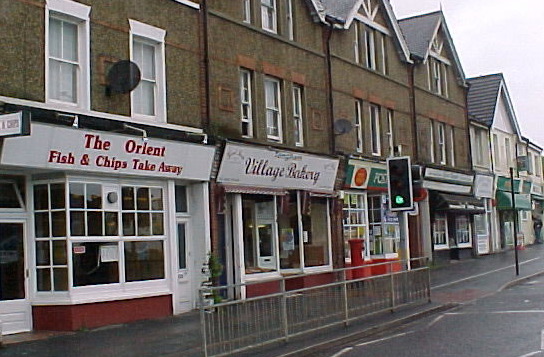
Local shops are the glue that bind communities together

Did you know that small local businesses are the largest employer both nationally and in our local communities? They are also the greatest supporters of charities which receive 250% more support from smaller business owners than they do larger businesses.

The benefit to you the consumer of buying local is that you receive much better customer service because local businesses take more time to get to know customers and as they are mainly owner-operated you benefit from the fountain of knowledge they have which will be first class! Their staff also tend to have a better understanding of the products they are selling and they are also more approachable and keen to resolve any problems that may arise.

The closure of local independent shops, businesses and traders would be catastrophic to any local community as it would force residents to travel further and limit their choice. Reduced local competition may well encourage the remaining suppliers – in particular the main multinationals – to inflate their prices. Small business is the best way to ensure innovation and low prices over the long term.

Local shops and traders are mainly based in local town centres and require comparatively little investment in infrastructure. Shopping local also makes more efficient use of public services thus ensuring that your taxes are put to good use. Think of the amount of money that is spent on the infrastructure when large out-of-town supermarkets are built.

Buying local may not be the complete answer to the recession but perhaps can alleviate some of its local effects. It can help solidarity with people pulling together to help themselves and each other.

Ten Reasons To Shop Local

• Buy local and support your local community

• It keeps our community unique

• Local shops sell a wide range of products

• It is more environmentally friendly

• It ensures your taxes are put to good use

• Shopping local saves you money

• Buying local creates LOCAL jobs

• Buy what you want – not what someone wants you to buy

• Local shops value their customers more

• It keeps prices low and ensures innovation in the long term

Go on – make a difference and shop local!

Share:
  • Print
  • Digg
  • StumbleUpon
  • del.icio.us
  • Facebook
  • Yahoo! Buzz
  • Twitter
  • Google Bookmarks
  • Add to favorites
  • blogmarks
  • Blogosphere
  • Google Buzz
  • PDF
  • email
  • Live
  • MSN Reporter
  • MyShare
  • MySpace
  • Technorati
  • Webnews.de

Malala – The Swat Valley Rebel

As National Liberals we have made our opposition to the UK’s involvement in US actions in Iraq, Afghanistan and Pakistan (via drones) quite clear. We don’t believe in using military force to change a government or a people’s culture. In any event its impact, apart from destruction, is limited and is usually consigned to the dustbin of history once the guns leave. However, we are not neutral in our cultural preferences. We believe in greater not less democracy (referendums and initiatives), greater civil liberties (for privacy and free expression) and the right for individuals to improve themselves through equality of opportunity. The recent shooting (although still alive) of a little girl in the Swat Valley of Pakistan (a Taliban stronghold) for having the temerity to choose her dress, her education and lifestyle reminds us what is, for us, acceptable and not. Our resident poet Jason reflects.

Malala – The Swat Valley Rebel

Who dare to stop me in the valley of Swat?
From acquiring education, for which I’ve a right.
Wrote thus, a teenage girl of little fright –
And lit too she, a flame of resistance against edict;
And vengeful fatwa imposed by holy men, criminally bent.

Aged fourteen, yet she displayed a mature disposition!
Among adults of amiable, adoptive and wavering positions;
And among cowards with guns, stood she firm with a pen,
To note her own dilemmas; yet shone bright her vision.
Swat – where even the mighty military cannot sway
The fate of ordinary people, came Malala with a spirit
To face the deviant dictators; and dared she, to defy
Edict bearers, and wake a nation to stand for girls’ rights.

Oh poor decent minds of the world! Do consider,
For a moment the era we live in, for its heightened terror!
Firing on defenceless children to impose deranged fear,
Seem the test to our resolve: should we take a stand or dither?
Jason
Share:
  • Print
  • Digg
  • StumbleUpon
  • del.icio.us
  • Facebook
  • Yahoo! Buzz
  • Twitter
  • Google Bookmarks
  • Add to favorites
  • blogmarks
  • Blogosphere
  • Google Buzz
  • PDF
  • email
  • Live
  • MSN Reporter
  • MyShare
  • MySpace
  • Technorati
  • Webnews.de

Liberty & Nation on its way!


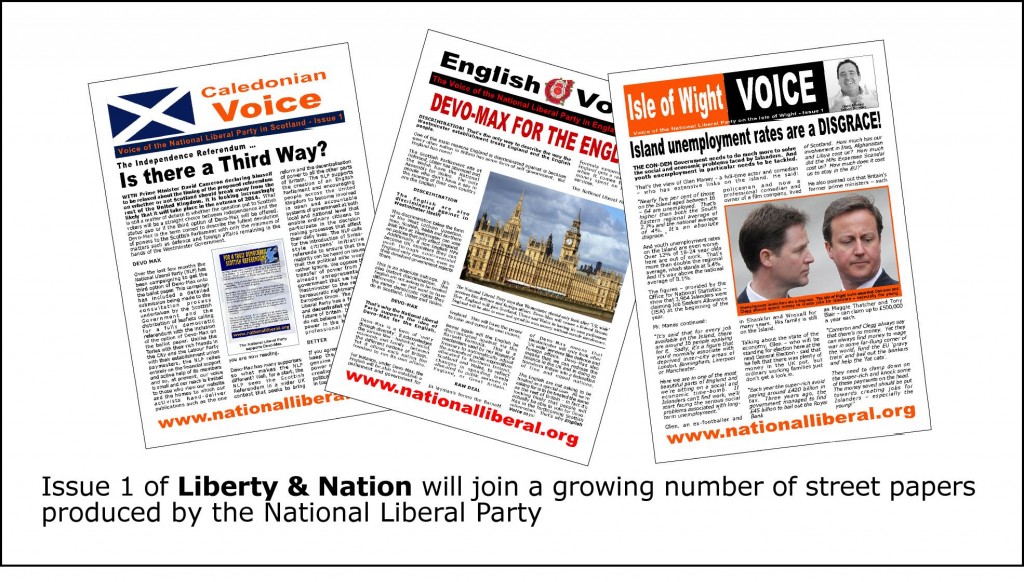
ABOUT a year ago, we announced that the National Liberal Party would be producing a street paper, Liberty & Nation. Despite it being delayed – due to other essential work – we’re glad to say that issue 1 will be out very soon!

Liberty & Nation will join Caledonian Voice, English Voice and the Isle of Wight Voice our growing arsenal of popular outreach material. (The NLP also produces an ideological magazine, New Horizon. To get hold of your FREE copy, simply click here: New Horizon No.2)

In due course we hope to produce other national, regional and local publications. Indeed, after Liberty & Nation, Kent Voice is scheduled to roll off of the NLPs production line.

Initially L&N will be available via e-mail. Hopefully, however, it’ll not be too long before it’ll be regularly available to leaflet with.

L&N will be produced in accordance with the National Liberal Party’s view that we should develop three distinct styles of newspaper, all aimed at different national ‘target’ groups. These styles (and target groups) would reflect the existing establishment media. Thus, we aim to produce ‘broadsheets’ aimed at readers of The Times, Guardian and Daily Telegraph, andreaders of ‘red tops’ like the Star, Mirror and Sun. However, to kick off with, L&N will be aimed at readers of the Daily Mail and Daily Express.

Look out for further news about L&N in the very near future! In the meantime, why not pre-order your FREE pdf copy simply by e-mailing natliberal@aol.com

Share:
  • Print
  • Digg
  • StumbleUpon
  • del.icio.us
  • Facebook
  • Yahoo! Buzz
  • Twitter
  • Google Bookmarks
  • Add to favorites
  • blogmarks
  • Blogosphere
  • Google Buzz
  • PDF
  • email
  • Live
  • MSN Reporter
  • MyShare
  • MySpace
  • Technorati
  • Webnews.de

What The Papers Say – Big Brother is watching you!

FOR some time now, the National Liberal Party has featured a Letters of the Month section, which can be found here: http://nationalliberal.org/letters-of-the-month

According to the introduction to the Letters of the Month section, it hosts letters published in local or national papers from members or supporters. We encourage you to write something that refers to the party or one of our policies.” Readers are asked to then send in copies of successfully printed letters to the NLPs e-mail address, natliberal@aol.com

We’d now like to extend this idea to include articles that have appeared in the media (especially in the local media) which are broadly in accordance with our ideas. We believe that there are lots of people out there who are naturally ‘national liberal’ in their views – but are unaware that the NLP exist as a political movement! (However, it should be noted that, the printing of such articles in this new What the Papers Say section does not imply that the writer or the media source are official members or supporters of the NLP.)
To kick off this new series we reproduce an article by Laura Allen which appeared in issue 187 of the West Belfast-based Shankill Mirror. Originally published under the title My Two Nupes … it examines the growth of the surveillance state.

Big Brother is watching you!

I’M SURE most of you have tuned into the TV programme Big Brother at some point and thought about whether you would go into ‘the house’ or not, based on the idea of being watched 24/7 by the nation. But a more chilling reality is that each day we are being monitored, maybe not 24/7 or by the nation, but by the police, the government and private companies, among others.

Consider a simple trip to buy a loaf of bread, how often would you say you are ‘being watched’, maybe once or twice? If you drive to the shop you may be caught by a traffic camera or speed camera. Once you get to the shop you can guarantee that there will be multiple cameras recording your every move in the shop. And what about that security guard that keeps looking at you as if you are a thief while you innocently look at the bread, deciding which one to buy.

Using your loyalty card? That company now knows the time you shopped with them and what you bought, which is held with every other record of your visits and used to predict what you will buy next. If you pay by debit card your actions are logged once again. Then you leave and are recorded by the same cameras that recorded you on the way in.

I suppose you could wonder what the harm is, as long as you aren’t doing anything wrong there is nothing to worry about, at least that’s what many of the people that support all this surveillance say. But that’s not the point, we have a right to privacy, and every time our actions are monitored we are stripped of that privacy. Even in the safety of our own homes we can be monitored, every time you make a phone call, send an e-mail or text message, or even browse the web, there is a chance that your actions are being monitored.

There is also supposed to be new technology coming out soon that accurately predicts when and where your next move will be, based on the places you ‘check into’ on Facebook and other social networks. Consider that the next time you check in, it’s not just your friends you are alerting. That seems a bit creepy to me. The official reasoning for the increase in monitoring activities is that crime rates are increasing every year and so we need more surveillance to catch the criminals.

However, is it just me or should the crime rates not have went down since the first year that cameras were put in place for this purpose? If cameras really were the solution to the problem, the problem would be getting better, not worse each year. It seems to me that the 1.84 million cameras operating in the UK are not there for our own safety, but rather so that we can have an eye kept on us, literally. Safety for us or controlling us … you decide.

Share:
  • Print
  • Digg
  • StumbleUpon
  • del.icio.us
  • Facebook
  • Yahoo! Buzz
  • Twitter
  • Google Bookmarks
  • Add to favorites
  • blogmarks
  • Blogosphere
  • Google Buzz
  • PDF
  • email
  • Live
  • MSN Reporter
  • MyShare
  • MySpace
  • Technorati
  • Webnews.de

From the Liberty Wall – Nations without States

THE NATIONS WITHOUT STATES group was founded at a National Liberal Party meeting earlier this year. According to the ‘mission statement’ of Nations without States:

“The National Liberal Party is sponsoring this pressure group called Nations without States to highlight the plight of peoples who aspire to nationhood. These might be based on peoples or tribes based within a state or even across borders that may or may not have been independently organised in the past. They might have a linguistic or historical separateness from their neighbours or fellow citizens. All will aspire to recognition, autonomy or independence.

As nationalists the group NwS will support all such peoples to determine their future whatever they wish that to be. This includes for example the Kurds, Flemish, Sikhs and Tamils. A genuine nationalist supports the right of self-determination where it is based upon a sound and just position and is supported by the majority of its ‘national’ community. The slogan ‘what is right for me is right for you’ simplifies why nationalism is actually an inter-nationalist creed, quite separate to chauvinism which seeks advantage for one nation at the expense of others.”

Self-Determination for Matebeleland!

Operating via Facebook (http://www.facebook.com/groups/184919468292372/) Nations without States has gone from strength to strength with people from various different continents being involved. Eventually the aim is to have a representative from every group striving for self-determination active with the NwS group.


With this in mind, the latest folks to join have been representatives of those advocating self-determination for Matebeleand. Paul Siwela – from the Matebeleland Liberation Organisation – has kindly provided some background information relating to the more recent suffering of his people:


Paul Siwela of the Matebeleland Liberation Organisation. Representatives of the Matabele are the latest group to join Nations without States.

over 40,000 men, women and children were savagely killed by being thrown alive into disused mine shafts, shot at point blank range, pregnant women bayoneted, locked up in thatched huts or houses and burnt alive and some made to dig shallow graves and made to kneel on shallow graves and shot. The surviving members of the family and neighbours would then be forced to dance on such graves singing songs to praise President Robert Mugabe and his party. All these people were killed by the government soldiers who were in the 5th Brigade almost entirely composed of Mugabe ethnic group.

Over 100,000 Ndebele women were raped and some impregnated and some later killed. Over 1,000,000 Ndebele people were dispersed mostly into South Africa, Botswana and even far afield into UK, Australia, Canada and New Zealand. The remaining population of around 3,500,000 are marginalised and discriminated in all spheres of life on a daily basis.”

In order to promote the idea of self-determination for Matebeleland – as well as all other nations – it’s been suggested that NwS initially produces three different newspapers. These will be aimed at readers of ‘red tops’ like the Star, Mirror and Sun, readers of the Daily Mail and Daily Express and readers of ‘broadsheets’ like The Times, Guardian and Daily Telegraph.

The NwS papers have provisionally been titled Freedom, Nation and The Phoenix. They will aim to raise awareness (throughout the British Isles) of the plight of the various captive nations around the world. Initially they will be e-publications – but it’s hoped that British-based representatives of these dispossessed nations and peoples will be able to leaflet with them in the not too distant future.

It’s also anticipated that – in due course – NwS will also produce various magazines and newsletters, as well as hosting conferences, lectures, workshops and arranging joint demonstrations. Translation services, a dedicated Nations without States web-site and increased use of social media are also on the cards.

Those wishing to help with any of these tasks should contact natliberal@aol.com

Share:
  • Print
  • Digg
  • StumbleUpon
  • del.icio.us
  • Facebook
  • Yahoo! Buzz
  • Twitter
  • Google Bookmarks
  • Add to favorites
  • blogmarks
  • Blogosphere
  • Google Buzz
  • PDF
  • email
  • Live
  • MSN Reporter
  • MyShare
  • MySpace
  • Technorati
  • Webnews.de

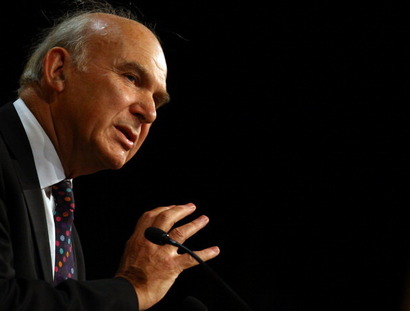
NO VINCE INSTEAD OF A BUSINESS BANK HOW ABOUT A PEOPLE’S ONE?

The Business Secretary’s suggestion at the Liberal Democrat conference of a new British Business Bank to help fund SME’s is not unwelcome. Our street banks have pulled in their horns and are restricting credit for fear of default. A new Business bank is supposed to fund such businesses via Government money (and perhaps somewhat optimistically match funded from private sources). Presumably it will take greater ‘risks’ e.g. supporting businesses that are not ‘asset’ rich in property and lend over a longer period than private banks.

Whilst we cannot object to a scheme that is more ‘user friendly’ than our own private banks it will still, we assume, lend at interest and operate for profit? One of the greatest problem with banks has been their greed, not just in bonuses, but in (interest) charges and credit creation i.e. lending out far more than they actually have (in the hope that most people won’t withdraw their deposits). The latter directly led to the US sub-prime crash and ultimately the ‘Debt Crisis’ because they lent money (to potentially increase profits) secured by lower assets to people who could ill afford to pay it back i.e. on benefits.

Instead Mr. Cable, what we actually need is a not-for-profit National People’s Bank, run by salaried (no bonuses) civil servants, and charging lower fees (rather than interest rates).

This is not a new idea. The National Liberals called for such a bank a few years ago (see also http://nationalliberal.org/a-state-bank that explains how it could work in competition with existing state banks). So while welcoming anything that weakens the power of the privately owned banks (and bankers) that have been so ruinous for public and personal finances, we need a People’s Bank that can lend cheap money to small businesses and the public alike!

Share:
  • Print
  • Digg
  • StumbleUpon
  • del.icio.us
  • Facebook
  • Yahoo! Buzz
  • Twitter
  • Google Bookmarks
  • Add to favorites
  • blogmarks
  • Blogosphere
  • Google Buzz
  • PDF
  • email
  • Live
  • MSN Reporter
  • MyShare
  • MySpace
  • Technorati
  • Webnews.de

By continuing to use the site, you agree to the use of cookies. more information

The cookie settings on this website are set to "allow cookies" to give you the best browsing experience possible. If you continue to use this website without changing your cookie settings or you click "Accept" below then you are consenting to this.

Close