Tuesday, 20 January 2026

Category » Articles

NLP’s Shop Local campaign report

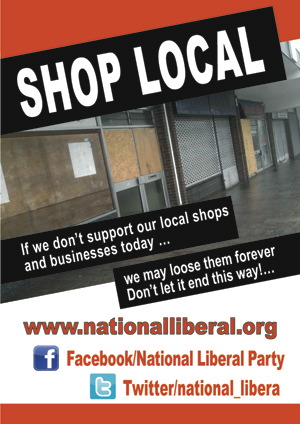
Our High Streets and small parades are a vital part of our communities, providing necessities and a community meeting point, but find themselves under threat of extinction. The core of these areas is the small shopkeeper but high rents & rates and unfair competition from large multiples, have sent many to the wall. Since local and national Government are unwilling to intervene, only the local community can save them by using them!

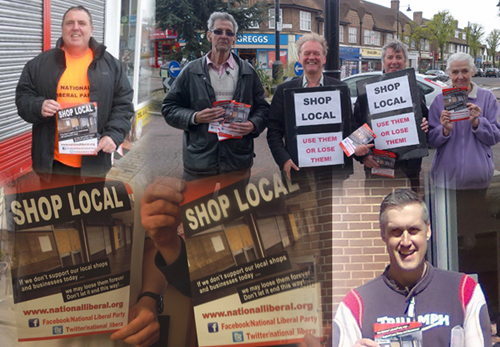
Over the last couple of weekends National Liberal Party activists have been promoting the national Shop Local campaign, distributing flyers, posters and running stalls. The aim is to encourage communities to use, when at all possible, their local shops. Here are a few reports:

Ulster

Sunday May 5 saw two activists brave the Ulster Spring weather (a mixture of heavy to light rain and freezing wind!) to distribute around 100 Support Local Shops and Businesses leaflets in Newtownabbey, Co. Antrim.

The eye-catching and very distinctive NLP leaflet explains how “Buying local means that you are supporting your local economy.” It goes on to explain the dangers posed by the chain stores and notes that:

“The closure of local independent shops, businesses and traders would be catastrophic to any local community as it would force residents to travel further and limit their choice. It could also result in the remaining suppliers, (in particular the main multinationals), inflating their prices.”

A few large NLP Shop Local posters were also laminated and secured to a large and prominent wire mesh fence situated between two small local shopping areas.

London

On Saturday 4 May members of Havering‘s National Liberal Party ran a Shop local campaign in one of the borough’s small shopping centres. Flyers were handed out explaining why high streets were important for communities, why they were struggling and why residents had to shop locally when they can. Under the slogan ‘Use them or lose them’, almost every shopper agreed with the message, especially since they were doing their bit for the cause in the first place! A spokesman said “Whilst government’s should be assisting the local shopkeeper they simply sit on their hands, turn a blind eye to the growth of Supermarket ‘Extra’s’ and blame the market. He added “If Government’s won’t help then consumers must shop locally if the shops are to survive”. Letters were published in the local press.

Isle of Wight

Our Isle of Wight campaigners leafleted in Ventnor, Shanklin, and Ryde but also discussed the campaign with locals. Apart from supporting it a number of people confused us with the Liberal Democrats which required undermining. Few so called UKIP voters knew any of their policies other than the EU and Immigration stances. Many were horrified to learn of UKIP’s Flat Rate tax that would benefit the very rich. Our Green concerns and Referendum democracy even struck a chord! Essentially our task is to meet the people and tell it how it is!

Devon

Our supporters in Devon chose one small shopping centre and handed out posters to local shopkeepers. Leaflets were also given out to shoppers. A local councillor took one and promised to raise the local business issues at the next council meeting the following week.

Scotland

Traders are being hit particularly hard north of the border and campaigners were out in Paisley, Govan, Renfrew and Glasgow.

Canvey Island

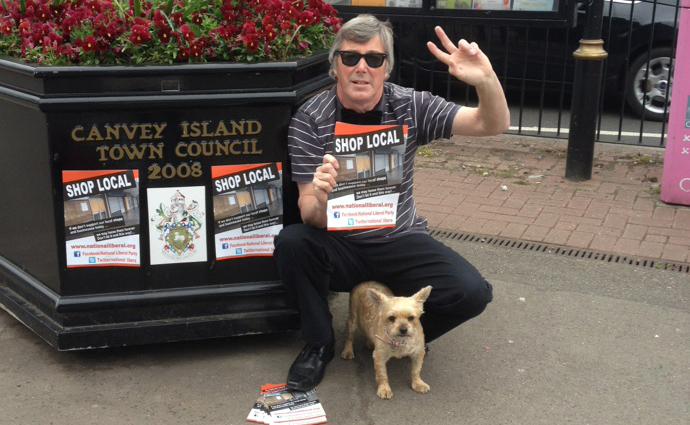
Posters and leaflets handed out by campaigners.

We hope to continue our Shop Local campaign indefinitely and a whole range of materials will be published. If you are interested in helping please contact us at natliberal@aol.com

Share:
  • Print
  • Digg
  • StumbleUpon
  • del.icio.us
  • Facebook
  • Yahoo! Buzz
  • Twitter
  • Google Bookmarks
  • Add to favorites
  • blogmarks
  • Blogosphere
  • Google Buzz
  • PDF
  • email
  • Live
  • MSN Reporter
  • MyShare
  • MySpace
  • Technorati
  • Webnews.de

Against the EU, For a Free Europa: Towards a Nation-state centred policy on Europe

THE NAME ‘National Liberal Party’ gives some indication of our poltical roots. Indeed, our ideology consists of a unique fusion of Progressive Nationalism (sometimes called ‘Green Nationalism’) and traditional Liberalism. It should be noted that our form of Nationalism shouldn’t be confused with those bigots, racists and right-wing imperialists who claim to be ‘Nationalists’. And our Liberalism shouldn’t be confused with the Politically Correct busy bodies who seem to want to dictate to everyone how they should think and act.


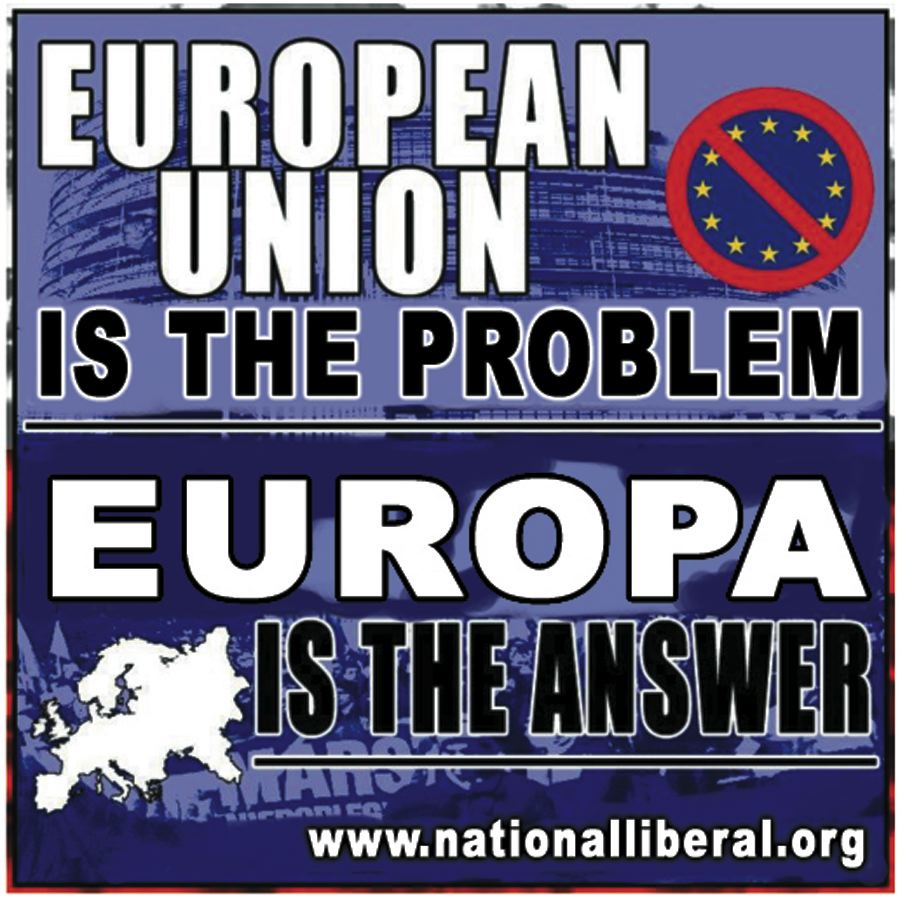
In this excellent in-depth article, Glasgow-based Andrew Hunter explains the NLPs opposition to the centralist, bureaucratic and increasingly totalitarian EU. He also looks at our alternative to the EU – a Free Europa.

IN THE recent local council elections in England the UK Independence Party, (UKIP), caused a political upset by gaining around 23% of the vote and having 147 councillors elected. Now, of course, it remains to be seen whether or not UKIP will be able to build on this success or if this seeming electoral breakthrough will ultimately be a flash-in-the-pan. There is definitely an element of UKIP’s vote being a protest by traditional Conservative voters against a Tory party leadership that they feel are pursuing a markedly un-traditional course. The media have also built-up UKIP’s chances and have virtually endorsed them as a “safe” protest party. Beyond the issue of Britain leaving the European Union, UKIP’s policies are not well known and the party and its new councillors will be subject to a level of scrutiny as never before. Prior to the poll attention was drawn to what many trade unionists saw as UKIP’s pro-boss and anti-worker stance on industrial relations.

With UKIP’s recent success and with opposition to Britain’s membership of the EU growing generally, now is a good time for national self-determinists to assess their stance on the EU and to decide how exactly we would like to conduct our relations with our neighbours on the continent.

THE EU has its roots in the ruins of Europe following World War Two. The politicians to which it fell the task of re-building the nations of Europe were determined to avoid any further conflicts and thus decided to link German coal production with French steel making so that neither of those two countries had the means to make war on the other. This formed the basis of the European Coal and Steel Community which included another four countries in addition to France and Germany. There then followed the Council of Europe, largely concerned with the protection of Human Rights and then the European Economic Community, which was set up by the Treaty of Rome in 1957. Britain remained outside of those bodies and when the Conservative government of Harold Macmillan applied to join the EEC in 1961 its application was famously vetoed by France’s President General De Gaulle in 1963. De Gaulle is said to have feared American influence in Europe operating through the agency of British membership and it was not until ten years later that Britain, along with Denmark and Ireland, joined the EEC. Norway had also been due to join at the same time but its citizens rejected EEC membership in a referendum.

The Labour government under Harold Wilson re-negotiated British membership of the EEC between April 1974 and March 1975 and put what it described as “Britain’s New Deal in Europe” to a referendum in June 1975. The government sought to re-assure voters that remaining in the EEC was in the best interests of the UK and that Parliament would not lose its sovereignty. In a booklet sent to every household in Britain, the government sought to counter fears on the issue: “The British Parliament in Westminster retains the final right to repeal the Act which took us into the Market on January 1, 1973. Thus our continued membership will depend on the continuing assent of Parliament”. The campaigns for and against remaining in the EEC were cross-party and saw some interesting alliances, for example, both Margaret Thatcher and Roy Jenkins campaigned for a “Yes” vote. Mrs Thatcher was later to become personified as an arch “Eurosceptic” while Roy Jenkins in 1977 as the President of the European Commission in a speech launched what ultimately was to become the Euro. The outcome of the referendum was heavily in favour of remaining in what was then sold to the British public as being merely a favourable trading arrangement. ‘Nationalists’ who warned that continuing to be a member of the EEC would result in the loosening of UK links with the Old Commonwealth countries, the gravitation of industry to the Benelux countries and the eventual loss of sovereignty were unsuccessful in persuading voters and lacked the financial resources that the “Yes” campaign could muster.

During the 1980s and 1990s the “European Project”, the term which enthusiasts for a centralised Europe use, gathered steam. In the mid-80s the European Commission under Jacques Delors set a target of achieving a single market by 1992. This was to be achieved by the removal of barriers to the movement of labour and capital between member states and the hope of enthusiasts for political integration was that these measures would eventually take on a political dimension. In 1985 the European Community, (as it was by then known), adopted the golden stars on a blue background design for a flag with the number of stars increasing as new members joined. In 1987 the Single European Act made the creation of a European Union a goal of member states and the Maastricht Treaty to create the European Union came into effect in 1993 though not without opposition with Danish voters initially rejecting the treaty and only accepting it in a second referendum after being granted monetary opt-outs and the previously strongly Euro enthusiast French and German electorates being split on the issue. Britain had already opted-out of monetary union and the social policy aspects of the treaty. In 1995 the Schengen pact opened-up the internal borders between many EU states and in the late 90s the road towards eastward expansion of the EU to embrace former Eastern Bloc countries got underway. The close of the century saw the Commission shaken by scandals involving fraud and mis-management.

Moving into the twenty-first century, 2002 saw the introduction of the Euro. Attempts to adopt an EU constitution were halted by rejection in referenda in France and the Netherlands. In recent years the worldwide financial crisis has rocked the EU economy with economically weaker countries such as Greece and Cyprus having to receive bailouts from the European Central Bank and the citizens of richer countries such as Germany becoming discontented that their taxes should be used to fund these bailouts. In the UK opposition to remaining in the EU continues to grow. With austerity and cut-backs in public services many people are asking why Britain should be continuing to contribute billions of pounds a year to the EU, (e.g. figures given in a December 2011 article on the Campaign for an Independent Britain website put our net contribution to the EU at £6.7bn per annum).

So how should the EU be viewed by genuine nationalists i.e. believers in the nation-state and what could be our alternative to it? One of the most obvious failures of the EU is that its efforts at central planning have been damaging to Britain’s economy. The opening up of British waters to continental fishing boats has devastated our fishing industry. The cost to British business of complying with EU regulations is estimated at £19bn a year. Across the EU we have the ridiculous situation that the more economically successful countries have to subsidise less successful. The free movement of labour from the lower-wage eastern European countries to the west has led to the depression of wages and conditions. The influx of eastern European workers has placed enormous strains upon local services. Overall, the EU is a hugely expensive bureaucratic regime that does not bring any benefits that we could not get by each individual member state agreeing to trade and assist each other where mutually beneficial. The billions of pounds that every year we send to Brussels could be better employed here in the UK to assist our farmers and fishermen and re-build our manufacturing base.

Historically however, culturally and geographically, we obviously have far more in common with our neighbours on the continent that we have with, say, the Far East. The world has changed considerably since Britain’s entry to the EEC in 1973. Back then foreign holidays were for most Britons still a relative novelty and our love affair with wine and continental cuisine was in its beginnings. Arguably cookery programmes and budget airlines have done more than anything else to promote understanding between us Britons and the peoples of the continent!

With the yoke of communism removed from the peoples of Russia and the other former Warsaw Pact countries the scope for European co-operation is massive and could potentially free Europe from dependence on the old superpower of the United States and the emerging one of China.

Would it not be better to have a Europe of free nations working together where needed but at all times retaining their independence and national and regional cultural identities?

• Sources:

The Daily Telegraph 4 & 5 May 2013.

BBC NewsA Timeline of the EU http://news.bbc.co.uk/1/hi/world/europe/3583801.stm

Britain’s New Deal in Europe HMSO 1975, reprinted by We demand a referendum 2012.

http://www.ark.ac.uk/elections/fref70s.htm

Europe A History by Norman Davies, Pimlico, London 1997.

http://www.freebritain.org.uk/essays/the-financial-cost

Share:
  • Print
  • Digg
  • StumbleUpon
  • del.icio.us
  • Facebook
  • Yahoo! Buzz
  • Twitter
  • Google Bookmarks
  • Add to favorites
  • blogmarks
  • Blogosphere
  • Google Buzz
  • PDF
  • email
  • Live
  • MSN Reporter
  • MyShare
  • MySpace
  • Technorati
  • Webnews.de

Time to make a Livable Wage the minimum wage!
The Government have been threatening and now implementing changes to the benefit system. They claim reducing the national debt requires a fall in public expenditure. This will include reducing the state’s benefit budget (one of the largest). They also say that we need, in any case, to prevent people becoming complacent on benefits instead of working and that to do so they should never be better off staying on benefits. However, the reason why many can’t work is because wages are too low rather than benefits too high. Benefits are means tested just above the poverty line. Why would you go to work, reduce your income and find, for example, you cannot pay the rent (which have gone up between 5 to 8 times higher than salaries) and become evicted?

Furthermore, the Government conveniently ignores the Tax credits it provides to millions of workers who do go to work but without them couldn’t afford to. Why is the taxpayer subsidising corporations? If we didn’t have to provide tax credits, because workers earnt enough in wages, then the Government’s budget could be cut without ordinary people suffering?

One of the lead articles in The National Liberal Trade Union group’s http://www.facebook.com/home.php#!/groups/277840098977231/ forthcoming publication Liberal Worker, calls for a Livable wage to be the National Minimum wage. In the meantime the following article by NLP member Glen Maney explains why it should.

TIME TO MAKE THE LIVING WAGE

THE NEW NATIONAL MINIMUM WAGE!

Low and stagnating pay is fast becoming a national crisis. In-work poverty has risen by 20% in the last decade and now stands at 6.1 million people living in low-income households. Average wages have fallen since 2008, and the number of low wage, low skill jobs is expected to grow

Instead of employment providing a route out of poverty, Britons are increasingly reliant on welfare to top up low wages, with the number of working families receiving tax credits rising 50% since 2003 to 3.3 million. Employment is being concentrated in low-paid work, resulting in 4.4m jobs paying less than £7 an hour; and only part-time hour’s jobs, largely in the retail sector, are keeping unemployment in check, with 1.4 million having to work part-time while seeking full-time work.

Largely because of ‘in-work’ poverty, child poverty is projected to rise from 2.6 million in 2009 to 3.1 million in 2015 and over the same period poverty among working-age adults without dependent children is projected to increase from 3.4 million to 4 million.

So Mr. Osborne and his ministers who claim that “poverty is about worklessness and welfare dependency”, should recognise that a couple of Independent reports have found that in fact “60% of children in low-income households have a working parent, the highest proportion in the history of statistics”.

As stated above, the rise in poverty rates is largely due to stagnating wages, minimum wage positions, part-time jobs, zero hour contracts, and now benefits cuts, which will result in lower incomes for some of the most vulnerable people in society.

So what would be the answer?

Well one part of a complex answer would be to pay a ‘Living wage’ as opposed to the ‘Minimum wage’.

What is the difference between a ‘Living wage’ and the ‘Minimum wage’?
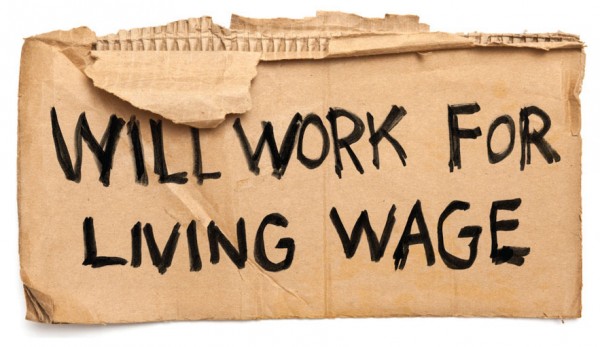
Essentially, a Minimum wage is a set amount per hour that employers are required to pay employees within certain classes of employment (and those employees meet the qualifications put in place by the wage laws that apply in a given jurisdiction). By contrast, a Living wage is the amount that an employee must earn in order to enjoy a reasonable standard of living within a specified area or region.

One of the chief differences between a minimum wage and living wage is that the former is often fixed while the other is variable. For example, a national government may set the minimum wage that applies to all employees covered by the applicable wage laws, and employers in all parts of the nation must comply by paying qualified employees at least that minimum wage. With a living wage, the amount required to enjoy a decent standard of living may be higher in some areas, such as metropolitan areas, while a lower wage would allow that same level or standard of living in a different area like a rural location.

For example, the UK Living Wage for outside of London is currently £7.45 per hour (The figure is set annually by the Centre for Research in Social Policy at Loughborough University) whilst the London Living Wage is currently £8.55 per hour (The figure is set annually by the Greater London Authority and covers all Greater London Boroughs).

An independent study of the business benefits of implementing a Living Wage policy in London found that more than 80% of employers believe that the Living Wage had enhanced the quality of the work of their staff, while absenteeism had fallen by approximately 25%.

Two thirds of employers reported a significant impact on recruitment and retention within their organisation. 70% of employers felt that the Living Wage had increased consumer awareness of their organisation’s commitment to be an ethical employer. Following the adoption of the Living Wage the study found turnover of contractors fell from 4% to 1%.

Good for the Employee

The Living Wage affords people the opportunity to provide for themselves and their families.

75% of employees reported increases in work quality as a result of receiving the Living Wage.

50% of employees felt that the Living Wage had made them more willing to implement changes in their working practices; enabled them to require fewer concessions to effect change and made them more likely to adopt changes more quickly.

Good for Society

The Living Wage campaign was launched in 2001 by parents in East London, who were frustrated that working two minimum wage jobs left no time for family life.

The causes of poverty are complex and in order to improve lives there should be a package of solutions across policy areas. The Living Wage can be part of the solution. It’s estimated that over 45,000 families have been lifted out of working poverty as a direct result of the Living Wage being paid to them.

The Resolution Foundation think-tank has calculated that if all those currently on the minimum wage received the Living wage there would be a £2.2bn net saving to the public sector including higher income tax and national insurance receipts.

The independent think-tank, the Institute for Fiscal Studies, has calculated that for every pound spent paying the Living wage; the Treasury saves 50p through not needing to pay tax credits and benefits.

The ‘Living wage’ also has some high profile supporters. Ed Miliband – Leader of the Opposition said in 2013 ‘Paying more than the minimum wage is a really important idea’. He realises that if companies pay the Living wage the welfare bill can be cut and administration costs can be brought down as many instances of tax credit, housing benefit etc can be cut.

He has latterly committed Labour to give private sector businesses tax breaks if they commit to paying their workers the Living wage.

It’s a shame of course, he didn’t do more to get a ‘Living Wage’ implemented when he was in a high position in Government, but then his party only had 13 years! Probably too much to ask of an incredibly inefficient Government, under whom Employment Laws and real terms wages were eroded.

Another unlikely supporter is Boris Johnson – Mayor of London, who said recently ‘’Paying the London (Living) wage is not only morally right but makes good business sense.’’

The Resolution Foundation also looked at whether this makes sense for the public purse. They calculated that if the minimum wage was a genuine Living wage, the gross savings on the benefit bill and the extra tax revenue would add up to £3.6bn a year. Take off the higher public sector wage bill and you get a net saving of £2.2bn.

A compulsory Living wage could be combined with policies to reduce rent rises, like stabilising rent controls common on the continent. The Mayor of London should be shouting these ideas from the rooftops!

Why are we subsiding Corporations?

This idea that the Government should subsidise low paid workers, instead of companies paying them properly, is pure stupidity. Why would you make legal a ‘minimum wage’ that no-one can live on!

Why is it then that a policy of ‘pure stupidity’ is followed? There are two reasons – Corporate greed and Government Control?

The ‘Living Wage’ would be a long term investment for business but as with everything today, a short term fast buck for the CEO’s and shareholders of businesses, is considered far more important than addressing ‘in work’ poverty.

People in poverty are also easy to ‘manage’, being grateful for any scraps the Government and even their own employers throw them.

As a National Liberal, I’d like to ask you, regardless of whether you’re a National Liberal supporter or not, to write to the Prime Minister and call for a ‘Living Wage’ to be implemented BY LAW with immediate effect, to the following address: https://email.number10.gov.uk/

You can see it is not only fair it makes sense!

Glen Maney

A Member of the National Liberal Party
Share:
  • Print
  • Digg
  • StumbleUpon
  • del.icio.us
  • Facebook
  • Yahoo! Buzz
  • Twitter
  • Google Bookmarks
  • Add to favorites
  • blogmarks
  • Blogosphere
  • Google Buzz
  • PDF
  • email
  • Live
  • MSN Reporter
  • MyShare
  • MySpace
  • Technorati
  • Webnews.de

Reviews of Caledonian Voice and English Voice.
MEMBERS AND SUPPORTERS of the National Liberal Party may be interested to know that two of its national publications – Caledonian Voice and English Voice – have received a very positive review on the well-known and popular Counter Culture web-site.

Both publications were reviewed by Andrew Hunter (to read the original review click here: http://countercultureuk.com/category/uncategorized/) and were posted up towards the end of last year.

Under the title Federalism for Britain: The NLP Launches two papers for England & Scotland the reviewer notes that both Caledonian Voice (CV) and English Voice (EV) have “eye-catching mastheads and lead articles” and “are produced to a high standard with impressive layouts that attract the reader.”

Counter Culture is probably better known for its fairly in-depth coverage of the annual Edinburgh Fringe Festival, which, according to its web-site – see http://www.edfringe.com/ for more details – claims to be “the largest arts festival in the world and takes place every August for three weeks in Scotland’s capital city.”

Counter Culture also covers a variety of other subjects such as local history, music, fim and so on. However, as far as we’re aware, this is the first time it’s reviewed party political publications of any sort.

The NLP would be interested to know if there are any more reviews out there. Also, we’re interested in featuring more reviews of our various publications – Caledonian Voice, English Voice, Isle of Wight Voice (issues 1 and 2), Kent Voice, Liberty & Nation, New Horizon (issues 1 and 2) or St. Andrews Voice. If any of our readers fancy themselves as a literary critic (!) please e-mail us at natliberal@aol.com and we’ll send you FREE pdfs of any (or all) of these puiblications.

In the meantime, printed below is the aforementioned published review of CV and EV.

Federalism for Britain: The NLP Launches two papers for England & Scotland.

JULY saw the launch of two new publications by the National Liberal Party (NLP), English Voice (EV), and Caledonian Voice (CV). As their titles suggest, the former is produced for England and the latter is aimed at Scottish readers and thus they will function as the national NLP papers for England and Scotland. Both papers are currently produced in a double-sided A4 format with the front page comprising eye-catching mastheads and lead articles with the reverse giving readers a general introduction to the NLP, its policies and its New Horizon e-zine. EV is currently available online while CV is available both online and in printed form for distribution door to door.
The common theme of the first issue of both publications can be summed-up as ‘Federalism for Britain’ and revives the concept of ‘The British Family of Nations’ which was a strong strand of de-centralist thinking in the 1980’s which sought to strengthen local and regional identities and culture and devolve power away from central government and down to the ordinary people. At the time this represented a radical departure from what had been hitherto orthodox policy which looked very much to a centralist British Government and a blanket British identity. With the question over Scotland’s future within the United Kingdom and calls for England to have its own Parliament, EV and CV bring a fresh view to these debates.

CV leads with The Independence Referendum…..Is there a Third Way? and puts forward the option of Devo-Max as alternative to both outright separation of Scotland from the rest of the UK and the status quo. Devo-Max seeks to devolve as much power to Holyrood from Westminster as possible leaving only issues common to the whole of the UK such as defence and foreign affairs vested centrally. The NLP’s distinctive stance in calling for the establishment of an English Parliament and the introduction of citizens’ initiative referenda along the Swiss lines are also highlighted:

“The NLP supports the creation of an English Parliament and encouraging people across the United Kingdom to become involved in open and accountable systems of government at both local and national level that enable ordinary citizens to participate in the decision making processes that affect their daily lives. The NLP calls for the introduction of Swiss-style citizens’ initiative referenda to ensure that the majority can be heard on issues that the political elite would rather ignore”.

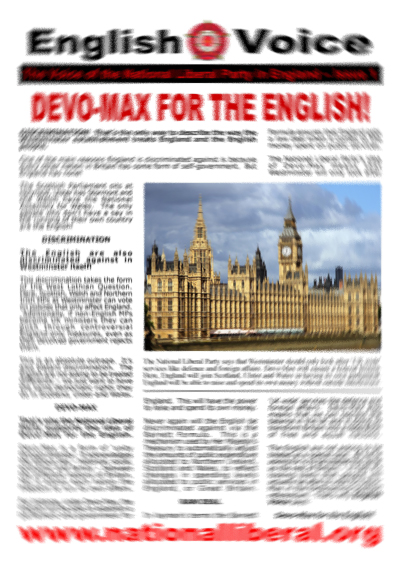
EV carries the bold headline DEVO-MAX FOR THE ENGLISH and pulls no punches when it lays out the anomaly of Scotland, Wales and Northern Ireland having their own parliaments or regional assemblies while England has none:

“DISCRIMINATION! That’s the only way to describe the way the Westminster establishment treats England and the English people. One of the main reasons England is discriminated against is because every other nation in Britain has some form of self-government. But England has none!”

EV then continues to point out other areas where England is disadvantaged relative to the other parts of the United Kingdom, such as the “West Lothian Question”, posed by the Labour MP Tam Dalyell back in 1977, which highlights how MPs from Scotland, Northern Ireland and Wales can vote on purely English matters in the House of Commons while under devolution English MPs could not vote on the same matters concerning those other parts of the UK. EV puts forward the creation of an English parliament under Devo-Max as the way to address the imbalance with the rest of the United Kingdom.

Both English Voice and Caledonian Voice are produced to a high standard with impressive layouts that attract the reader. CV has been produced in printed form with the aim of being distributed especially in small towns and rural areas that do not often see any form of political campaigning. It will be interesting to see what the response is. Readers interested in distributing CV door to door in their areas should contact the NLP’s office for details of how copies can be sent to them. I understand that issue two of both papers should be out before the end of the year.

Both papers are also available via e-mail. To get hold of them, e-mail natliberal@aol.com and ask for your FREE pdf copy of Caledonian Voice and English Voice.

Reviewed by Andrew Hunter

Share:
  • Print
  • Digg
  • StumbleUpon
  • del.icio.us
  • Facebook
  • Yahoo! Buzz
  • Twitter
  • Google Bookmarks
  • Add to favorites
  • blogmarks
  • Blogosphere
  • Google Buzz
  • PDF
  • email
  • Live
  • MSN Reporter
  • MyShare
  • MySpace
  • Technorati
  • Webnews.de

HALT THE DECLINE – SHOP LOCAL!

Many of us will be aware of local shops closing in our area(s). A combination of high rents, rates, and competition from Supermarkets (especially their ‘Extra’ outlets) have taken their toll. They are replaced by betting or charity shops, takeaways, or simply left empty.
Most of us have little contact with neighbours, let alone those in nearby streets, spending most of our time in doors or travelling in cars. A high street or shopping parade therefore, plays a vital role in maintaining a ‘community spirit’, being a point of contact for a local community to meet and interact. Unfortunately the less the variety of shops the less likely people will actually shop in the area at all. For the elderly and infirm they are even more vital in providing them with their daily needs.
Central or Local Government have presided over this decline rather than fought it. Both could do an awful lot more via taxation and discounting, and introduce legislation to protect the balance of the shopping mix e.g. retail, leisure, charity etc. Ultimately however the only meaningful action to halt the decline is by shopping local. If a community use their existing local shop wherever possible, rather than a supermarket chain, they might survive.
The National Liberal Party is to launch a campaign on this ‘SHOP LOCAL’ theme at the beginning of May. We are producing leaflets and posters. We shall launch a week long period of leafleting and letters culminating in a nationwide Day of Action on May 4th in local high streets. In the long term we intend to continue that campaign in certain areas to see if we can help turn around shopping habits. Do you want to be involved? Even an individual can hand out a few leaflets/posters in their local shopping parade. It is not difficult! If you are interested in taking part please contact us at natliberal@aol.com urgently!

This campaign was sponsored by a supporter. We intend launching other sponsored national campaigns throughout the year. Is there a policy or point of view you would like ‘getting out there?’ If so and you would like to become a sponsor please contact us at natliberal@aol.com to discuss.

Share:
  • Print
  • Digg
  • StumbleUpon
  • del.icio.us
  • Facebook
  • Yahoo! Buzz
  • Twitter
  • Google Bookmarks
  • Add to favorites
  • blogmarks
  • Blogosphere
  • Google Buzz
  • PDF
  • email
  • Live
  • MSN Reporter
  • MyShare
  • MySpace
  • Technorati
  • Webnews.de

What Constitutes ‘Hate’? Have Your Say!
THE MANY problems faced by Britain – whether economic or social – are not going to be solved by screaming and shouting.  Thus, the National Liberal Party is not interested in ‘hitting the headlines’ using the tired formula of macho–posturing and gesture politics.  These problems will only be overcome by a combination of careful thought and action.
This means that we favour informed and reasoned debate.  Here we concentrate on arguments, points of view and facts.  We are not interested in personalities, prejudice or promoting self-interest.

The National Liberal Party seeks to build an organisation that encourages free speech and debate.  To do this, we also attempt to take into consideration as many views as is possible in open debate.  Thus, members and supporters are always encouraged to have their say.

We’re also interested in encouraging people to develop their debating skills.  That’s why the NLP has introduced a new series of articles called Have Your Say! Whilst each subject will be announced on this web-site, they’ll be conducted in full on the National Liberals Facebook site, which can be found here: http://www.facebook.com/home.php#!/groups/52739504313/?fref=ts
Before we start our third debate we’d like to remind folks of our ground rules:

  • First of all, say what you think – but think what you say.

  • Secondly, just debate the issue(s) raised.  There should be no personal attacks.

  • As previously noted, we’re simply not interested in personalities.

  • Please note that we may ask selected members and supporters to play ‘devil’s advocate’.  Hopefully, this’ll help sharpen the debating skills of all involved!

  • Finally, it should be remembered that all of the views expressed in Have Your Say! are personal and should not be taken to be the official view of the NLP itself.

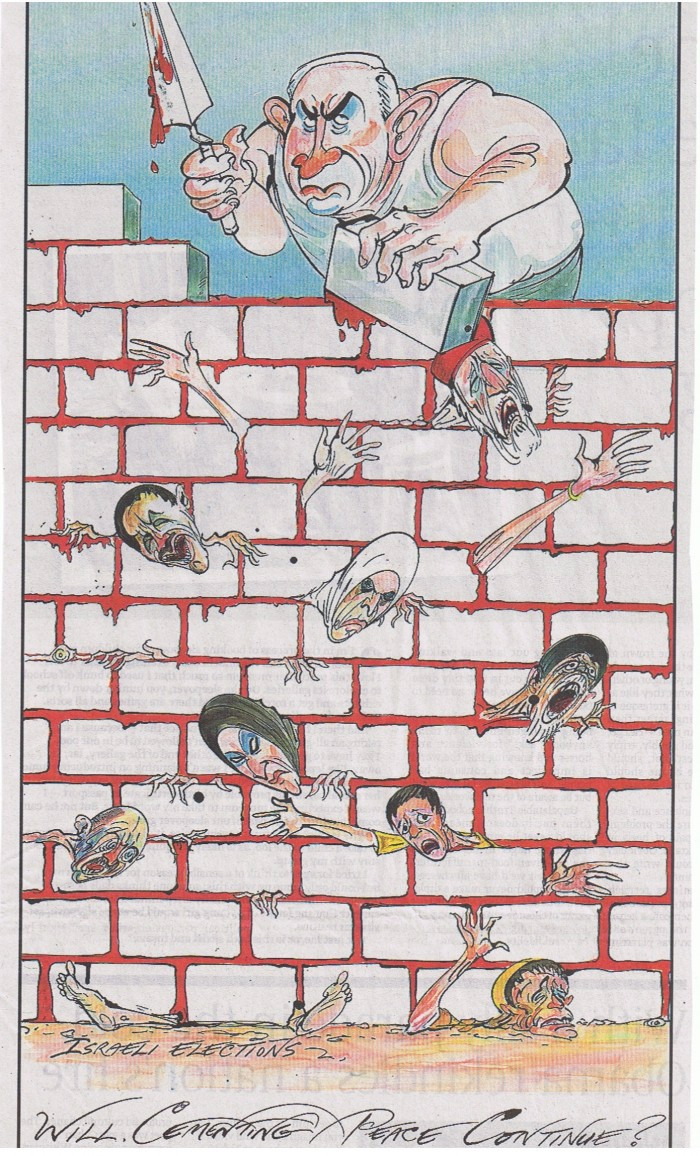
With all this in mind, we ask National Liberals to carefully study the cartoon – drawn by Gerald Scarfe and printed much earlier this year in the Sunday Times – which depicts Israeli Prime Minister Benjamin Netanyahu appearing to lay bricks for a wall using the bodies and blood of Palestinians. The caption to the cartoon read “Will cementing the peace continue?”

The cartoon was attacked by the Board of Deputies of British Jews who – in a complaint to the Press Complaints Commission – likened it to something that’s usually published by “the virulently anti-Semitic Arab press.” However, this view wasn’t shared by everyone – see the excellent article by the Jewish writer, Simon Kelner, here:
http://www.independent.co.uk/voices/comment/rupert-murdoch-gerald-scarfe-and-why–as-a-jew–im-dismayed-by-the-jewish-lobbys-outrage-8472600.html

Whilst it’s clear to National Liberals that the Scarfe cartoon is specifically directed at Mr. Netanyahu’s and his policies (and can in no way be described as ‘anti-Semitic’) we’d be keen to know what our readers think.

Allied to this main question are several others: is it right to avoid debating the Israeli/Palestinian question by accusing people of being ‘anti-semitic’?  In fact, is it right to avoid any sort of debate simply by slinging mud and making vague and broad statements that someone is ‘anti-semitic’, ‘anti-muslim’, ‘anti-Irish’, ‘racist’, ‘homophobic’ or whatever?  Also, can a cartoon (like the one produced by Scarfe) ever be described as ‘hateful’?  Indeed, What Constitutes ‘Hate’?

Share:
  • Print
  • Digg
  • StumbleUpon
  • del.icio.us
  • Facebook
  • Yahoo! Buzz
  • Twitter
  • Google Bookmarks
  • Add to favorites
  • blogmarks
  • Blogosphere
  • Google Buzz
  • PDF
  • email
  • Live
  • MSN Reporter
  • MyShare
  • MySpace
  • Technorati
  • Webnews.de

By continuing to use the site, you agree to the use of cookies. more information

The cookie settings on this website are set to "allow cookies" to give you the best browsing experience possible. If you continue to use this website without changing your cookie settings or you click "Accept" below then you are consenting to this.

Close