





Thursday, 26 November 2026

Category » Articles

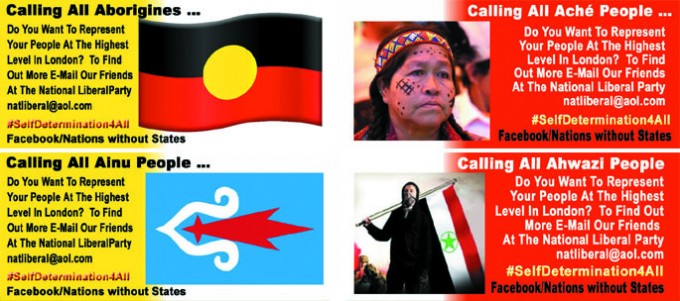
From The Liberty Wall – Nations without Sates – Calling All Aborigines, Aché, Ainu & Ahwazi People …
“Freedom is never voluntarily given by the oppressor; it must be demanded by the oppressed.”

• Martin Luther King Jr.


THE GREATER LONDON AUTHORITY (GLA) ELECTION should have been held 17 days ago – on 7th May.
They’re held every four years and 25 seats are up for grabs. The election is unique in that it comprises of three different ‘contests’ – each with its own ballot paper. This means that the London electorate votes for the Mayor of London, 14 Constituency Members & 11 Members that represent the whole of London (London-wide Members) all in one hit.

As this section of the official London Elects web-site notes – https://www.londonelects.org.uk/im-voter/what-do-mayor-london-and-london-assembly-do – the London Assembly is responsible for areas such as policing, transport, housing, planning and the environment.

However, due to the Covid-19 crisis, the GLA election has now been postponed until Thursday May 6th 2021. But what has all this got to do with Nations without States?

The main reason is that our friends and comrades of the National Liberal Party -NLP – were intending to stand candidates (under the banner of Self-Determination For All!) in the election. Here, they were hoping to draw attention to the fact that countless people around the world are demanding Self-Determination – whether it be some form of recognition, autonomy or independence.

Self-Determination is the raison d’être of the National Liberal Party.
Therefore, they’ll support the right of all people who desire freedom. This includes for example the Catalans, Flemish, Kurds, Sikhs and Tamils. (The irony of the election being held in London – the English capital – won’t be lost on supporters of both NwS & the NLP. For those who don’t know, England doesn’t have its own Parliament. Westminster is a British, and not English, Parliament!)

The NLP have advised us that they are still organising for next May – although, now that there’s no immediate hurry, much of this is now being done behind the scenes.

Nations without States will also keep on highlighting the causes of those people who desire some form of Self-Determination. As our educational outreach posters (above) indicate, to date we’ve looked at the Aborigines, Aché, Ainu & Ahwazi People. Next up will be an article about the Åland Islands.

In the meantime, however, we feel that it’ll be appropriate to reproduce an article which appeared in issue 1 of Nation, the ‘Newsletter of Nations without States’. Identities, Self-Determination and Initiatives provided information about NwS and outlined our strategy. It talks about the need to ‘build a broad-front alliance which consists of self-determinists from the British Isles and the various foreign Diasporas living here.’ Whilst fighting elections wasn’t specifically mentioned at this early stage – although we feel that it’s implicit in the article – issue 2 of Nation reported that NwS wished to build ‘a whole new voting demographic.’

As usual, we welcome any feedback from fellow Self-Determinists once this article appears on Facebook/Nations without States.

Identities, Self-Determination and Initiatives

NATIONS WITHOUT STATES (NwS) is an exciting new activist based pressure group sponsored by the National Liberal Party. The NLP – Britain’s true centre party – is the only party that supports self-determination for all nations. Check out its website: www.nationalliberal.org

Founded in March 2012, the Organising Committee of NwS consists of Jagdeesh Singh, Graham Williamson and Sockalingam Yogalingam. It is currently appointing NwS Representatives, who’ll become official links to their community’s Diaspora. It also hopes to produce a self-determinist manifesto and constitution in the near future.

The main aim of NwS is to highlight the plight of all peoples who aspire to nationhood. These might be based on peoples or tribes within a state or even across borders; folk that may or may not have been independently organised in the past. They might have a linguistic or historical separateness from their neighbours or fellow citizens. All seeking statehood will aspire to recognition, autonomy or independence.

We will support the right of all such peoples to determine their future. These include, for instance, the Kurds, Flemish, Sikhs and Tamils. Nations without States – NwS – supports the right of self-determination where it is based on a sound and just position and is supported by the majority of its ‘national’ community.

As self-determinists we believe that the concept of nationhood is universal – and in an era of globalisation it needs protection and promotion as one solution to our political ills. A proud and recognised nation within its own state and at ease with itself is far more likely to ensure internal and external peace than any ‘supra-national empire’.

Thus, Nations without States will aim to:

• Showcase the many suppressed nations and those groups that struggle to obtain recognition for their nations and/or some level of autonomy or independence. We will do this via conferences, meetings, demonstrations, days of action, pickets, publications, leaflets and social media. Here we’ll look at the ‘forgotten nations’ of the world explaining their historical background, their present situation and what the future might hold. We are more than happy to allow representatives of such peoples as individuals or groups to present their case.

• Help build a broad-front alliance which consists of self-determinists from the British Isles and the various foreign Diasporas living here. We will co-ordinate the representatives and groups among the various Diasporas in the West so that each cause will benefit from each other’s experience, strength and contacts. Hopefully, by working together – via joint conferences, demonstrations and educational outreach material – each group will be able to push their national cause that little bit further towards their goals.

NwS is unique because it links all of our national struggles. We believe that joint strategies and the pooling of our resources will make us much stronger. This is essential – as we’re up against powerful governments who have a vested interest in denying people self-determination. Some of these governments are openly dictatorial – indeed, they’re not adverse to a spot of genocide. Even some of the ‘democratic’ governments just pay lip service to true democracy and human rights.

They also have lots of money to spend on PR. In many cases they can call upon a compliant media to either smear those fighting for self-determination or simply not bother reporting views which represent an ‘inconvenient truth’.

Those interested in helping NwS overcome these vested interests and obtaining self-determination for all of our nations, should contact nationswstates@aol.co.uk or check out Facebook/Nations without States.

Share:
  • Print
  • Digg
  • StumbleUpon
  • del.icio.us
  • Facebook
  • Yahoo! Buzz
  • Twitter
  • Google Bookmarks
  • Add to favorites
  • blogmarks
  • Blogosphere
  • Google Buzz
  • PDF
  • email
  • Live
  • MSN Reporter
  • MyShare
  • MySpace
  • Technorati
  • Webnews.de

COVID-19 KASHMIR CONFERENCE

An electronic Conference on Kashmir’s Lockdown running quite separately and earlier than the global one was held last week. Various Kashmiri organisations, politicians, human rights activists and our (national) Self-Determinist pressure group Nations without States, attended.

Some notable attendees included the Conference Moderator Barrister M. Tramboo, Chairman Professor K. Buchner MEP (the Conservative Green ODP), and President in exile Carles Puigdemont (of Catalonia). The Conference discussed the need for the world to acknowledge Kashmir’s Self-Determination and Human Rights.

A Resolution was agreed by the participants calling the UN, EU, individual states and whomever will listen, to lobby for a solution (to follow). It was agreed that such conferences should be held on a regular basis.

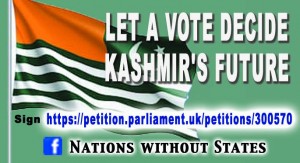
Our Parliamentary petition was brought up as one initiative, amongst many, that supporters can get behind: https://petition.parliament.uk/petitions/300570/

Share:
  • Print
  • Digg
  • StumbleUpon
  • del.icio.us
  • Facebook
  • Yahoo! Buzz
  • Twitter
  • Google Bookmarks
  • Add to favorites
  • blogmarks
  • Blogosphere
  • Google Buzz
  • PDF
  • email
  • Live
  • MSN Reporter
  • MyShare
  • MySpace
  • Technorati
  • Webnews.de

Isle Of Wight Voice Debate (1) Universal Basic Income – Beyond Left & Right

THE INTRODUCTION of a Universal Basic Income – UBI – is the subject of the first debate to be sponsored by the Isle of Wight Voice – the voice of the National Liberal Party on the Isle of Wight.

However, before we can start this debate, it’ll be useful to know what a Universal Basic Income is. For those who don’t know, it’s an unconditional, periodic cash payment that the government makes to everyone. There’re no strings attached & it isn’t means tested. Essentially, it’s been described as a floor below which no one’s cash income can fall.

The Isle of Wight Voice (IoWV) believes that there’s four main practical reasons why some form of national payment is needed:

• MANY JOBS will be lost due to the rapid advances made in IT and robotics. If workers have no jobs, how will they pay their bills?

• A UNIVERSAL Basic Income acknowledges that people contribute to society in many ways – and not only via paid work. Here we’re thinking of those who carry out voluntary and/or charitable work.

• A GUARANTEED income will allow people to develop cultural & artistic skills. This will allow us to move away from an overly materialistic society, obsessed with GDP and excessive profits.

• THE BENEFITS system is a complete shambles. Some people are waiting weeks & even months for some form of payment. Some form of UBI will ensure that no one is left in absolute poverty.

Practical reasons aside, the introduction of a UBI is a subject that goes beyond the traditional ‘left’ & ‘right’ political divide. This is of great interest to us as we feel that the Establishment has been allowed to rule for far too long via its strategy of ‘divide & conquer’. As such, we’re not concerned too much about labels – we’re far more interested in ideas. Here, the IoWV wishes to nail its colours to the mast by declaring that we’re neither of the ‘left’ nor the ‘right’ – neither are we capitalist or socialist. We’re not great fans of ‘Big Government’ so the actual mechanics of distributing a UBI worries us to some extent.

With all the above in mind, we’d ask readers to study this article – originally called ‘Universal Basic Income: Ruling class scam or step toward socialism?’ by Tim Libretti in the US leftist paper, the People’s World – and let us know what you think about UBI. You can do so when you see this article appear on the National Liberals Facebook site https://www.facebook.com/groups/52739504313

You can read Tim Libretti’s original article here: https://www.peoplesworld.org/article/universalbasic-income-ruling-class-scam-or-step-toward-socialism/?fbclid=IwAR2HWl0yRHQYwIoI3Cr8gqdH_ OOfReQPUJgTANsIxD5XR8A47KOePuX8vkU Please note that we have left any North American spellings & phrases as they are. It goes without saying that there are no links between Tim Libretti, the People’s World, the National Liberal Party or the Isle of Wight Voice.

.

Universal Basic Income – Beyond Left & Right

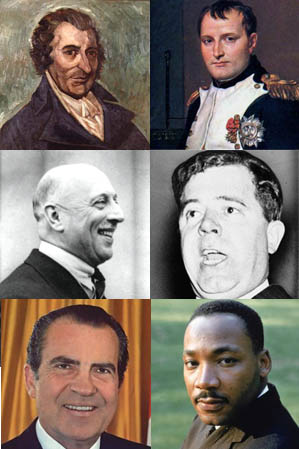
Pictured from top left to bottom right: Thomas Paine (1737 - 1809), Napoleon Bonaparte (1769 – 1821), Major CH Douglas (1879 – 1952), Huey Long (1893 - 1935), Richard Nixon (1913 – 1994) & Martin Luther King, Jr., (1929 – 1968). All held different political positions & views but endorsed the idea of a minimum guaranteed income.

The more mega-capitalists like Richard Branson, Mark Zuckerberg, Chris Hughes, Elon Musk, and the like support it, the more some on the left grow suspicious. Left-leaning intellectual Chris Hedges (1), for example, characterizes the universal basic income as an oligarchical plot designed to defuse any call or movement for actual and substantial structural change to the capitalist system, the dynamics of which create the inequity and misery people suffer to begin with.

And, of course, we do need to recognize the truth that universal basic income policy is not designed to alter the structure of capitalism but rather provide some basic relief to the misery and poverty capitalism creates. Obviously, we need to keep our eyes on the prize of achieving the end of class society and exploitation and creating a world in which the fruits of our collective labors are shared.

Nonetheless, as Daniel Ravenós and Julie Wark (2) have pointed out, so far the universal basic income “is the only policy being mooted as a way of universally guaranteeing the most basic right of all: the right to material existence.” And, in response to Hedges’ concerns, they point out that a universal basic income can nonetheless abet revolutionary class struggle, arguing that “while not a universal panacea, is one way of strengthening vulnerable members of society in their struggle against the oligarchs.”

And, hey, why not go along with the scam, as long as we don’t fall for it? Take the money and run right down the revolutionary road. Destination: socialism.

What is important is that we cultivate and sustain a political and class consciousness rooted in awareness of the fact that our current economic arrangement—capitalism—is precisely what generates the grotesque inequality we need to eliminate. And by extension that same system is responsible for the grotesquely inequitable distributions of political power that deprives the mass of our population the right of self-determination—denies them freedom.

The universal basic income, I would argue, is already beginning to shift our national consciousness in directions that can direct us on the road to socialism. It is bringing issues of class and inequality more into focus and making them part of the national conversation, though in theoretically insufficient ways.

Chris Hughes (3), for example, the co-founder of Facebook, has argued strenuously for a universal basic income as not necessarily a comprehensive solution but as at least a moderating analgesic for the severity of income inequality and poverty in America, asserting, “We talk about inequality—and the economy in general—in terms that make it seem like these are structural problems that we can’t do anything about. When in reality, we’ve created the rules of the road: the way the economy works now.”

While he might not fully articulate what a different economic structure or system would look like (he doesn’t say the “S” word), he does unsettle the notion that capitalism is a fixed and unchangeable thing. He raises the specter that another economy is possible and makes the important point that people control and build the economy, which means we can, in fact, change it and create it anew.

As a culture and in our political discourse, we tend to talk about “the economy” in ways that dehistoricize it and make it seem permanent, as if capitalism is the only game in town. We don’t hear many people in talking about our economy say “the capitalist economy” to distinguish it, say, from feudal or socialist economies. As a culture, this makes it a lot harder for us to entertain different kinds of economic arrangements.

While Hughes, I’m guessing, does not identify as a Marxist, his intervention in this debate does begin to offer a different language for talking about our economy and the fact that poverty is not simply the fault or just desert of lazy or feckless people, but rather a product of capitalist economy. This  language  opens  and  orients  the  national  consciousness  to  a  potentially  imaginativeconversation about what a socially just and humane economy might look like. It’s an opener, anyway.

Billionaire Mark Zuckerburg (4), similarly provokes thinking about both the effectiveness and fairness of class society—and by extension capitalism—in his advocacy for a universal basic income. In a commencement address he delivered at Harvard, he indicated how growing up with financial security allowed him the freedom to pursue his inventions, explaining, “If I had to support my family instead of having time to code, if I didn’t know I’d be fine if Facebook didn’t work out, I wouldn’t be standing here today.”

These capitalists point not just to the unfairness, even inhumanity, of capitalism, but they even hint at what Marx stressed in his analysis of the history of class society: Capitalism, while it unleashed the creativity feudalism had constrained, it also fetters human creativity and the forces of production overall, leading to an economy at once inhumane and inefficient.

Secondly, and more importantly, the universal basic income, in asserting everyone’s right to a material existence, accomplishes some important work in our cultural consciousness, in Marxist directions, in terms of dissociating or de-coupling the work people do from their ability to have their material needs met and, more to the point, to share in the fruits of our collective labor.

In other words, the implementation of a universal basic income can begin to erode the powerful meritocratic ideology that, as I have argued elsewhere (5) in the pages of People’s World, is a centrally insidious ideology sustaining capitalism. As a culture, we are for the most part perfectly happy valuing people’s work unequally, regardless of how essential it is to our lives. Our capitalist culture makes it seem normal and just that the doctor doing the important work of keeping us healthy deserves a lot more money—and hence access to more resources—than the farmworker who does the important and essential work of feeding us. As a culture, we lack a recognition that this very way of valuing work is a product of a capitalist economy, that the way we determine the “merit” of work grows out a capitalist mentality.

Definitive of Marxism for me is the principle made famous in The Communist Manifesto which Marx reiterates in his Critique of the Gotha Program, namely the idea: “From each according to his abilities, to each according to his needs!” This notion challenges, indeed explodes, the idea that the work people do should bear any relation to their ability to meet their needs or have access to the fruits of our collective labor.

The American dominant culture, however, forcefully insists upon not only differentially valuing work but also linking the work one does to one’s ability to consume or access resources (purchasing power) to live. A vital piece of Marxist thought is precisely this powerful gesture of de-linking the work people do (or not) from their right to a material existence.

The universal basic income, as a policy, does this important cultural work of de-linking people’s merit—people deserving nourishment, housing, healthcare, education, safety, and other basic human rights—from the type of work they do, how much they work, and even from whether they work or not.

Moving to a socialist culture and imagination means we must recognize and eradicate the capitalist values infecting us. Meritocracy is a deeply rooted capitalist value many in America do not even recognize as capitalist.

Mayor Michael Tubbs (6) of Stockton, California, however, has been able to implement a universal basic income in his city, with a plan to be piloted on a small scale beginning in 2019. What motivated him was precisely the socialist imagination of Dr. Martin Luther King, Jr., which he has invoked explicitly, recalling reading King’s Where Do We Go From here: Chaos or Community, in which King calls for a guaranteed annual income.

While certainly no remedy for or alternative to capitalism, the universal basic income can address poverty and improve lives while at the same time altering our entrenched thought patterns and inspiring an imagination to ease us on down the road to socialism.

1.https://www.counterpunch.org/2018/04/06/universal-basic-income-left-or-right/ 2.https://www.counterpunch.org/2018/04/06/universal-basic-income-left-or-right/ 3.https://www.bloomberg.com/news/features/2018-05-04/facebook-co-founder-chris-hughes-wants-universalbasic-income 4.https://www.cnbc.com/2017/12/27/what-billionaires-say-about-universal-basic-income-in-2017.html 5.https://www.peoplesworld.org/article/meritocratic-thinking-devalues-all-work-job-talk-series-part-3/ 6.https://www.washingtonpost.com/gdpr-consent/?next_url=https%3a%2f%2fwww. washingtonpost.com%2fnews%2fpost-nation%2fwp%2f2018%2f06%2f04%2fa-city-ponders-whether-500-amonth-no-strings-attached–would-help-reduce-poverty%2f%3fnoredirect%3don%26utm_term% 3d.860279bf2be3&noredirect=on&utm_term=.860279bf2be3

Share:
  • Print
  • Digg
  • StumbleUpon
  • del.icio.us
  • Facebook
  • Yahoo! Buzz
  • Twitter
  • Google Bookmarks
  • Add to favorites
  • blogmarks
  • Blogosphere
  • Google Buzz
  • PDF
  • email
  • Live
  • MSN Reporter
  • MyShare
  • MySpace
  • Technorati
  • Webnews.de

Harrow Voice Debate (2) – What Should We Make Of The Coronavirus?

Coronavirus. Where did it come from and how did it travel to the four corners of the earth in such a short period of time? Is it just another form of flu – if not, how does it differ? And why are governments talking about introducing drastic measures to counter it?

WHAT SHOULD we make of the Coronavirus? Where did it spring from – and by what means – and how did it travel to the four corners of the earth in such a short period of time?

These are just some of the questions that people are asking since the outbreak began in China and then spread rapidly into Europe, North America and the Middle East.

It’s generally accepted that the Cronoavirus (Covid-19) originated in late September in the Huanan Seafood Wholesales Market in city of Wuhan. Wuham is the capital of Hubei province in Central China. Huanan Seafood Wholesales Market is also sometimes described as a ‘wet market’ – and it’s where live animals such as bats, snakes, rabbit and birds are said to be illegally sold

To give an idea of scale, the population of Wuhan’s metropolitan area is 19 million whilst the population of Hubei province – in 2015 – was 58,500,000. Wuhan serves as a major transport hub and the political, cultural, and economic hub of Central China – which could explain why the virus travelled so fast within China – and Hubei is known as the ‘Land of Fish and Rice’.

It also seems to be clear that Northern Italy was the first area in Europe to be hit. And it was hit hard. Many people – including ourselves at Harrow Voice – are mystified as to why this should be. Does anyone have any thoughts regarding this?

The rapidly moving situation (relating to Covid-19) makes it next to impossible to accurately predict how many people locally, nationally and internationally will contract it, or, sadly, die from it.

The main thing to remember at the moment is that – unfortunately – the UK figure is liable to rise as the government believes that coronavirus will spike in around two weeks time. Hopefully, the figures will go down after that, but there’s still no indication of when things will go back to relative normality.

Despite this – and along with many other people – Harrow Voice (HV) has an odd feeling about what’s going on. We fully admit that we can’t quite put our finger on it, but we’re wondering why various governments are going to such extraordinary (and unprecedented) lengths to tackle this virus.

This Live Science site https://www.livescience.com/56598-deadliest-viruses-on-earth.html

provides some context and we certainly recall the SARS and Avian flu scares from yesteryear. We’re also aware that ‘ordinary’ flu kills thousands of people each year. However, a health scare has never been used to effectively crack down on the civil and religious liberties of our people – so much so that it’s been suggested that we’re sleepwalking into authoritarianism.

So what makes Covid-19 so different and does the government know something that we don’t? And what’ll happen once this is all over?

To be fair, no one outside of a select few could probably answer the first question. However, HV would like to give some pointers in an attempt to answer the second. And we hope to expand on these ideas in future debates.

First of all, we think that the slogan Small Is Beautiful! makes even more sense now than it ever did. No matter how coronavirus originated we get the feeling that one vital aspect of globalism – the entirely free movement of people – has helped to spread it. Therefore, more should be done to protect our territorial integrity. We feel that it’s entirely reasonable and sensible to know who’s in our country at any one time – especially if they are harbouring highly contagious viruses.

(On saying the above, and we want to make this perfectly clear, it does not excuse any personal attacks on Chinese nationals here or anywhere else. Such attacks are completely out of order – not to mention counterproductive – and it’s important to remember that the vast majority of people, Chinese or otherwise, are in no way responsible for the actions of their respective governments.)

We also feel that it would be preferable to be more autonomous and as self-sufficient as possible. This should apply across the board and includes individuals, local areas – such as our borough of Harrow – and all nations. And when we talk about self-sufficiency we’re talking in terms of food, energy, water, recycling and so on.

In particular, we need to start investing in Research and Development here and encourage a wide industrial base by making things ourselves rather than importing. That means investing in education and training and not relying on importing skilled or unskilled workers.

On a similar theme, we’re more convinced than ever that capitalism (as well as socialism) has to go. We need to go back to our economic roots in terms of small businesses, local independent businesses, sole traders, family farms, Co-Operatives and so on. These should form the backbone of the economy. Indeed, we really need to wean ourselves off of our over reliance on massive supermarkets and fast food chains. In short, we need to move away from centralisation and promote a more decentralised, organic – or rooted – way of living that’s in tune with nature.

Autonomy, decentralisation & self-sufficiency also ties in with our belief in ‘small government’ – meaning that we should be less reliant on central government.

Whilst we’re on the subject of autonomy, we believe that there’s something to the argument that London (along with many other cities – and the South East of England as a whole) is now far too large & over crowded to be sustainable.

For instance, Greater London, of which Harrow forms a part of, covers 1,572 1,572 km2 (607 square miles) and the population, as at the 2011 census was 8,174,000. Therefore, Harrow Voice has some sympathy with the belief that the capital city should be scaled back to its original inner boroughs. This would mean that outer London boroughs will return to their original historic counties. Thus Harrow will become part of Middlesex again.

As with our first debate (see the link below), we’d appreciate you comments – especially if you have any specialist knowledge relating to Covid-19 – on any of the points we’ve raised here. Just look out for this debate when it appears on our National Liberals Facebook site – https://www.facebook.com/groups/52739504313/ – or the National Liberal Party Facebook site – https://www.facebook.com/NationalLiberalParty/

• ALSO check out

Harrow Voice Debate (1) – What Do You Think Of Universal Basic Services? http://nationalliberal.org/

harrow-voice-debate-1-–-what-do-you-think-of-universal-basic-services
Share:
  • Print
  • Digg
  • StumbleUpon
  • del.icio.us
  • Facebook
  • Yahoo! Buzz
  • Twitter
  • Google Bookmarks
  • Add to favorites
  • blogmarks
  • Blogosphere
  • Google Buzz
  • PDF
  • email
  • Live
  • MSN Reporter
  • MyShare
  • MySpace
  • Technorati
  • Webnews.de

A Referendum Is An Act Of Self-Determination

.

REGULAR READERS will know that the National Liberal Party (NLP) intended to stand up to 25 candidates in theGreater London Assembly elections – which were scheduled for 7th May.


Here, we were going to campaign on the issue ofSelf-Determination ForAll! The election would have provided us with an excellent opportunity to hone our social media skills and build a powerful Self-Determinist electoral bloc. However, as we reported two days ago – http://nationalliberal.org/public-notice – they have now been postponed for a year due to thecorona virus outbreak.


With this in mind, the NLP has cancelled its planned donors dinner (27th) and election meeting (29th) until further notice. But this doesn’t mean that we’ll be placing less emphasis on Self-Determination. In fact, we’ll be stepping up a gear! In the same way a dog is for life and not just for Christmas, we feel that Self-Determination is for life and not just for elections!

We believe that the principle of Self-Determination can be applied largely in three areas – National, Political and Economic. Our intended Greater London Assembly (GLA) election campaign would have mainly focussed on National Self-Determination. However, we also intended to look at matters relating to Political & Economic Self-Determination as well.


The first article (in this series of three) looked at Economic Self-Determination – see For Economic Self-Determinationhttp://nationalliberal.org/for-economic-self-determination However, in this article we’ll be looking at Political Self-Determination.

The NLP definesPolitical Self-Determination as a system which ‘seeks to ensure that the collective will of the people as well as the variety of political opinion is reflected in decision making. Thus, for example, we favour greater use of Referendums to meet the former, and PR to reflect the latter (we favour a system close to the Swiss model of Direct Democracy).’

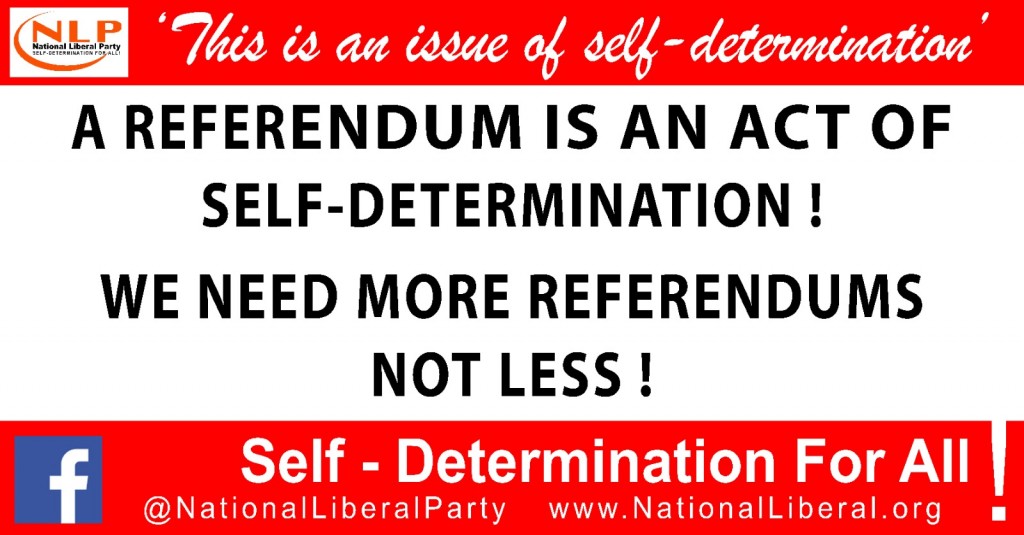
As the title of this article –A Referendum Is An Act Of Self-Determination – suggests, we would like to see representative democracy replaced by participatory democracy in the form of Referendums (as well as Preferendums). The NLP feels that direct democracy should be the only show in town.

For those who don’t know, a referendum is ‘a method of referring a question or set of questions to the entire electorate directly.’ Since 1973 the UK has held 11 referendums, the most famous (or infamous, depending on your point of view!) being the EU Referendum of 2016. (1)

We would prefer that referendums were held on a much more regular basis – as they do in Switzerland. In future articles we’ll take a more in-depth look at referendums (and look at some examples from Switzerland itself).

Referendums are usually decided on a simple ‘Yes/No’ vote. However, it could be argued that preferendums are more democratic in that they allow the electorate toselect a range of different options (generally, three or more) in order of their preference. It’s thought that the use of a preferential voting system – rather than a simple majority – also accurately allows everyone’s point of view to be taken into account.

Other elements of Political Self-Determination must include replacing the ‘First Past The Post’ (2) voting system with one of Proportional Representation. As indicated in the articleFrom The Liberty Wall – Total Democracy – We Want Total Democracy! there also needs to be a ‘None Of The Above’ (NOTA) option on the ballot paper (3) and a process of Voter Recall.

We’re also interested in the system whereby members of the public can create petitions which can be debated in parliament if they attract100,000 signatures or more (4). However, it has obvious flaws in that the Petitions Committee (which consists of around a dozen MPs) has the power to decide what and can’t be presented for debate.

Again, we’ll be looking at these issues in more depth in the near future.

So far we’ve concentrated on Political Self-Determination initiatives that are largelyNational in nature. However, we feel that many of them can also be adapted toLocal government. With this in mind, we’ve recently been advised of a system employed in Spain whereby locals have a direct say in the spending of a portion of the local budget. As this brief article (5) from The Post (a Spanish-based weekly English language paper) of early October 2019 notes:

‘Residents of San Pedro del Pinatar can have their say on the local budget until October 13, the town hall announced last week.

The council has allocated€200,000 to a participative budget scheme (presupuesto participativo), for which residents can send their proposals via the municipal website, www.sanpedrodelpinatar.es

Proposals can be made by any resident aged over 16, who is registered on the municipal register (padrón) and the cost of carting them out cannot exceed the €200,000 budget.

Council technicians will then select the most feasible proposals and these will be posted on the website so that they can be voted on between November 18 and 22.

The winning proposal will be included in the budget for 2020.’

The NLP feels that a similar system could be introduced by UK local authorities. This’ll give local communities some say over the spending of a proportion of their rates and would be an effective form of local political Self-Determination.

  1. https://www.parliament.uk/get-involved/elections/referendums-held-in-the-uk/
  2. We believe that the current ‘First Past The Post’ (FPTP) electoral system is not fit for purpose. Indeed, it could be argued that FPTP is anti-democratic. It’s certainly injust as it actually allows governments to be formed with only a fraction of the overall vote. For instance, the 2005 Labour government only had the support of 35% of the electorate whilst in 2015, the Tories formed a government with only 37% of the vote https://www.electoral-reform.org.uk/voting-systems/types-of-voting-system/first-past-the-post/
  3. http://nationalliberal.org/from-the-liberty-wall-–-total-democracy-–-we-want-total-democracy
  4. https://www.parliament.uk/get-involved/sign-a-petition/
  5. https://issuu.com/rotativosdelmediterraneos.l./docs/post_628
Share:
  • Print
  • Digg
  • StumbleUpon
  • del.icio.us
  • Facebook
  • Yahoo! Buzz
  • Twitter
  • Google Bookmarks
  • Add to favorites
  • blogmarks
  • Blogosphere
  • Google Buzz
  • PDF
  • email
  • Live
  • MSN Reporter
  • MyShare
  • MySpace
  • Technorati
  • Webnews.de

Britain’s Reactionary Racists React!

Left: Sajid Javid (50) attended the University of Exeter & studied Economics and Politics. He joined the Tories whilst at University. Before entering politics full time, he worked in the banking industry, initially joining the New York City-based JPMorgan Chase Bank. He later joined London-based Deutsche Bank AG as a director. He went on to became a managing director and then global head of Emerging Markets Structuring. Right: Rishi Sunak (40) went to Lincoln College, Oxford. He worked for Goldman Sachs – who describe themselves as a ‘leading global investment banking, securities and investment management firm’ - between 2001 and 2004. He then worked for hedge fund management firm The Children’s Investment Fund Management becoming a partner in 2006. He later joined another hedge fund firm - Theleme Partners. He was also a director of investment firm Catamaran Ventures, owned by his billionaire father-in-law, Indian businessman N. R. Naravana Murthy.

BRITAIN’S REACTIONARY RACISTS recently got their knickers in a twist when Rishi Sunak – a rising star in the Tory party – was appointed Chancellor of the Exchequer.

But who is Sunak and why did the racists go ape when he was appointed?

Sunak has been the MP for Richmond (in North Yorkshire) since May 2015. Richmond is a safe Conservative seat – and has been held by them for over 100 years – and this was reflected in Sunak’s huge majority of 19,550. In the 2017 election he increased his majority to 23,108. He bettered this in last year’s general election where his majority was an incredible 27,210 (his total vote was 36,693 – 63.6%).

Sunak has simply been promoted by Boris Johnson to the position of Chancellor of the Exchequer. Here he replaces Sajid Javid, who resigned in mid-February (after rejecting an order to fire his team of aides, saying “no self-respecting minister” could accept such a condition).

Sunak is no stranger to the Treasury Department – as he’d served under Javid as Chief Secretary to the Treasury from July 2019 – February 2020 – so he was the obvious choice.

The only real difference between Rishi Sunak and Sajid Javid that we can see is that the former is a teetotal Hindu whilst the former enjoys the odd drink and – whilst his family are Muslims – Javid is non-religious. Apart from that, they both have impeccable Tory credentials. Both have been to university and have worked in & have extensive contacts within the banking sector.

As we’ve already noted, Britain’s reactionary racists were up in arms over Sunak’s promotion. The reason for this is because of the regressive form of identity politics that they adhere to.

Indeed, the reactionary right is gripped by a great universal conspiracy. They tend to live in a fantasist-like parallel world and view anyone with a light brown skin as an Islamic terrorist – irrespective of their religion! (In fact, we’d wager a bet that many reactionaries wouldn’t know the difference between Muslim’s, Hindu’s or Sikh’s let alone those who interpret Islam in differing ways.)

Reactionaries are also fond of ignoring facts and prefer to make grand and sweeping statements. (However, whether they actually believe what they say is open to debate.) They tend to lump all members of entire religious and/or racial communities together and judge those communities on the actions of a few.

Unlike the reactionary right, the National Liberal Party couldn’t care less who is the Chancellor of the Exchequer. We’ve absolutely no interest in their race, ethnicity, religion or sexual orientation.

As we mentioned earlier, the reactionary right (like those on the reactionary left) are obsessed with regressive identity politics. As such, they’re fixated on the individuals who’re facilitating the capitalist system – and have nothing of interest to say about the capitalist system itself. In fact, the only time the reactionary right take time out to address the banking system is if they can link it to ‘the Jews’. And because of their out-and-out opposition to all Muslims, they fail to understand that the Islamic banking system forbids usury!

This fixation on personalities illustrates the shallowness of both the reactionary right (and left). To some extent, it doesn’t matter who’s in government – for powerful corporate big business and banking elites rule the roost.

The reactionary right’s approach is about as meaningful and effective as rearranging the deckchairs on the Titanic. The National Liberal Party, on the other hand, isn’t interested in changing the Chancellor – we want to change the whole banking system itself!

• CHECK OUT Facebook/National Liberals

Share:
  • Print
  • Digg
  • StumbleUpon
  • del.icio.us
  • Facebook
  • Yahoo! Buzz
  • Twitter
  • Google Bookmarks
  • Add to favorites
  • blogmarks
  • Blogosphere
  • Google Buzz
  • PDF
  • email
  • Live
  • MSN Reporter
  • MyShare
  • MySpace
  • Technorati
  • Webnews.de

By continuing to use the site, you agree to the use of cookies. more information

The cookie settings on this website are set to "allow cookies" to give you the best browsing experience possible. If you continue to use this website without changing your cookie settings or you click "Accept" below then you are consenting to this.

Close