Friday, 16 January 2026

Category » Articles

Ulster Voice Debate (2) Independence For Ulster?

‘Bigotry is an incapacity to conceive seriously the alternative to a proposition. It has nothing whatever to do with belief in the proposition itself.’

G.K. Chesterton


WELCOME to the second debate sponsored by Ulster Voice – the voice of the National Liberal Party in Ulster. One of the initial aims of UV is to publicise and promote the work of non-conformists and free thinkers in Ulster. We’re interested in those who ‘think outside of the box’ and we’re particularly interested in those who’re willing to reach out beyond the religious divide.


With the above in mind we’re reproducing an article – originally called Unionists Should Wake Up And Smell The Tory Coffee – written by Dr. John Coulter last month. Dr Coulter is a journalist and political commentator for the Daily Telegraph online and Sunday Times who describes himself as a ‘revolutionary unionist’. The article – the original can be viewed here: https://www.thepensivequill.com/2020/01/unionists-should-wake-up-and-smell-tory.html – originally appeared in The Pensive Quill, which is edited by Anthony McIntyre. McIntyre is an Irish Republican (who is critical of and dissents considerably from current Sinn Féin thinking). Uniquely, he allows non-Republicans to have their say in TPQ.


Ulster Voice doesn’t agree with everything in this article – for instance, we have no interest in ‘milking the EU cow for all that it is worth’ and would rather stand on our own two feet. However, we do agree with Dr. Coulter’s critism of the woeful failure of Unionism to think or plan strategically and their (almost blind) reliance on the Tories.


We’d invite everyone to read the article and answer this simple question: Independence for Ulster? Let us know via the National Liberals Facebook site – https://www.facebook.com/groups/52739504313/– or the National Liberal Party Facebook site – https://www.facebook.com/NationalLiberalParty/


It goes without saying that there are no official links between Dr. John Coulter, The Pensive Quill, Anthony McIntyre, UlsterVoice and the National Liberal Party.


.

Unionists Should Wake Up And Smell The Tory Coffee

.

Dr. John Coulter has been a long-time advocate of an independent Ulster. Our Ulster artwork features what's officially called the Second Ulster National flag – but more commonly known as the Ulster Independence (or Ulster nationalist) flag.

Could an Independent Ulster survive economically along with an Independent Scotland and the Irish Republic as a Celtic Alliance of Nations within the European Union? Political commentator, Dr John Coulter, uses his latest Fearless Flying Column to put the case for this solution in the event of a Boris Government throwing Northern Ireland ‘under the bus’ as the price for the UK exiting the EU.

.

I’ll be 61 this year, God Willing, and I’ve been a card-carrying member of the Ulster Unionist Party since I was 18 when I joined the North Antrim Young Unionists as an A Level student at Ballymena Academy.

.
My parents and grandparents all had long associations with the Party, with my late father, Rev Dr Robert Coulter MBE, being a former UUP Councillor and Mayor in Ballymena, UUP Chief Whip in the Northern Ireland Forum, and a former Assembly member and Stormont Commissioner between 1998 and 2011.

.

Even as a primary school pupil, I recall serving sandwiches to UUP Westminster candidate Henry Clark during the 1970 Westminster election campaign when he lost the supposed safe Ulster Unionist Commons seat to a certain Rev Ian Paisley.

.

One element has always struck me about the Unionist ideology – we never seem to have a Plan B when things go wrong! Today, Monday 13 January, is a D-Day for the Stormont Assembly; either the power-sharing Executive is on the road to clear restoration, or Northern Ireland faces another Assembly poll, or the Boris Government imposes Direct Rule from Westminster.

.

In the past, many Unionist leaders have deluded themselves into thinking that a Conservative Government really politically ‘loves’ Northern Ireland. Unionists, in reality, need to waken up politically and smell the coffee on offer from the Tories.

.

It was Ted Heath who shafted the original Stormont Parliament in 1972; it was Maggie Thatcher who stabbed Unionism in the back with the 1985 Anglo-Irish Agreement; it was John Major who agreed the Downing Street Declaration in 1993 which set the wheels in motion for Sinn Fein in government in Northern Ireland, and the eventual disbanding of the RUC; and it was Boris Johnston who has thrown the DUP ‘under a bus’ concerning the Brexit deal.

.

Have you got the message in Northern Ireland, Unionists? You may be able to trust individual Tories, but you cannot trust a Conservative party in Government. Get with the programme!

.

So if things go ‘pear shaped’ for the Assembly today, and the Northern Ireland economy goes equally ‘pear shaped’ after Brexit on 31 January, what is Unionism’s Plan B for the Six Counties of political Ulster?

.

Alliance, the SDLP and Sinn Fein all have their Plan B’s ready to implement – Irish unity. Even liberal Unionism wants a discussion on the possibility of a Unionist role in a united Ireland.

.

Unionism’s Plan B should be an Independent Ulster within the European Union, forming a Celtic Alliance with the Irish Republic and an equally Independent Scotland.

.

The key question which Unionists must ask; given that Boris Johnston threw the DUP ‘under the bus’ regarding his Brexit deal, he is equally capable of driving that bus over Northern Ireland several times economically so that the Province becomes a financially crippled wasteland.
.
Yes, you can point to the fact that Johnston has chucked a bucket of politically freezing water over Scottish National Party calls for a second independence referendum, but even with his massive Commons majority, even Boris cannot ignore the latest surge in support for the SNP in December’s Westminster General Election.

.

I’ve made mention (1) of the solution of Ulster Independence in my writing in the past. Indeed, for the past five years, since 2015, I have been advocating (2) the need for Unionists to consider the merits of an economic Celtic Alliance.

.

The one pitfall which a Celtic Alliance must avoid is that the European Union fails to fund the new political arrangement. This may sound politically hypocritical coming from myself as an ardent Brexiteer.

.

I have not switched sides. I am recognising that while in a national UK vote, the electorate in 2016 opted to leave the EU, but Scotland and Northern Ireland voted ‘Remain’.

.

What Unionists need to understand is the brutally honest question – which is the better situation? To be in an Independent Ulster which is milking the EU cow for all that it is worth, or to be a minority partner in a UK in which the Tory Government is punishing Northern Ireland with massive austerity for the DUP pre-Christmas voting habits?
.
A key plank of the SNP’s independence programme is that it would rejoin the EU, but Scots take note – you need to avoid the scenario that you become nothing more than a third rate banana republic (3).
.

The ‘Independence’ Plan B involving Ulster, Scotland and the Irish Republic will only work if the EU can guarantee funding for the new Celtic Alliance, especially if the economic price tag for the UK leaving the EU under a Boris Brexit Deal is financial austerity in Scotland and Northern Ireland, but an economic boost for England and Wales.

.

In the meantime, Unionists must not hang around their Orange Halls with wee meetings hoping that Johnston and his massive Commons majority will change their minds on Tory austerity for Northern Ireland.

.

Unionists need to some time in early 2020 establish a Unionist Embassy in Dublin’s Leinster House. It is something which I have campaigned for since 2014 (4):

.

Unionism made a fatal tactical error in 1985 after Thatcher signed the Anglo-Irish Agreement. Unionists should have reciprocated the Republic establishing the Maryfield Secretariat by setting up a Unionist Embassy at the very heart of the Dublin parliament and demanding a say in the running of Southern affairs.

.

Maryfield gave the Dublin government its first real say in the running of Northern Ireland since partition in the 1920s. As we near the centenary of the original Anglo Irish Treaty which paved the way for partition, Unionism needs to box clever and get its Unionist Embassy in Dublin off the ground and up and running politically.

.

In 1985 and 1986, while Unionism tramped the streets of Northern Ireland with its ‘Ulster Says No’ and ‘Ulster Still Says No’ campaigns, Dublin Nationalism made strides politically using Maryfield.

.

Such a Unionist Embassy would lay the foundations for a Celtic Alliance and could also act as a springboard to defuse the emergence of a dissident loyalist movement; the latter aiming to repeat the Dublin and Monaghan atrocities of 1974 in the event that Irish unity becomes a reality in a post Brexit British Isles.

.

Whatever decisions emerge on 13 January, there can be no doubting that Unionism must begin thinking with its head rather than marching with its feet in 2020. Unionism requires a Plan B if the Stormont Plan A flops – like it or not, the Celtic Alliance is that Plan B.

.

Follow Dr John Coulter on Twitter @JohnAHCoulter

.

Listen to commentator Dr John Coulter’s programme, Call In Coulter, every Saturday morning around 9.30 am on Belfast’s Christian radio station, Sunshine 1049 FM. Listen online at www.thisissunshine.com

.

  1. https://www.northernslant.com/could-the-idea-of-independence-for-northern-ireland-re-emerge-after-brexit/
  2. http://www.nuzhound.com/articles/Daily_Star/arts2015/may11_Celtic-Alliance__JCoulter_Star.php
  3. https://www.thepensivequill.com/2014/08/theyve-scot-no-chance-republic-would-be.html?m=0
  4. http://www.nuzhound.com/articles/Daily_Star/arts2014/jul14_Loyalists_need_Dublin_input__JCoulter_Star.ph

• ALSO CHECK OUT:

Ulster Voice Debate (1) – Do Secularists Have A Point Concerning Islam? http://nationalliberal.org/ulster-voice-debate-1-do-secularists-have-a-point-concerning-islam

Share:
  • Print
  • Digg
  • StumbleUpon
  • del.icio.us
  • Facebook
  • Yahoo! Buzz
  • Twitter
  • Google Bookmarks
  • Add to favorites
  • blogmarks
  • Blogosphere
  • Google Buzz
  • PDF
  • email
  • Live
  • MSN Reporter
  • MyShare
  • MySpace
  • Technorati
  • Webnews.de

For Economic Self-Determination

THE WHOLE raison d’être of the National Liberal Party can be summed up in the slogan SELF-DETERMINATION FOR ALL!

This is all well and good, but what exactly is Self-Determination?  To answer this question, the online Encyclopaedia Britannicahttps://www.britannica.com/topic/self-determination – seems as good a place to start.  It describes Self-Determination like this:

‘Self-determination, the process by which a group of people, usually possessing a certain degree of national consciousness, form their own state and choose their own government.  As a political principle, the idea of self-determination evolved at first as a by-product of the doctrine of nationalism, to which early expression was given by the French and American revolutions. In World War I the Allies accepted self-determination as a peace aim. In his Fourteen Points the essential terms for peaceU.S. Pres. Woodrow Wilson listed self-determination as an important objective for the postwar world; the result was the fragmentation of the old Austro-Hungarian and Ottoman empires and Russia’s former Baltic territories into a number of new states.

After World War II, promotion of self-determination among subject peoples became one of the chief goals of the United Nations.  The UN’s predecessor, the League of Nations, had also recognized the principle, but it was in the UN that the idea received its clearest statement and affirmation.

The UN Charter clarifies two meanings of the term self-determination. First, a state is said to have the right of self-determination in the sense of having the right to choose freely its political, economic, social, and cultural systems. Second, the right to self-determination is defined as the right of a people to constitute itself in a state or otherwise freely determine the form of its association with an existing state. Both meanings have their basis in the charter (Article 1, paragraph 2; and Article 55, paragraph 1). With respect to dependent territories, the charter asserts that administering authorities should undertake to ensure political advancement and the development of self-government (Article 73, paragraphs a and b; and Article 76, paragraph b).’

The National Liberal Party has previously sought to distil the Encyclopaedia Britannica’s authoritative definition of Self-Determination into something much simpler and easier to remember.  Thus, we believe that the principle of Self-Determination can be applied to three areas: National Self-Determination, Political Self-Determination & Economic Self-Determination.

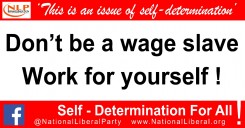
Our poster (above) looks at Economic Self-Determination and indicates that this means avoiding a life of wage slavery.  The NLP has previously noted that Economic Self-Determination:

‘seeks to distribute ownership as widely as possible and as close to the individual as practical by favouring home ownership, self-employment, small businesses, cooperatives and employee shareholdings. (We believe that ownership is the key to economic and social health: where workers obtain a just reward for their labours and gain a feeling of well-being through their having a genuine personal stake in society).’

The following e-poster http://nationalliberal.org/liberty-nation-says-neither-capitalism-nor-socialism(produced by Liberty & Nation – the voice of the National Liberal Party) successfully illustrates what Economic Self-Determination is all about and notes that it stands in opposition to the centralising and exploitative nature of both capitalism & socialism.

NLP members and supporters will be aware that we intend to fight next year’s Greater London Assembly elections.  Here we’ll be standing under the banner of Self-Determination For All!

We intend to use the GLA election to raise awareness of the concept of self-determination, gain experience in electioneering – with special emphasis on Social Media tactics – and to forge links and build alliances between various different self-determinists living in London.

Although our campaign will largely concentrate on National Self-Determination, we also hope to use it to promote – and develop – our ideas on Economic & Political Self-Determination as well.

With the above in mind, look out for our forthcoming article and poster entitled Self-Determination is a human right. In the meantime, we’d encourage our readers to check out the following links and do whatever they can to support our campaign.  Self-Determination For All!

.

• ALSO CHECK out:


Self-Determination For All! http://nationalliberal.org/self-determination-for-all-3

#SelfDetermination4All http://nationalliberal.org/selfdetermination4all

Greater London Assembly Elections 2020 – Help Us Fight For National & Political Self-Determination For All! http://nationalliberal.org/greater-london-assembly-elections-2020-–-help-us-fight-for-national-political-self-determination-for-all

Read This If You Support Self-Determination … https://nationalliberal.org/read-this-if-you-support-self-determination-…

Will You Represent Your People? http://nationalliberal.org/will-you-represent-your-people

GLA Candidate Meeting! http://nationalliberal.org/gla-candidate-meeting

Share:
  • Print
  • Digg
  • StumbleUpon
  • del.icio.us
  • Facebook
  • Yahoo! Buzz
  • Twitter
  • Google Bookmarks
  • Add to favorites
  • blogmarks
  • Blogosphere
  • Google Buzz
  • PDF
  • email
  • Live
  • MSN Reporter
  • MyShare
  • MySpace
  • Technorati
  • Webnews.de

Harrow Voice Debate (1) – What Do You Think Of Universal Basic Services?

WELCOME TO the first debate hosted by Harrow Voice – the voice of National Liberal Party in Harrow (Middlesex). Regular readers will be aware that our sister publications Caledonian Voice, Devon Voice and Welsh Voice have previously debated (see links below) the idea of a Universal Basic Income (UBI). The idea behind UBI is that each individual living in the UK would receive some form of regular income from the government. This money would be issued unconditionally, meaning that it wouldn’t be means tested.


Harrow Voice is deeply interested in the various ways that ordinary working families can be financially supported in the future – especially given the rapid advancements in Artificial Intelligence (AI) and robotics, which will lead to job losses.


This article – originally entitled Why UBI’s Cousin, UBS, Is Better https://medium.com/bigger-picture/why-ubis-cousin-ubs-is-better-c08778c7c865– was originally published last year in Medium, a US-based blog which publishes work by amateurs and professionals. Written by Inés Fernández, this thought-provoking article looks at the idea of providing Universal Basic Services (UBS) instead. Such services would guarantee a minimum standard of life and include free healthcare, education, democracy & legal services, housing, food, transport and information.

Harrow Voice invites everyone to read the article and answer this simple question: What Do You Think Of Universal Basic Services? Let us know via the National Liberals Facebook site – https://www.facebook.com/groups/52739504313/ – or the National Liberal Party Facebook site – https://www.facebook.com/NationalLiberalParty/


It goes without saying that there are no official links between Inés Fernández, Medium, Harrow Voice and the National Liberal Party. Please note that Harrow Voice has kept the original North American spelling and phrases as they are.

.

Why UBI’s Cousin, UBS, Is Better


Examining universal basic income vs. universal basic services


By Inés Fernández


THE INCREASING concerns over automation and the future of work have started to fuel the popularization of ideas like universal basic income (UBI) — a policy which would provide every citizen with a certain amount of money a month that they can spend however they want. Perhaps most notably, U.S. Democratic presidential candidate Andrew Yang is centering his platform around this idea (albeit his version excludes those outside the 18–65 age group and those receiving welfare services).


Implementing UBI, without a doubt, would be better than letting the millions of workers who will lose their jobs to automation perish. However, there are some points that make UBI less preferable than its less flashy alternative: universal basic services (UBS), which, as its name suggests, entails that all necessary basic services (defined differently by every proponent, but could include healthcare, housing and utilities, transportation, education, and a meal plan) be publicly funded and made free at the point of service. If you are a UBI proponent, allow me to make the case to you as to why this is so.


UBI (or at least any UBI program that is not in addition to UBS, like Andrew Yang’s) will, at the end of the day, go towards paying for these services, but is less effective at it. This is because, by providing the services directly, if someone’s total cost in all these areas is $500, the government would spend $500 on that person, while if another person’s costs are $1000, it would spend $1000. But with UBI, the government would give the same amount to both people — if it is under $1000, then one has insufficient money to cover their basic needs, and if it is over $500, then one of them is receiving excess money. Evidently, this is a more inefficient use of funds than just covering people’s needs.


The biggest challenge with UBI, as any UBI advocate knows, is that it is difficult to pick the perfect amount. No matter the number, some people will receive too much, and some people will receive too little. This is why UBS ensures no one will go without the essential services they need in a way that UBI will never be able to.


Don’t get me wrong, a UBI on top of UBS would be great, and if feasible, I would probably support it. But a UBI in place of UBS (or in place of welfare programs, which are just non-universal basic services) is unacceptable. Many progressives fear that UBI is a neoliberal excuse to underfund these programs, and if implemented in this manner, their concerns would likely be justified.


With UBS, since people would have these expenses covered for them (remember — the money would come from the same place UBI money is intended to), they would save thousands of dollars and to re-invest in the things that UBI advocates dream of: consumer spending and starting small businesses. Also, they would be more prone to take business risks, knowing they have this safety net and won’t end up homeless or unable to pay for their kids’ education if it goes wrong. In other words, all the benefits that are supposed to be achieved through UBI — a healthier and more educated population, a reduction in homelessness, an increase in mental health due to alleviated financial distress, a safety net on which to rely on while going through job retraining, a reduced dependency on salary and consequent empowerment of workers — would be achieved, except more efficiently, since it is more targeted and provides each person with exactly what they need. Not a cent less, not a cent more.


Furthermore, counterintuitively to many UBI proponents, it is even possible to make the case that UBS is less bureaucratic — instead of the government giving citizens money and citizens providing it to the service, it is provided to the service directly, cutting out the middleman. It is more politically feasible, since most governments already have these programs reserved for a select few, and UBS would simply require expanding them to everybody as opposed to starting a whole new program.


Perhaps more importantly, though, providing services through a UBS program would be cheaper than through UBI, not just because of the increased dollar-per-person efficiency, but for the same reasons that healthcare and education are cheaper per capita in every other developed country than in the United States — the government has more bargaining power than any individual citizen, and would it be able to negotiate down the prices with the entity that is providing them.


Of course, any candidate proposing UBS would have to figure out the details of how exactly they would go about it, including whether they want the government to run these services or merely fund them (I suspect many would prefer the latter) and whether they want to offer the services as an opt-in option or as the sole provider (I suspect many would prefer the former). But I personally support UBS because, independently of all the economic and practical arguments, I think that in a society that can offer them, it is immoral to deny people access to any of these services on the grounds that they cannot afford them. It would not only have positive repercussions on society, but it is the humane thing to do.


If you agree with this ideal but disagree with its implementation, I would love to hear why (be it in the comments or on Twitter). Nevertheless, whether through UBI, UBS, or another policy, one thing is clear: We must find a way to cultivate a more modern relationship to work, because if survival depends on salary, it is very likely that automation will wreck havoc on our society.


• READERS interested in Universal Basic Income – UBI – should also check out the following debates:


Caledonian Voice Debate (1) – Universal Basic Income For Scotland? http://nationalliberal.org/caledonian-voice-debate-1-universal-basic-income-for-scotland

Welsh Voice Debate (1) – Who Really Stands To Win From Universal Basic Income? http://nationalliberal.org/welsh-voice-debate-1-who-really-stands-to-win-from-universal-basic-income


Devon Voice Debate (1) Universal Basic Income For Devon? (Part 1) http://nationalliberal.org/devon-voice-debate-1-–-universal-basic-income-for-devon-part-1


Devon Voice Debate (1) Universal Basic Income For Devon? (Part 2) http://nationalliberal.org/devon-voice-debate-1-–-universal-basic-income-for-devon-part-ii


Devon Voice Debate (1) Universal Basic Income For Devon? (Part 3) http://nationalliberal.org/devon-voice-debate-1-–-universal-basic-income-for-devon-part-iii

Share:
  • Print
  • Digg
  • StumbleUpon
  • del.icio.us
  • Facebook
  • Yahoo! Buzz
  • Twitter
  • Google Bookmarks
  • Add to favorites
  • blogmarks
  • Blogosphere
  • Google Buzz
  • PDF
  • email
  • Live
  • MSN Reporter
  • MyShare
  • MySpace
  • Technorati
  • Webnews.de

From The Liberty Wall – Free Speech: How Do We Protect It? – The Freedom To Offend

A BELFAST-BASED Free Speech advocate recently sent us an article from the Belfast Telegraph of 2nd January. The article – by Fionola Meredith – mirrors our view that, and as Salman Rushdie has noted, “What is freedom of expression? Without the freedom to offend, it ceases to exist.”


Fionola Meredith’s article was based on an interview given to the Times of London by Sir Alan Moses towards the end of last year. Here Sir Alan – a Former Lord Justice of Appeal and outgoing chairman of the Independent Press Standards Organisation (IPSO) – defended freedom of speech, and insisted that the media should be allowed to discuss sensitive subjects, such as religion.


As advocates for free thought, free Free & free assembly for all, we welcome Sir Alan’s comments and Fionola Meredith’s article. This is particularly so when one thinks of the suffocating (yet powerful) woke and Politically Correct times in which we live.


We’d appreciate it if other supporters would keep an eye out for articles which especially appear in the mainstream media (MSM) that support the general idea of free thought, free speech and free assembly for all.


It goes without saying that there are no official links between Fionola Meredith, the Belfast Telegraph and Free Speech: How Do We Protect It?

.


There is no right not to be offended: why we must heed the outgoing Ipso chief


Sir Alan Moses is correct, says Fionola Meredith. Freedom of speech is more important than hurt feelings


There is no right not to be offended: that’s according to Sir Alan Moses, the outgoing chairman of the UK’s main press regulator, Ipso. Moses stated that it was vital for democracy that the media be allowed to discuss sensitive subjects such as religion and gender without fear of being censored.


Hurray for Sir Alan! Somebody had to stand up and say it.

We live in a world where people act as if being offended is like kryptonite to Superman: deadly for their personal wellbeing.

Frequently this victim mentality is attributed to snowflakey millennials who have been brought up with an unprecedented level of privilege, entitlement and an overweening sense of their own importance.

There’s no doubt that this toxic seam of intolerance – for that is what it is – runs like a sore through many British and Irish universities, with absurd attempts to ‘no-platform’ speakers that certain students dislike.

However, I’ve seen many old geezers get just as exercised about repressing, shunning or otherwise obliterating stuff they don’t approve of.

If I don’t like it, ban it: that’s the prevailing message.

To be fair to Sir Alan, a former lord justice of appeal, he didn’t come out and say ‘suck it up, cry-babies’.

Admitting that dealing with complaints about offence was one of the most difficult aspects of the Ipso role, he said: “If you’re the victim of something that is deeply offensive, it is the most unpleasant, uncomfortable thing that you can imagine. But what we have to acknowledge is that, in striking the right balance in this country, there is no right not to be offended.”

This message cannot be repeated too often. The novelist Salman Rushdie has more reason than most to take a personal interest in it, given that a fatwa – or execution order – was declared on him in 1989 by Iran’s Ayatollah Khomeini, after the publication of his book, The Satanic Verses.


Mass book burnings, bannings and death threats followed. It was nine years before the author came out of hiding, but Index on Censorship has noted that as recently as 2016, funds were being raised to add to the fatwa.


Rushdie said: “Nobody has the right to not be offended. That right doesn’t exist in any declaration I have ever read. If you are offended it is your problem and frankly lots of things offend lots of people. I can walk into a bookshop and point out a number of books that I find very unattractive in what they say. But it doesn’t occur to me to burn the bookshop down.”


Similarly, if somebody writes, says or tweets something that conflicts with your own beliefs, you don’t have to go into public meltdown and immediately try to organise a huge social media pile-on, where reason and balance gets trampled into the dirt by the howling mob.


You have options. You could express your disagreement. You could enter into a discussion. Or hey, here’s a radical idea, how about simply ignoring it and walking away?


True, Rushdie’s persecution is an extreme example. Here in Northern Ireland, where offence-taking is practically a national sport, there are numerous instances of self-indulgent huffing about them’uns on the other side. Most of this is low-level yapping and whataboutery.


But one of the most astounding examples that came to light last year was the case of Lee Hegarty.


According to the former Ulster Unionist MP Ken Maginnis, speaking in the House of Lords, Hegarty – previously a Northern Ireland Office (NIO) worker, who then took up a role with the Parades Commission – made a complaint under human rights legislation because he was so offended by portraits of the Queen adorning the walls of his workplace.


The alleged price of poor Mr Hegarty’s hurt feelings? Ten grand in compensation.


That’s a hell of a lot of money to salve Mr H’s wounded emotions. I really hope he didn’t get PTSD or anything from having to see pictures of HRH every day.


If I got a tenner for each time I’ve been insulated or offended as a result of the work I do, I’d be an extremely rich woman. Maybe not as rich as Mr Hegarty though.


I’m no royalist, but to me there’s something almost obscene – yet entirely typical of the way such things are done in la-la-land Northern Ireland – about pandering to outraged political sensibilities in such an extreme way.


There is no right not to be offended. As we enter not just a new year but a new decade, we must reaffirm this fundamental democratic truth.


• READ the original Belfast Telegraph article here: https://www.belfasttelegraph.co.uk/opinion/columnists/fionola-meredith/fionola-meredith-there-is-no-right-not-to-be-offended-why-we-must-heed-the-outgoing-ipso-chief-38829708.html


• READ the original interview with Sir Alan Moses in the Times here: https://www.thetimes.co.uk/article/sir-alan-moses-free-speech-means-freedom-to-offend-press-watchdog-insists-nzcsfzj6z?wgu=270525_73669_15797131443162_a22283a29e&wgexpiry=1587489144&utm_source=planit&utm_medium=affiliate&utm_content=30828


• CHECK OUT the Independent Press Standards Organisation (IPSO) here: https://www.ipso.co.uk/


• ALSO CHECK OUT Index on Censorship here: https://www.indexoncensorship.org/


• SUPPORT Free Speech: How Do We Protect It? here: https://www.facebook.com/groups/1607711629485795/


Share:
  • Print
  • Digg
  • StumbleUpon
  • del.icio.us
  • Facebook
  • Yahoo! Buzz
  • Twitter
  • Google Bookmarks
  • Add to favorites
  • blogmarks
  • Blogosphere
  • Google Buzz
  • PDF
  • email
  • Live
  • MSN Reporter
  • MyShare
  • MySpace
  • Technorati
  • Webnews.de

From The Liberty Wall – Nations without States – Calling All Aborigines …

.

NATIONS WITHOUT STATES – NwS – is a pressure group which seeks to highlight the plight of peoples who aspire to nationhood. Its raison d’être can be summed up in one simple slogan: Self-Determination For All!

Those who seek nationhood may be peoples or tribes based within a state or even across borders that may or may not have been independently organised in the past. They might have a linguistic or historical separateness from their neighbours or fellow citizens. All will aspire to recognition, autonomy or independence.

.

As self-determinists, Nations without States supports the right of all such peoples to determine their future whatever they wish that to be.

.

This includes for example the English, Flemish, Kurds, Sikhs and Tamils. A genuine self-determinist supports the right of self-determination globally where it is based upon a sound and just position and is supported by the majority of its ‘national’ community. The slogan ‘what is right for me is right for you’ simplifies why genuine nationalism is actually an inter-nationalist creed, quite separate to chauvinism which seeks advantage for one nation at the expense of others.

.

For many years now, NwS has sought to unite various groups – some who would have previously operated in isolation from each other – in order to strengthen their claim to self-determination. As we noted in issue 1 of Nation – the Newsletter of Nations without States – ‘the only way forward is for self-determinists to unite and fight. We need to follow a strategy which will be conducted both on the streets and in the corridors of power.’


The call to operate ‘on the streets and in the corridors of power’ was followed up in issue 2 of Nation. It detailed several areas where NwS intended to build ‘counter power’ – a parallel system ‘that belongs to self-determinists and not our oppressors.’ This counter power would involve the following:

.

• Build the infrastructure of an alternative mass media of news and entertainment. We’ve made a couple of small steps in the right direction here with the publication of Nation and our street paper Freedom, and the establishment of our Facebook site.

.

• Build both a cultural and counter-cultural movement that’ll provide positive alternatives – especially for our youth – to globalism and modern consumer culture, which is designed to reduce everybody to the lowest common level by abolishing all inherited cultures and identities.

.

• Build a social support network that can provide help, solidarity and humanitarian aid for our peoples both here and abroad.

.

• Build a political movement that engages with various self-determinists with the aim of creating a whole new voting demographic.

.
NwS intends to look at – and expand upon – all of these ideas in due course. But for the time being we’d like to concentrate on the idea of building a new voting demographic.


The reason for this is that later our friends & comrades from the National Liberal Party – NLP – will be standing candidates for the Greater London Assembly elections, scheduled for 7th May 2020 (1). The NLP will be standing under the slogan of Self-Determination For All!

.

The NLP can field a total of 25 candidates. As of a couple of weeks ago nine candidates had been confirmed (2). Initially, the NLP would like to reflect the widespread number self-determinist communities living in the UK (and who would like to be represented, if elected, at the highest level in London).

With the above in mind, Nations without States would like to help the NLP locate potential candidates from the various diaspora communities living in London. We kick off with the Aborigines, the various indigenous peoples of the Australian mainland and many of its islands (excluding the Torres Strait Islands).

.

We appreciate that it’s hard to know if there are any Aboriginal folks living in London. As far as we’re aware, the vast majority still live in Australia – indeed, almost two thirds of Aboriginal people live in urban areas of Australia’s eastern states (3). However, given that Greater London has an estimated population of 8.17 Million (4) it’s not inconceivable that some younger Aboriginal folks – particularly those from an artistic or sporting background – are living in the capital.

.

Even if there are none, both ourselves and the NLP would be interested in making contact with any activists who know about – and support – the Aboriginal Australians.

.

We’re particularly interested in what forms of self-determination are being mooted – such as greater recognition, autonomy or independence – as well as cultural issues. Nations without States are also very interested in bringing these issues to the attention of fellow activists (who’re interested in self-determination) via our Facebook site: https://www.facebook.com/groups/184919468292372/

.

However, with the May Greater London Assembly elections in mind, it’s vitally important that anyone who generally supports the cause of self-determination (and, if possible, the Aboriginal Australian cause) gets in touch with the National Liberal Party as soon as possible.

.

As we noted earlier, the NLP wants to use this opportunity to bring the unique idea of Self-Determination For All! to the attention of London’s electorate. If you fit the bill, please contact natliberal@aol.com as soon as possible!

  1. http://nationalliberal.org/self-determination-for-all-3
  2. http://nationalliberal.org/gla-candidate-meeting
  3. https://www.creativespirits.info/aboriginalculture/people/aboriginal-population-in-australia
  4. http://livepopulationof.com/population-of-london/
Share:
  • Print
  • Digg
  • StumbleUpon
  • del.icio.us
  • Facebook
  • Yahoo! Buzz
  • Twitter
  • Google Bookmarks
  • Add to favorites
  • blogmarks
  • Blogosphere
  • Google Buzz
  • PDF
  • email
  • Live
  • MSN Reporter
  • MyShare
  • MySpace
  • Technorati
  • Webnews.de

New Horizon – National Liberalism In Action – Civil Liberties

JUST OVER five weeks ago we reproduced the second article – Head & Heart – from issue 1 of New Horizon, the online ideological magazine of the National Liberal Party. That article examined how, historically, Liberals adopted nationalism as part of their creed and became known as National Liberals.


We now move onto National Liberalism In Action! which takes a look at (the then) NLP ‘recruitment campaign that focused on Five key policy areas; Civil Liberties, Democracy, Environment, and the NHS.’


The first of these – Civil Liberties – is of great importance to National Liberals. We believe that ‘the defence of personal liberty is at the heart of our mission.’ Indeed, it could be argued that defending everyone’s Civil Liberties is the key to ensuring personal self-determination and freedom.


As always, we encourage thorough debate of our ideas. Therefore, we’d encourage readers to share their when this article is reproduced on either of our two Facebook sites – National Liberals https://www.facebook.com/groups/52739504313/ – and National Liberal Party – https://www.facebook.com/NationalLiberalParty/

,

National Liberalism In Action!

.

The defence of personal liberty is at the heart of National Liberalism. Indeed, it could be argued that defending everyone’s Civil Liberties is the key to ensuring personal self-determination and freedom. Readers interested in Civil Liberties should check our the Facebook group Free Speech: How do we protect it? which supports the idea of Free Thought, Free Speech & Free Assembly For All. It also campaigns for a formal constitution and bill of rights, based on the concept of civil and religious liberties for all. It also feel that a civil rights watchdog should be established to protect the people’s ability to make use of these rights.

WHILST New Horizon is dedicated to promoting, dissecting and discussing the ideology of National Liberalism, we cannot forget those National Liberals who are attempting to put this into practice. We know that there are individuals (groups?) who ascribe to the movement’s ideals throughout the Europe, from Turkey to Scandinavia and beyond, even globally. Here in the UK some are involved in pressure groups such as English Green (a non-socialist green movement), whilst others are in the political party – the National Liberal Party.

.

We shall dedicate a section each issue to those operating in the ‘real’ rather than our ‘cyber’ world. In this first issue we host articles supporting and expanding on the NLP’s latest recruitment campaign that focused on Five key policy areas; Civil Liberties, Democracy, Environment, and the NHS.

.

CIVIL LIBERTIES – A PRECIOUS COMMODITY ‘HARD TO OBTAIN EASY TO LOSE’

.

IN December, nearly 400 years ago, the English Parliament passed an act entitled the ‘Bill of Rights’. It put down limits on the powers of the Sovereign (Monarch) and set out the rights of Parliament and the rules for freedom of speech therein, the requirement to regular elections to Parliament and the right to petition the monarch without fear of retribution. This built upon various other ‘events’ such as the much earlier Magna Carta of 1215 This is the first recorded document where a King, previously ruling under a ‘Divine Right’, accepted that his ‘subjects’ had rights, including the right not to be gaoled without trial. In time, similar various pieces of legislation came to cover the whole of the United Kingdom and make up Britain’s ‘Unwritten Constitution’, in particular the concept of individual rights and liberties. It took many years, much struggle, blood, sweat and tears to achieve.

.

TAKING LIBERTIES …

.

Today however, we see an increasing encroachment upon our civil liberties and individual freedoms. The phrase an ‘Englishman’s home is his castle’ is more than just a quaint phrase. It reflects an historical view that a Government’s writ largely remained outside our ‘ramparts’ and did not extend to personal affairs. In reality this has broken down ever since the end of the first World War with increasing attempts to interfere in our ‘private lives’ or ‘private views’ (should they not conform to the PC – left or right – of the day). It wasn’t always that way*

.

Technology, whilst a ‘liberating’ force for many individuals is also being used to enslave us too. CCTV, continual push for biometric ID cards, communication eavesdropping and monitoring, to name just a few developments that will make it increasingly easier for any future Government to turn 1984 into a reality.

.

History shows that once liberties are surrendered they are very difficult to restore.

.

For National Liberals however the defence of personal liberty is at the heart of our mission. Governments struggle, at best, to resist the lure of power and often seek to centralise authority into their hands. This will inevitably impact upon individual freedoms. In times of heightened threats to national or personal security, Authority will seek to restrict their citizens movements and expression. What are and are not acceptable restrictions are of supreme importance to many. Outside of Authority, National Liberals must be part of societies ‘civic conscience’. Inside of Authority, they must ensure the ‘correct balance’ is struck between personal freedom and collective security and responsibility.

.

To assist in maintaining this balance, we call for the Government appointment of a specific Civil Liberty Watchdog, with some executive blocking powers, to ensure our civil liberties are maintained in the face of private or public threats.

.

The National Liberal Party will continue to expose, and campaign against, the steady encroachment of our individual freedoms and civil liberties. Whilst the main political topics of the day; the economy, immigration, Europe and education presently hold the attention of sections of the public, political parties and the media we believe that concern over loss of civil liberties will one day hold everyone’s attention.

.

* As the famous historian A.J.P Taylor stated in his book English History: 1914-45 ‘Until August 1914 a sensible law-abiding Englishman could pass through life and hardly notice the existence of the state, beyond the post office and the policeman. He could live where he liked and as he liked. He had no official number or identity card.’

.

• ALSO Check out:

.

Build New Horizon! http://nationalliberal.org/build-new-horizon

New Horizon – Head & Heart http://nationalliberal.org/new-horizon-head-heart

Share:
  • Print
  • Digg
  • StumbleUpon
  • del.icio.us
  • Facebook
  • Yahoo! Buzz
  • Twitter
  • Google Bookmarks
  • Add to favorites
  • blogmarks
  • Blogosphere
  • Google Buzz
  • PDF
  • email
  • Live
  • MSN Reporter
  • MyShare
  • MySpace
  • Technorati
  • Webnews.de

By continuing to use the site, you agree to the use of cookies. more information

The cookie settings on this website are set to "allow cookies" to give you the best browsing experience possible. If you continue to use this website without changing your cookie settings or you click "Accept" below then you are consenting to this.

Close