Thursday, 15 January 2026

Category » Articles

A Referendum Is An Act Of Self-Determination

.

REGULAR READERS will know that the National Liberal Party (NLP) intended to stand up to 25 candidates in theGreater London Assembly elections – which were scheduled for 7th May.


Here, we were going to campaign on the issue ofSelf-Determination ForAll! The election would have provided us with an excellent opportunity to hone our social media skills and build a powerful Self-Determinist electoral bloc. However, as we reported two days ago – http://nationalliberal.org/public-notice – they have now been postponed for a year due to thecorona virus outbreak.


With this in mind, the NLP has cancelled its planned donors dinner (27th) and election meeting (29th) until further notice. But this doesn’t mean that we’ll be placing less emphasis on Self-Determination. In fact, we’ll be stepping up a gear! In the same way a dog is for life and not just for Christmas, we feel that Self-Determination is for life and not just for elections!

We believe that the principle of Self-Determination can be applied largely in three areas – National, Political and Economic. Our intended Greater London Assembly (GLA) election campaign would have mainly focussed on National Self-Determination. However, we also intended to look at matters relating to Political & Economic Self-Determination as well.


The first article (in this series of three) looked at Economic Self-Determination – see For Economic Self-Determinationhttp://nationalliberal.org/for-economic-self-determination However, in this article we’ll be looking at Political Self-Determination.

The NLP definesPolitical Self-Determination as a system which ‘seeks to ensure that the collective will of the people as well as the variety of political opinion is reflected in decision making. Thus, for example, we favour greater use of Referendums to meet the former, and PR to reflect the latter (we favour a system close to the Swiss model of Direct Democracy).’

As the title of this article –A Referendum Is An Act Of Self-Determinationsuggests, we would like to see representative democracy replaced by participatory democracy in the form of Referendums (as well as Preferendums). The NLP feels that direct democracy should be the only show in town.

For those who don’t know, a referendum isa method of referring a question or set of questions to the entire electorate directly.’ Since 1973 the UK has held 11 referendums, the most famous (or infamous, depending on your point of view!) being the EU Referendum of 2016. (1)

We would prefer that referendums were held on a much more regular basis – as they do in Switzerland. In future articles we’ll take a more in-depth look at referendums (and look at some examples from Switzerland itself).

Referendums are usually decided on a simple ‘Yes/No’ vote. However, it could be argued that preferendums are more democratic in that they allow the electorate toselect a range of different options (generally, three or more) in order of their preference. It’s thought that the use of a preferential voting system – rather than a simple majority – also accurately allows everyone’s point of view to be taken into account.

Other elements of Political Self-Determination must include replacing the ‘First Past The Post’ (2) voting system with one of Proportional Representation. As indicated in the articleFrom The Liberty Wall – Total Democracy – We Want Total Democracy! there also needs to be a ‘None Of The Above’ (NOTA) option on the ballot paper (3) and a process of Voter Recall.

We’re also interested in the system whereby members of the public can create petitions which can be debated in parliament if they attract100,000 signatures or more (4). However, it has obvious flaws in that the Petitions Committee (which consists of around a dozen MPs) has the power to decide what and can’t be presented for debate.

Again, we’ll be looking at these issues in more depth in the near future.

So far we’ve concentrated on Political Self-Determination initiatives that are largelyNational in nature. However, we feel that many of them can also be adapted toLocal government. With this in mind, we’ve recently been advised of a system employed in Spain whereby locals have a direct say in the spending of a portion of the local budget. As this brief article (5) from The Post (a Spanish-based weekly English language paper) of early October 2019 notes:

‘Residents of San Pedro del Pinatar can have their say on the local budget until October 13, the town hall announced last week.

The council has allocated€200,000 to a participative budget scheme (presupuesto participativo), for which residents can send their proposals via the municipal website, www.sanpedrodelpinatar.es

Proposals can be made by any resident aged over 16, who is registered on the municipal register (padrón) and the cost of carting them out cannot exceed the €200,000 budget.

Council technicians will then select the most feasible proposals and these will be posted on the website so that they can be voted on between November 18 and 22.

The winning proposal will be included in the budget for 2020.’

The NLP feels that a similar system could be introduced by UK local authorities. This’ll give local communities some say over the spending of a proportion of their rates and would be an effective form of local political Self-Determination.

  1. https://www.parliament.uk/get-involved/elections/referendums-held-in-the-uk/
  2. We believe that the current ‘First Past The Post’ (FPTP) electoral system is not fit for purpose. Indeed, it could be argued that FPTP is anti-democratic. It’s certainly injust as it actually allows governments to be formed with only a fraction of the overall vote. For instance, the 2005 Labour government only had the support of 35% of the electorate whilst in 2015, the Tories formed a government with only 37% of the vote https://www.electoral-reform.org.uk/voting-systems/types-of-voting-system/first-past-the-post/
  3. http://nationalliberal.org/from-the-liberty-wall-–-total-democracy-–-we-want-total-democracy
  4. https://www.parliament.uk/get-involved/sign-a-petition/
  5. https://issuu.com/rotativosdelmediterraneos.l./docs/post_628
Share:
  • Print
  • Digg
  • StumbleUpon
  • del.icio.us
  • Facebook
  • Yahoo! Buzz
  • Twitter
  • Google Bookmarks
  • Add to favorites
  • blogmarks
  • Blogosphere
  • Google Buzz
  • PDF
  • email
  • Live
  • MSN Reporter
  • MyShare
  • MySpace
  • Technorati
  • Webnews.de

Britain’s Reactionary Racists React!

Left: Sajid Javid (50) attended the University of Exeter & studied Economics and Politics. He joined the Tories whilst at University. Before entering politics full time, he worked in the banking industry, initially joining the New York City-based JPMorgan Chase Bank. He later joined London-based Deutsche Bank AG as a director. He went on to became a managing director and then global head of Emerging Markets Structuring. Right: Rishi Sunak (40) went to Lincoln College, Oxford. He worked for Goldman Sachs – who describe themselves as a ‘leading global investment banking, securities and investment management firm’ - between 2001 and 2004. He then worked for hedge fund management firm The Children’s Investment Fund Management becoming a partner in 2006. He later joined another hedge fund firm - Theleme Partners. He was also a director of investment firm Catamaran Ventures, owned by his billionaire father-in-law, Indian businessman N. R. Naravana Murthy.

BRITAIN’S REACTIONARY RACISTS recently got their knickers in a twist when Rishi Sunak – a rising star in the Tory party – was appointed Chancellor of the Exchequer.

But who is Sunak and why did the racists go ape when he was appointed?

Sunak has been the MP for Richmond (in North Yorkshire) since May 2015. Richmond is a safe Conservative seat – and has been held by them for over 100 years – and this was reflected in Sunak’s huge majority of 19,550. In the 2017 election he increased his majority to 23,108. He bettered this in last year’s general election where his majority was an incredible 27,210 (his total vote was 36,693 – 63.6%).

Sunak has simply been promoted by Boris Johnson to the position of Chancellor of the Exchequer. Here he replaces Sajid Javid, who resigned in mid-February (after rejecting an order to fire his team of aides, saying “no self-respecting minister” could accept such a condition).

Sunak is no stranger to the Treasury Department – as he’d served under Javid as Chief Secretary to the Treasury from July 2019 – February 2020 – so he was the obvious choice.

The only real difference between Rishi Sunak and Sajid Javid that we can see is that the former is a teetotal Hindu whilst the former enjoys the odd drink and – whilst his family are Muslims – Javid is non-religious. Apart from that, they both have impeccable Tory credentials. Both have been to university and have worked in & have extensive contacts within the banking sector.

As we’ve already noted, Britain’s reactionary racists were up in arms over Sunak’s promotion. The reason for this is because of the regressive form of identity politics that they adhere to.

Indeed, the reactionary right is gripped by a great universal conspiracy. They tend to live in a fantasist-like parallel world and view anyone with a light brown skin as an Islamic terrorist – irrespective of their religion! (In fact, we’d wager a bet that many reactionaries wouldn’t know the difference between Muslim’s, Hindu’s or Sikh’s let alone those who interpret Islam in differing ways.)

Reactionaries are also fond of ignoring facts and prefer to make grand and sweeping statements. (However, whether they actually believe what they say is open to debate.) They tend to lump all members of entire religious and/or racial communities together and judge those communities on the actions of a few.

Unlike the reactionary right, the National Liberal Party couldn’t care less who is the Chancellor of the Exchequer. We’ve absolutely no interest in their race, ethnicity, religion or sexual orientation.

As we mentioned earlier, the reactionary right (like those on the reactionary left) are obsessed with regressive identity politics. As such, they’re fixated on the individuals who’re facilitating the capitalist system – and have nothing of interest to say about the capitalist system itself. In fact, the only time the reactionary right take time out to address the banking system is if they can link it to ‘the Jews’. And because of their out-and-out opposition to all Muslims, they fail to understand that the Islamic banking system forbids usury!

This fixation on personalities illustrates the shallowness of both the reactionary right (and left). To some extent, it doesn’t matter who’s in government – for powerful corporate big business and banking elites rule the roost.

The reactionary right’s approach is about as meaningful and effective as rearranging the deckchairs on the Titanic. The National Liberal Party, on the other hand, isn’t interested in changing the Chancellor – we want to change the whole banking system itself!

• CHECK OUT Facebook/National Liberals

Share:
  • Print
  • Digg
  • StumbleUpon
  • del.icio.us
  • Facebook
  • Yahoo! Buzz
  • Twitter
  • Google Bookmarks
  • Add to favorites
  • blogmarks
  • Blogosphere
  • Google Buzz
  • PDF
  • email
  • Live
  • MSN Reporter
  • MyShare
  • MySpace
  • Technorati
  • Webnews.de

New Horizon – National Liberalism In Action – The Nature of Democracy

THIS IS the third in a series of articles reproduced from issue 1 of New Horizon – the ideological publication of the National Liberal Party. This series to copper-fasten a central tenant of National Liberal belief – that the ‘Idea’ is all important and that it trumps everything else. It even transcends concepts such as a ‘Leader’ and the ‘Party.’ National Liberals also recognise that at times – usually in regrettable & extreme circumstances – the ‘Leader’ and the ‘Party’ are not one and the same as the ‘Idea.’ In short, sometimes leaders and political parties come and go – but the idea remains. The former are there to serve the latter.


We feel that this viewpoint sets National Liberalism miles apart from Conservatism or Socialism. Whilst we’re obviously interested in examining the lives of those who we regard as ‘points of reference’ (in that they’ve said or done things that we find interesting) we’re certainly not into ‘hero worship.’ But just look at the way some Labour Party supporters (depending on how they define ‘Socialism’) view Tony Blair or Jeremy Corbyn through rose tinted lenses. The same rose tinted glasses are employed by many Conservatives who harp back to the days of Margaret Thatcher or who think that the current Prime Minister, Boris Johnson can do no wrong. National Liberals believe that it’s unhealthy – almost cultist – to view ‘Leaders’ (and, indeed, the ‘Party’) in this way.


Another thing that sets us apart from others is our love of internal & external debate. Indeed, the National Liberal Party – as well as our various publications – has been promoting regular debates for many years now. Eagle-eyed readers will also know that (from the start of last year) we’ve introduced a series of eye-catching posters, all designed to promote discussion & debate on all matter of subjects. The most recent poster-based debate – from just a couple of weeks ago – can be found here: http://nationalliberal.org/the-national-liberal-party-asks-…-does-big-pharma-have-too-much-power-join-the-debate


Therefore, whilst we obviously believe in the validity of our ideas, we’re not ideological purists in the Stalinist sense – where even the mildest (or constructive) criticism is rejected out-of-hand.

With all of the above in mind, we’d appreciate any comments – good, bad or indifferent – relating to our ideas. Simply post them up when this article appears on either our National Liberals Facebook site – https://www.facebook.com/groups/52739504313/?fref=nf – or our NLP Facebook site – https://www.facebook.com/NationalLiberalParty/

.

National Liberalism In Action!


ISSUE 1 of New Horizon – the online ideological magazine of the National Liberal Party - was launched towards the end of 2015. To get hold of a FREE pdf copy, simply e-mail natliberal@aol.com

WHILST New Horizon is dedicated to promoting the ideology of National Liberalism, we cannot forget those National Liberals who are attempting to put this into practice. We know that there are individuals (groups?) who ascribe to the movement’s ideals throughout the Europe, from Turkey to Scandinavia and beyond, even globally. Here in the UK some are involved in pressure groups such as English Green (a non-socialist green movement), whilst others are in the political party – the National Liberal Party.

.

We shall dedicate a section each issue to those operating in the ‘real’ rather than our ‘cyber’ world. In this first issue we host articles supporting and expanding on the NLP’s latest recruitment campaign that focused on Five key policy areas; Civil Liberties, Democracy, Environment, and the NHS.

.

The Nature of Democracy

.

To hear David Cameron and William Hague on television and radio, anyone might be forgiven for believing that the United Kingdom, in its democratic institutions, is the last word in ‘democracy’. Westminster flatters itself as the ‘Mother of Parliaments’ which implies that it is a model for other nations to emulate.

.

We do have much to take pride in. For much of the past millennium the word of the Sovereign was law. The King was set on his throne by God and had a ‘divine right’ to govern in any way he pleased, however capricious and arbitrary he might have been.

.

Magna Carta

.

This arbitrary power was first challenged in England in 1215 at Runnymede when King John was forced to sign the Magna Carta – the Great Charter of the Liberties of England – by feudal barons. This set down the principle that the King is also subject to the law of the Land.

.

When Charles I refused to be bound by the Law he had to be defeated by parliamentary armies in 1642-49 and eventually executed for his treason.

.

The Glorious Revolution of 1689 finally vanquished the doctrine of ‘the Divine Right of Kings’, as practised in France by the ‘Sun King’, Louis XIV. Louis was the absolute dictator of France and James II wanted to have the same dictatorial powers in England, Scotland and Ireland.

.

In England, the principle had become well established that elected representatives of his subjects should check the King’s actions and that those representatives should be able to make laws. It was by no means truly democratic, but it was a significant step away from absolutism. It is not surprising that James encountered strong opposition, which led to his removal by William of Orange and his defeat at the Boyne. The Constitutional Monarchy and parliamentary government finally put down roots.

.

At first the vote in the UK was restricted to certain classes; all of them male. New Zealand adopted universal suffrage for all citizens in 1893. In Britain it was in 1928 and as late as 1971 in Switzerland. Democracy as an idea seems to be catching on, albeit slowly.

.

What is Democracy?

.

But what exactly is ‘democracy’? We hear of ‘liberal democracy’, ‘representative democracy’, ‘parliamentary democracy’, ‘majoritarian democracy’, ‘direct democracy’ and ‘consensus democracy’. All that these have in common is that somewhere in the process, somebody gets to cast a vote and somebody or something wins a majority. Is that it then?

.

Is democracy simply the rule of a majority?

.

Apologists for the ‘First Past the Post’ system of parliamentary representation argue that it is. A candidate with the support of, say, 26% of the total poll is deemed elected even though his ‘majority’ is tiny. What counts is that he is out in front. The fact that 74% of voters supported other candidates is deemed irrelevant. According to its apologists, this system enables stable government with a workable majority in parliament. Its detractors, in contrast, point out that such a government is in danger of losing touch with the people it purports to represent. Once ‘the people have spoken’ their elected representatives can ignore their wishes for up to five years. These parliamentarians are often at the mercy of party whips that use a mixture of threats and promises to keep them in line.

.

Democratic deficit

.

In a divided society this can be dangerous if one section of the community is, in effect, always excluded from decision-making by a form of parliamentary despotism. The (failed) attempt to replace FPTP with the Alternative Vote earlier this year was intended to address this democratic deficit. AV would have been an improvement on FPTP, but inferior to the Single Transferable Vote system of Proportional Representation as used in Northern Ireland.

.

Northern Ireland has one major flaw in its system, however, as it is governed by a mandatory five-party coalition. There is no opposition, so no alternative government is waiting in the wings to take over if the incumbent regime messes things up. No matter who you vote for, the government always gets in!

.

In Westminster FPTP elections, we get the chance to ‘throw the rascals out’ every four or five years, but once elected our parliamentarians can do whatever they like without reference to the electorate.

.

Direct Democracy

.

One suggested improvement might be a system of direct democracy where Members of Parliament act as popular delegates. This worked well in ancient Athens where everyone knew almost everyone else but seems impractical in a modern largely anonymous society. How are MPs to be brought closer to the people?

.

The National Liberal Party suggests that we introduce referendums as a regular consultative constitutional measure. The party is circulating an on-line petition which states:

.

Everyday important decisions are made by Government which directly affects the people. However the people are never consulted as part of the decision making process. The war in Afghanistan is just one example of this.

.

The National Liberal Party and the undersigned call for the introduction into law the use of Referendums based on the successful direct democracy system used in Switzerland, allowing people to vote on major issues such as Europe (including renegotiating the Lisbon Treaty), Nuclear power, immigration, the creation of an English Parliament and going to war.

Go to http://www.gopetition.com/petitions/consult-thepeople.html

.

Switzerland: a practical application of ‘Direct Democracy’

.

In Switzerland regular elections are held to elect representatives to their Federal (national) Parliament. As in Northern Ireland, the use of PR ensures that the party split in the number of representatives more closely resembles a party’s percentage vote than clearly is the case in Westminster. This allows government to reflect the ‘popular will’ by forcing the main parties to act in coalition. Significant minority opinion and minor parties are not shut out of influence. The government will still get in, but it will vary in response to the shifting strengths of the constituent parties in the parliament.

.

In addition to this superior electoral system, Switzerland operates three mechanisms of Direct Democracy: Referendums, Initiative and Recall. Referendums cover votes on Government proposed changes to the Constitution, important Federal (National) laws or International treaties. Initiatives allow the public themselves to call for changes to the Constitution or Federal law. Recall allows the electorate to petition for a reelection of public officials for unacceptable behaviour. Had a similar system been operating here, electors could have petitioned for the recall of those MPs who fiddled their expenses to pay for duck ponds and for similar abuses of office.

.

This form of Direct Democracy institutionalises the voters’ right to decide on issues themselves. Implementation of these measures would go a long way to address the ‘democratic deficit’ in the United Kingdom.

.

These ideas are anathema to the European power elite for whom democracy is a bit of an inconvenience. Whatever might be said of the former Prime Ministers of Greece and Italy, they were at least elected to office. Not so their ‘technocratic’ successors. It ought to be astonishing that these changes of government were given such an easy ride by the press. Witness the howls of protest when Mr Papandreou announced his intention to put a euro-zone bailout scheme to a popular referendum. Within days he was forced to cancel the referendum.

.

For the EU ‘Eurocrats’, democracy is all very fine as long as the people make the ‘right’ decision. When this does not go according to plan, the aberrant nation is bullied into voting again, as happened when the people of the Republic of Ireland rejected the Nice Treaty in a constitutional referendum.

.

In contrast, Switzerland today is prosperous, peaceful, democratic and not a member of the European Union. There’s probably a lesson there for us all.

.

• ALSO Check out:

Build New Horizon! http://nationalliberal.org/build-new-horizon

New Horizon – Head & Heart http://nationalliberal.org/new-horizon-head-heart

New Horizon – National Liberalism In Action – Civil Liberties http://nationalliberal.org/new-horizon-–-national-liberalism-in-action-–-civil-liberties

Share:
  • Print
  • Digg
  • StumbleUpon
  • del.icio.us
  • Facebook
  • Yahoo! Buzz
  • Twitter
  • Google Bookmarks
  • Add to favorites
  • blogmarks
  • Blogosphere
  • Google Buzz
  • PDF
  • email
  • Live
  • MSN Reporter
  • MyShare
  • MySpace
  • Technorati
  • Webnews.de

From The Liberty Wall – Nations without States – Calling AllAché People …

.

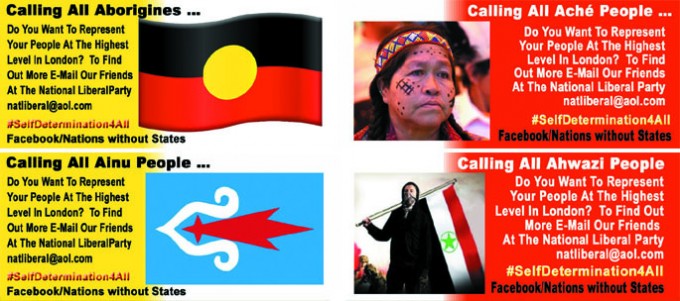
NATIONS WITHOUT STATES – NwS – kicked off this year with an appeal to anyAboriginal Australiansliving in London (who would most probably be youngsters from an artistic or sporting background) who’d be interested in promoting their case for Self-Determination at the highest level in the capital.

.

The opportunity to do so is due to the forthcomingGreater London Assembly elections – scheduled for 7th May. Here, our friends and comrade of the National Liberal Party (NLP) intend to stand up to 25 candidates under the slogan ofSelf-Determination For All!

.

We now turn our attention to theAché People.

.

The Aché – sometimes called theAxe people – are hunter-gatherers, an indigenous people who live in eastern Paraguay, South America. Like many other indigenous people in South America, they have suffered years of persecution at the hands ofcolonists, loggers, and ranchers. This was particularly so in the 1960s & 1970s.

During the latter half of the 20th century, the Paraguayan government launched a ‘pacification program’ which encouraged theAché to settle in permanent villages or camps. However, in recent years theAché have demanded land rights – the return of historical land which is currently being deforested by landless farmers and unscrupulous timber merchants.


NwS concedes that it’s probably unlikely that any descendants of theAché people living in London (and thus able to stand in the GLA elections in three months time). However, we feel that this is no reason to ignore their plight. When it comes to issues relating to Self-Determination, we work on the understanding thateither we all have rights – or none of us have rights!


With the above in mind, the National Liberal Party have advised us that they’d be happy to accommodate anyone – no matter what their ethnic background – who has a special interest and knowledge of the Aché people.  Election to the GLA would provide an excellent platform to promote – and give a voice to – the cause of theAché (and other South American indigenous people.)


The GLA has wide-ranging powers – all relating to London. However, a member of the GLA taking up the cause of the Aché people would be newsworthy in its own right. That member can also help organise support for the Aché people in communities, work-places and colleges and add weight to campaigns for allindigenous people. And let’s face it, there arehundreds of unique ethnic minorities in the world – all of whom are victims of globalism. They are losing their culture, identity, languages & traditions. We feel that they’re all unique and all are worth protecting and preserving.


Therefore, we’d ask anyone who has a special knowledge and interest in theAché people to come forward and play your part in righting the many wrongs they’ve been subjected to. Are you up for it?  If so, contact our friends in the National Liberal Partynatliberal@aol.com now. Make history – not excuses!

• ALSO check out


From The Liberty Wall – Nations without States – Calling AllAborigineshttp://nationalliberal.org/from-the-liberty-wall-–-nations-without-states-–-calling-all-aborigines-…

Share:
  • Print
  • Digg
  • StumbleUpon
  • del.icio.us
  • Facebook
  • Yahoo! Buzz
  • Twitter
  • Google Bookmarks
  • Add to favorites
  • blogmarks
  • Blogosphere
  • Google Buzz
  • PDF
  • email
  • Live
  • MSN Reporter
  • MyShare
  • MySpace
  • Technorati
  • Webnews.de

Localism + Coworking = Small Is Beautiful!

THE NATIONAL LIBERAL PARTY supports localism (1).  Localism is a belief that supports the local production and consumption of goods, local control of government, and promotion of local history, local culture and local identity.

.

The online Cambridge Dictionary (2) describes localism as ‘the idea that people should have control over what happens in their local area, that local businesses should be supported, and that differences between places should be respected.

.

With the above in mind, it can be safely said that localism can be summed up in the slogan Small is Beautiful!

.

Our economic ideas also reflect our belief in, and support for, localism.  We’re probably best known for our support of local shops.  A quick look at the NLPs web-site – http://nationalliberal.org/ – Twitter feed – Twitter/NationalLiberal and and two Facebook sites – Facebook/National Liberals & Facebook/National Liberal Party – will demonstrate this.  Indeed, virtually every day our Twitter feed encourages folks to Shop Local as well as supporting the following groups:

.

Local Self-Employed Workers,

Local Independent Traders,

Local Small Businesses,

Local Shops,

Local Entrepreneurs,

Local Co-Operatives,

Local Social Enterprises and

Local Micro-Businesses

.

Our social and economic ideas support localism and are also rooted in the slogan Small is Beautiful! For instance, we favour organic, self-sustaining communities living in harmony with nature. Thus we favour a greater empthasis on rural living – a return to the land – as opposed to cramming more and more people into teeming cities like London, Birmingham, Manchester and so on.

.

Economically, we are inspired by many – and varied – ideas.  An article entiled The Economic Roots and influences of National Liberalism (in issue 1 of New Horizon – the ideological journal of the National Liberal Party) noted:

.

Some of these influences – and the people who have promoted them – include, the liberal national interpretation of classical liberal free trade, the progressive yet pragmatic Liberal National party approach to labour relations and economic affairs e.g. Earnest Brown’s tenure as Minister for Labour or even earlier, Lord Rosebery’s call for Britain to become (and Britons to be part of) a ‘great property-owning democracy’. Then there are ‘visionary’ ideas such as the Distributism of GK Chesterton and Hilaire Belloc, monetary reform ideas (including elements of Social Credit), even some early socialists such as Kier Hardie and Bob Blatchford and Guild Socialism (as advocated by the likes of William Morris, GDH Cole and Arthur Penty). The ideas of the Co-operative movement, the Chartists and Levelers and support for small businesses and shopkeepers, and some libertarian economists, are also of interest.

.

Therefore, it could be said that our economic ideological roots represent a synthesis of various radical, free-thinking ideas that seek to offer a genuine alternative to orthodox capitalist and socialist (or communist) solutions.’

.

In issue 2 of New Horizon we also referenced a future examination of ‘the principles of Islamic Banking (sometimes called ‘participant banking’ and which forbids usury)’ and ‘National Syndicalism.’  (To obtain FREE pdf copies of issues 1–4 of New Horizon, simply e-mail natliberal@aol.com and we’ll send you them.)

..

With all of the above in mind, we should now add Coworking to the list of social and economic ideas which both inspire us and sit easily with our localist ideals.

.

Coworking was started in 2005 by Brad Neuberg in San Francisco, California.  According to the main Coworking site (3) the idea was effectively conceived out of confusion and frustration.  In Neuberg’s words:

.

In 2005 I was working at a startup and was unhappy with my job. Before that I had worked for myself doing consulting and traveling and hungered for the community a job can provide. At that point I was confused because I had both worked for myself and worked at a job and was unhappy because I couldn’t seem to combine all the things I wanted at the same time: the freedom and independence of working for myself along with the structure and community of working with others.

.

… I decided to create a new kind of space to support the community and structure that I hungered for and gave it a new name: coworking.”

.

It’s generally accepthed that there are five core values which underpin Coworking:  Community, Openness, Collaboration, Sustainability and Accessibility.

.

But – in practical terms – what does coworking offer?  Basically, it’s an arrangement in which several workers from different companies share ‘incubator’ facilities – such as office space, (allowing cost savings and convenience through the use of common infrastructure, such as equipment, utilities, and receptionist and custodial services.)  Sometimes coworking spaces offer simple refreshments (or kitchens and/or cafes) and parcel acceptance services. In some cases, they are even pet-friendly and offer bike storage.  Local coworking spaces are normally regarded as affordable comfortable working offices ‘on your doorstep’ where the likes of creative freelancers and entrepreneurs can even use a desk for a day.

The National Liberal Party feels that these coworking spaces can play a vital role in revitalising both rural areas (as people don’t need to move to large towns and cities to seek work) and our urban High Streets, many of which are sadly becoming increasingly desolate.

.

The concept of Coworking ties in with our ideas on economic self-determination (4) and freedom.  Coworking spaces also sit nicely alongside social enterprises, workers co-operatives, small family businesses and the like.

.

To sum up, there are many advantages to coworking.  They are:

.

Environmentally friendly

Reducing the amount of landlords earning (often extortionate) income from renting businesses premises

No hierarchical employer/employee relationship

Shared resources, equipment, skills & costs

Business Networking

.

In future articles we hope to take another look at coworking spaces.  We’ll also be running articles in support of the other forms of economic activity that we favour (as mentioned earlier).  In the meantime, we’d urge all of our readers to support their local coworking spaces!

.

  1. http://nationalliberal.org/the-national-liberal-party-supports-localism
  2. https://dictionary.cambridge.org/us/dictionary/english/localism
  3. https://coworking.com/
  4. https://nationalliberal.org/for-economic-self-determination

Share:
  • Print
  • Digg
  • StumbleUpon
  • del.icio.us
  • Facebook
  • Yahoo! Buzz
  • Twitter
  • Google Bookmarks
  • Add to favorites
  • blogmarks
  • Blogosphere
  • Google Buzz
  • PDF
  • email
  • Live
  • MSN Reporter
  • MyShare
  • MySpace
  • Technorati
  • Webnews.de

Love Is In The Air

IN FOUR DAYS TIME – on 14th February – it’ll be Valentines Day. Also known  as Saint Valentine’s Day or the Feast of Saint Valentine, it’s generally considered as a celebration of romance.  With thin in mind, and to mark Valentines Day itself, our friends and comrades at Free Speech: How Do We Protect It? have just produced a special Love Free Speech poster (pictured at top right).  This follows the example of our friends and comrades from Nations without States, who produced a Love Your Nation – Love Your People poster last year.  It can be seen at above left.

For those who don’t know, Nations without States – NwS – is a pressure group which was established to highlight the plight of peoples who aspire to nationhood.  As the NwS Facebook page https://www.facebook.com/groups/184919468292372/– notes, these ‘might be based on peoples or tribes based within a state or even across borders that may or may not have been independently organised in the past.  They might have a linguistic or historical separateness from their neighbours or fellow citizens.  However, all will aspire to recognition, autonomy or independence.

As Self-Determinists, the group NwS will support the right of all such peoples to determine their future whatever they wish that to be. This includes for example the Kurds, Flemish, Sikhs and Tamils. A genuine Self-determinist supports the right of self-determination globally where it is based upon a sound and just position and is supported by the majority of its ‘national’ community. The slogan ‘what is right for me is right for you’ simplifies why genuine nationalism is actually an inter-nationalist creed, quite separate to chauvinism which seeks advantage for one nation at the expense of others.’

We feel that the NwS poster reinforces the positive message that Self-Determination is all about love of one’s own & not hatred of others.

The poster produced this year by Free Speech: How Do We Protect It? is a positive one as well.  It reflects the concept of ‘free thought, free speech & free assembly for all,’ which should be a universal principle.  Their Facebook site –  https://www.facebook.com/groups/1607711629485795/ – expands on this idea by stating:

‘We believe that Britain should have a formal constitution and bill of rights, based on the concept of civil and religious liberties for all. We also feel that a civil rights watchdog should be established to protect the people’s ability to make use of these rights.

We believe in absolute free speech with very few exceptions to this rule – say for those who promote violence. Either we all have rights – or none of us has rights. We support civil and religious liberties for all.’

Free Speech is particularly interested in cases whereby ‘elements of the State’ are ‘trying to curtail free speech.’  However, it’s becoming increasingly apparent that a bizarre combination of Big Tech multinational capitalist corporations and woke Metropolitan ‘socialists’ are doing the bidding of the State in terms of censorship.

Both Nations without States & Free Speech should be congratulated on their positive Valentines Day-related posters.  Fighting for Self-Determination & freedom of speech can be a daunting prospect, as both causes involve dealing with powerful vested interests – particularly in terms of the State & multinational corporations.  Fortunately, however, neither group is interested in simply moaning or, even worse, acting in a purely reactive manner.

Whilst many people would be downbeat and disillusioned, those involved with NwS & Free Speech remain upbeat.  Both groups are working to a strategy, which involves the building the infrastructure of an alternative mass media of news, views, information, culture, sport  & entertainment.  The production of these respective posters is a both a reflection of their positive outlook for the future and a strong conviction in respect of their ideals.

Share:
  • Print
  • Digg
  • StumbleUpon
  • del.icio.us
  • Facebook
  • Yahoo! Buzz
  • Twitter
  • Google Bookmarks
  • Add to favorites
  • blogmarks
  • Blogosphere
  • Google Buzz
  • PDF
  • email
  • Live
  • MSN Reporter
  • MyShare
  • MySpace
  • Technorati
  • Webnews.de

By continuing to use the site, you agree to the use of cookies. more information

The cookie settings on this website are set to "allow cookies" to give you the best browsing experience possible. If you continue to use this website without changing your cookie settings or you click "Accept" below then you are consenting to this.

Close