Monday, 8 June 2026

For Self-Determination & Peace!

.

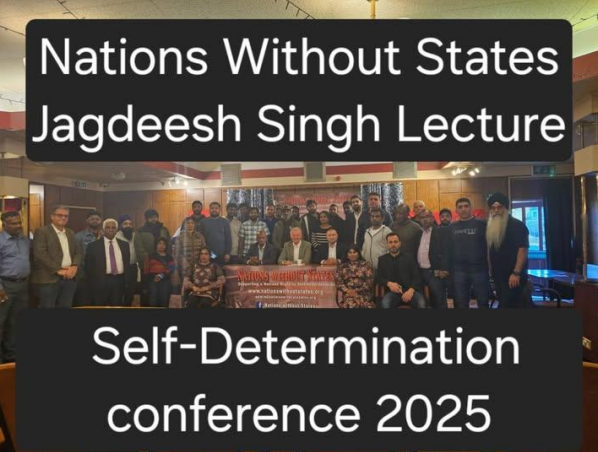
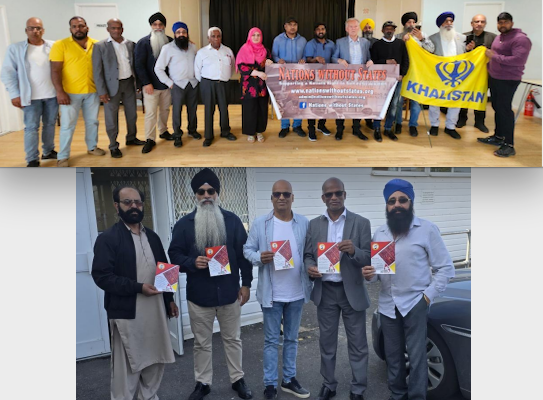
TWO DAYS AGO, Nations without States – NwS – held a very successful conference, in Slough, Berkshire.


Some of the speakers & delegates – representing different nations and peoples – at a recent ‘Self-Determination & Peace’ conference. Nations & peoples are rooted in positive aspects – such as ancestry, heritage and ethnicity. Therefore, self-determinists reject negative aspects, like colonialism, imperialism & forced migration (which are ultimately driven by capitalism) as well as all forms of hatred. True self-determinists are motivated by love & not hate.

The ‘Self-Determination & Peace’ conference was jointly organised with the New World Human Rights Watch & the Mustaqbill Foundation.

.
The meeting included speakers & delegates representing different nations & peoples including Ahwazi Arabs (from Iran), England, Kashmiris, Sikhs, & Tamils.
.
The meeting – which sought to promote the idea that self-determination is the only way to achieve peace – featured several speakers.
.
One of the most well-known was Dr. Sockalingham ‘Yogi’ Yogaligam, who is the President of Movement for Self-Determination of Tamil Eelam (MSDTE) & a Committee Member of Nations without States.
.
FUNDAMENTAL RIGHT TO SELF-DETERMINATION
.
Speaking specifically about the plight of the Tamils (of North & East of Sri Lanka) Yogi noted that their ‘fundamental right to self-determination has been denied, suppressed, and violently resisted.’
.
He continued by stressing that the ‘Tamil people of the island of Sri Lanka are a distinct nation.  We have our own language, our own homeland, our own historical consciousness.’
.
All those who support the concept of self-determination will know that a common language, homeland & historical consciousness form the building blocks of any nation. 
.
Nations & peoples are rooted in positive aspects – such as ancestry, heritage and ethnicity.  Therefore, self-determinists reject negative aspects, like colonialism, imperialism & forced migration (which are ultimately driven by capitalism) as well as all forms of hatred.
.
Echoing this theme (and once again using the plight of the Tamils as an example) Yogi stated that peace ‘must be built on truth, accountability, and recognition.  Recognition of the Tamil nation.  Recognition of our right to decide our future.  Recognition that reconciliation cannot be built on denial.’
. 
TRUTH IS ON OUR SIDE
.
He concluded by stressing that gaining self-determination can be a long and difficult journey.  However, ‘truth is on our side.  And truth, when pursued with determination and unity, cannot be extinguished’.
.
As we’ve previously noted, Yogi’s speech specifically related to the Tamils & their quest for nationhood.  It’s something that all self-determinists can relate to.  To illustrate this, the ‘Self-Determination & Peace’ conference was held in Berkshire, England.  Yet England is the only ‘Home Nation’ that isn’t self-governing!  (Scotland, Ulster & Wales all have their own assembly or parliament. Westminster, whilst located in England, is not an English parliament but a UK one.)
.
The meeting concluded by unanimously passing the following resolution:
.
‘We the attendees of Self-Determinist (SD) Conference in Slough 15/06/25 agree that the greatest contribution to Peace right now in the world is the peaceful implementation of SD everywhere e.g. a referendum on Khalistan (in India) and a plebiscite in Kashmir as mandated by the UN.’
 
Share:
  • Print
  • Digg
  • StumbleUpon
  • del.icio.us
  • Facebook
  • Yahoo! Buzz
  • Twitter
  • Google Bookmarks
  • Add to favorites
  • blogmarks
  • Blogosphere
  • Google Buzz
  • PDF
  • email
  • Live
  • MSN Reporter
  • MyShare
  • MySpace
  • Technorati
  • Webnews.de

Free from Brussels: Why Britain’s Working Class Must Forge Its Own Future

.

THE National Liberal Party has a longstanding policy of reprinting articles that represent a diverse range of opinion that may be of interest to our readers.  Some articles we agree with, others we disagree with.  But all are thought provoking.
 
So why do we do this? 
 
Firstly, we’re building a safe space for honest, open & respectful debate.  Secondly – and very importantly – we’re creating a culture of trying to understand where others & their ideas are coming from.  As the old saying goes: ‘Before we conform, or condemn, let us at least be curious.’
 
This latest article – Free from Brussels: Why Britain’s Working Class Must Forge Its Own Future – appeared towards the end of last month.
 
It was written by Paul Knaggs (pictured below) who is the editor & founder of Labour Heartlands.  It’s a ‘staunch left-wing’ online publication dedicated to free speech & ‘the immense value of vigorous debates and open dialogues in shaping well-informed opinions.’
 
We’d encourage all those who enjoy alternative & non-conformist points of view to read the article below.  You can find the original here: https://labourheartlands.com/free-from-brussels-why-britains-working-class-must-forge-its-own-future/
 
It goes without saying that there are no links between the National Liberal Party, Paul Knaggs or Labour Heartlands. 
.
.

REJOINING THE EU? NOT IF YOU CARE ABOUT BRITAIN’S WORKING CLASS

.
THE EU WAS never built for workers. It was designed by bankers, for bankers, with a rulebook written in the language of capital. Those pushing for a return to Brussels’ embrace, whether through Starmer’s “reset” or eventual ‘rejoin’, have conveniently forgotten that the loudest and most principled opposition to the European project once came from the democratic socialist tradition. Brexit Was a Working-Class Revolt Against the EU’s Neoliberal Empire.
.

THE WORKING CLASS VOTED OUT FOR A REASON

.
It wasn’t xenophobia or nostalgia that drove Brexit. It wasn’t racist pensioners or backward northerners who delivered Brexit, despite what metropolitan liberals claim. It was lived experience. The towns and cities that bore the brunt of deindustrialisation, where steelworks shut, pits closed, and factories vanished, voted Leave. These weren’t mindless protest votes. They were a clear-eyed rejection of a system that had gutted their communities while enriching London and Brussels.
.
For decades, the EU promised prosperity. What it delivered was stagnation, cheap labour undercutting wages, and a political class that told former engineers and miners to become coders or delivery drivers. These weren’t ignorant votes. They were calculated rejections of a system that had failed ordinary people for decades.
..
These communities understood what too many Remainers still refuse to admit: the EU helped write the script for Britain’s managed decline.

.

THE EU’S IRON CAGE OF NEOLIBERALISM

.
EU Fiscal Policy Of Austerity
.
Let’s be blunt: EU membership makes genuine socialist policy impossible. Its treaties and directives enshrine neoliberalism as constitutional law. Its core directives are designed to prevent exactly what Britain’s working class needs:
•  State aid rules make industrial revival through public ownership nearly impossible.

•  Competition law prevents governments from prioritising local and national businesses over multinationals

•  Fiscal rules like the Maastricht criteria force austerity, even in recession. Reducing public spending to 3% of GDP for government deficits and 60% of GDP for public debt. Set in the Stability and Growth Pact and enshrined in the EU Treaties

•  Free movement creates a race to the bottom for wages in many sectors, particularly the lower end

This isn’t theoretical. When French railway workers protested against privatisation, they were told EU rules required it. When Greece elected a left-wing government promising to end austerity, the EU crushed them. When Italy tried to rescue failing banks, EU state aid rules hampered them.

.

The EU is neoliberalism carved into constitutional stone, designed specifically to be beyond the reach of democratic change. It isn’t a neutral platform. It’s a fortress of market orthodoxy, purpose-built to prevent the kind of democratic economic planning Britain now desperately needs.
.

BRITAIN NEEDS INDUSTRIAL STRATEGY, NOT FREE TRADE

 
Nationalisation of the coal industry, January 1947
.
.
After decades of allowing the market to decide everything, Britain’s industrial base has been hollowed out. Nine of the ten poorest regions in Northern Europe are in the UK, a damning indictment of both EU membership and domestic policy failure.
.
What Britain needs isn’t Starmer’s craven crawl back to Brussels. It needs:
.
1.  A sovereign industrial strategy that rebuilds manufacturing in former industrial heartlands
.
2.  Public ownership of key utilities water, energy, and rail, without EU competition rules standing in the way

3.  Local and regional investment controlled by democratically accountable bodies, not distant EU commissioner

4.  Training and apprenticeships for British youth instead of importing skilled workers

5.  Immigration policies that serve national needs without undermining wages

6.  Migration policies that protect wages and integrate new arrivals fairly

.

7.  Skills and training for British youth, not endless reliance on imported labour
.

8.  Rebuilding manufacturing in the Midlands and North

.

None of this is possible inside the EU’s institutional straitjacket. EU rules are designed to prioritise cross-border capital flows over workers’ interests. Rules that prevent member states from doing precisely what Britain must now do.
.
.
Before Brexit became a culture war, the strongest EU critics came from the socialist Left. Tony Benn warned that the EU transferred power “from those you can elect to those you cannot remove.” Jeremy Corbyn voted against every EU treaty that came before Parliament. Peter Shore condemned the “bankers’ Europe” being built at democracy’s expense.
.

BUILDING SOMETHING BETTER

.
Leaving the EU wasn’t a leap into the unknown. It was a refusal to be ruled by a system that had already failed us.
.
What comes next should not be isolationist, but independent. Not reactionary, but regenerative. Not protectionism, but strategic trade. Not xenophobia, but a migration system that serves the British working class rather than undermining it.
.
Remaining outside the EU’s restrictive framework gives Britain the freedom to:
.
•  New manufacturing hubs in our former industrial heartland
.

•  A national investment strategy directed at levelling up beyond Westminster’s PR gimmicks

.

•  Implement regional development without Brussels approval
.
•  Protect strategic industries without violating competition law
.

•  Design trade deals that benefit workers, not just corporations

.

•  A second city built in the North to break the gravitational pull of London

.

•  Energy, transport, and infrastructure projects that create real jobs and renew pride in place

.

These ambitions are not just necessary, they’re now possible. But only outside the EU. We have the freedom to build an economy that works for the many, not the few, exactly what the establishment fears most.
.

THE GREEN CASE FOR MADE IN BRITAIN

.
Robber Barons Tariffs
.
There’s another powerful reason to rebuild our manufacturing base: the planet cannot sustain the insanity of global supply chains that ship everyday items thousands of miles for marginal cost savings.
.
The EU’s model of borderless trade isn’t just economically unsustainable, it’s environmentally catastrophic. Every plastic toy manufactured in Asia, every piece of furniture from Eastern Europe, every vegetable grown in Spain that could be grown here carries a carbon footprint that’s killing our future.
.
Brexit gives us the opportunity to build a genuinely green industrial strategy:
.

•  Localised production that slashes transport emissions and shipping pollution

.

•  Shorter supply chains that reduce vulnerability to global disruptions

.

•  Circular economy initiatives free from restrictive EU procurement rules
.

•  Strategic manufacturing of essential goods like medical supplies, energy components, and food

.

•  Regional specialisation based on local skills and resources rather than global race-to-the-bottom competition
.
We cannot be a nation of shopkeepers if the nation doesn’t make the goods to sell. The EU’s borderless market has turned Britain into a consumption economy dependent on imports and financial services, neither of which provides secure, well-paid jobs for working-class communities.
.
If Trump’s trade wars have taught us anything, it’s that a country needs not only to be sustainable but to sustain itself. Nations that cannot produce essential goods become subordinate to those that can. The globalist monster feeds on dependency, which is precisely what the EU’s model creates.
.
True environmental sustainability cannot be achieved through consumer guilt trips and carbon offsets. It requires fundamental restructuring of how and where we produce the things we need. Making what we use, close to where we use it, isn’t just common sense, it’s the only path to genuine sustainability.
.

BREXIT WAS JUST THE START:

THE CASE FOR A SOVEREIGN, SOCIALIST BRITAIN

.
.
As Starmer schemes in Brussels, Britain’s working class faces a clear choice: accept a gradual return to EU subordination, complete with its job-destroying neoliberalism, or demand a truly independent economic strategy that puts British workers first.
.
The EU offers nothing to the communities it already failed. It promises only more of the same: deindustrialisation dressed as progress, exploitation marketed as opportunity, and poverty rebranded as flexibility.
.
What Britain needs isn’t more empty rhetoric about “levelling up” or powerless metro mayors with fancy titles but no real funding. We need genuine transformation: roads, railways, and digital infrastructure fit for the 21st century. We need investment in the North that goes beyond London politicians’ photo opportunities and actually rebuilds communities gutted by decades of neglect.
.
This isn’t difficult, it just takes political will. Unfortunately, successive governments, Labour and Conservative alike, have found it impossible to think beyond the M25. Their vision extends only as far as the suburbs of the capital, while the rest of the country crumbles.
.
Why not build a new second city in the heart of our former industrial heartlands? Why not create manufacturing hubs that produce the goods we use, here in Britain, by British workers earning decent wages? Why not establish regional investment banks that put local development over London profits?
.
The EU’s rigid framework makes such ambition nearly impossible. Its state aid rules, competition law, and fiscal constraints are designed to prevent exactly this kind of transformative national investment. Breaking free from Brussels gives us the chance to rebuild Britain according to the needs of its people, not the demands of transnational capital.
.
Britain’s workers deserve better than to be sacrificed on the altar of European integration once again. They need a government that fights for them, not for the approval of unelected bureaucrats in Brussels.
.
The EU never worked for Britain’s working class. It’s time to build something that does.
Share:
  • Print
  • Digg
  • StumbleUpon
  • del.icio.us
  • Facebook
  • Yahoo! Buzz
  • Twitter
  • Google Bookmarks
  • Add to favorites
  • blogmarks
  • Blogosphere
  • Google Buzz
  • PDF
  • email
  • Live
  • MSN Reporter
  • MyShare
  • MySpace
  • Technorati
  • Webnews.de

The House Of Lords – Should It Stay Or Should It Go? Part 7

.

There are 650 seats in parliament. In the 2019 general election, the Conservative Party – under the leadership of Boris Johnson – won 43.6% of the vote. This gave them a majority of 80 seats. In the 2024 general election, Sir Keir Starmer’s Labour Party won 411 seats. This represented a massive 174-seat majority. To stop any government with a super majority bulldozing legislation through a series of checks & balances is required. But is the House of Lords up to the job?
Picture Credits:
Boris Johnson https://www.thelist.com /928949/boris-johnsons-former-staffer-reveals-gruesome-secrets-about-the-partygate-scandal/
Sir Keir Starmer Picture Credit: https://www.indy100.com/politics/keir-starmer-tuition-fees-university

WE FEEL that a majority of people would agree that there needs to be a series of checks & balances on the House of Commons.  This is particularly so when one party has such a majority that it can literally bulldoze legislation through.

.
However, many people believe that the body set up to run these checks & balances – the House of Lords – is a ‘controversial’ institution.
.
With the above in mind, we’ve been running a series of articles looking at the constitutional & historical reasons why the Lords was established as well as examining both the pros & cons of the institution itself.
.
‘CONTROVERSIAL’
.
So, why do some people believe that the House of Lords is controversial? There are many reasons – but most centre on issues relating to democracy, accountability, and tradition versus modernisation.
.
They include:
.
•  DEMOCRATIC LEGITIMACY.  Unlike the House of Commons, the members of the House of Lords are not elected by the public. Instead, many are appointed, or are given seats due to their status or contributions.
.
This raises concerns about whether it is fair or appropriate for unelected individuals to have a say in making or revising laws that affect everyone.
. 
•  INHERITED PRIVILEGE vs. MERITOCRACY. The presence of hereditary peers — those who inherit their seats — has been criticised as an outdated practice that favors privilege and family background over merit.
.
This debate often reflects broader philosophical questions about whether modern governance should be based on merit and expertise or tradition and inheritance.
. 
•  POTENTIAL FOR UNDERMINING DEMOCRACY. Some argue that having an unelected chamber with the power to amend or delay legislation passed by the elected House of Commons can undermine the will of the people and democratic accountability.
.
•  COST & EFFICIENCY. Critics also point to the financial cost of maintaining the House of Lords and question whether it is necessary in a modern democracy.
.
Some advocate for a unicameral (single-chamber) system, believing it would be more efficient and cost-effective.
.
•  ROLE & PURPOSE. While supporters say the House of Lords provides valuable expertise and a check on the elected government, its exact role and influence remain a topic of debate.
.
Proposals have included transforming it into an advisory council without legislative power or abolishing it altogether in favour of a single legislative chamber.
.
ABOLISH THE HOUSE OF LORDS?
.
Those who have concerns about the Lords tend to fall into two camps: Reformists and Abolitionists.
.
Last month we looked at the main proposals of those who want reform.  They included transforming the House of Lords into an elected Senate, creating an independent commission responsible for appointing non-partisan members of the upper chamber & gradually phasing out the hereditary peerage system.
.
PROPOSALS
.
We will now look at the proposals of those who want to completely abolish the House of Lords.  Here, there seems to be two main strands of thought:
.
•  ESTABLISH AN ADVISORY COUNCIL. One radical alternative is to transform the House of Lords into an advisory council with no legislative power.
.
This body would consist of experts, former politicians, and distinguished individuals who would provide advice and recommendations on proposed legislation.
.
While they would not have the power to amend or reject bills, their insights could inform debates in the House of Commons and enhance the quality of the legislative process.
.
Those who promote the idea of an advisory council believe that it could preserve the expertise and experience of the current House of Lords without undermining democratic accountability.
.
•  SINGLE LEGISLATIVE CHAMBER.  Some advocates argue for a unicameral system (1).  This would eliminate the need for an upper chamber altogether. Under this model, the House of Commons would become the sole legislative body, with all members elected by the public.
. 
Those who support this idea claim that it’ll streamline the legislative process, reduces costs, and ensure that all political power is derived directly from the electorate (as all members of the single chamber are typically elected by the public). This approach is seen as promoting more efficient governance and a straightforward democratic framework.
.
•  To be continued.
.
(1)  A unicameral system is a type of legislative structure in which there is only one legislative chamber or house. In this system, all legislative responsibilities—such as debating, amending, and passing laws—are carried out by a single body, rather than being divided between two separate chambers, as is the case with a bicameral system (like the UK Parliament’s House of Commons and House of Lords).
.
•  THIS ARTICLE should be read in conjunction with the following:
.
The House Of Lords – Should It Stay Or Should It Go? Part 1  https://nationalliberal.org/the-house-of-lords-should-it-stay-or-should-it-go-part-1
 
The House Of Lords – Should It Stay Or Should It Go? Part 2  https://nationalliberal.org/the-house-of-lords-should-it-stay-or-should-it-go-part-2
 
The House Of Lords – Should It Stay Or Should It Go? Part 3  https://nationalliberal.org/the-house-of-lords-should-it-stay-or-should-it-go-part-3
.
The House Of Lords – Should It Stay Or Should It Go? Part 4 https://nationalliberal.org/the-house-of-lords-should-it-stay-or-should-it-go-part-4
 
The House Of Lords – Should It Stay Or Should It Go? Part 5
https://nationalliberal.org/the-house-of-lords-should-it-stay-or-should-it-go-part-5
 
The House Of Lords – Should It Stay Or Should It Go? Part 6 https://nationalliberal.org/the-house-of-lords-should-it-stay-or-should-it-go-part-6
Share:
  • Print
  • Digg
  • StumbleUpon
  • del.icio.us
  • Facebook
  • Yahoo! Buzz
  • Twitter
  • Google Bookmarks
  • Add to favorites
  • blogmarks
  • Blogosphere
  • Google Buzz
  • PDF
  • email
  • Live
  • MSN Reporter
  • MyShare
  • MySpace
  • Technorati
  • Webnews.de

From The Liberty Wall – Nations without States – Nasser’s Grandson Warns Of US-Led Neocolonialism
NATIONS WITHOUT STATES recently came across this interesting article which featured on RT (Russia Today).  It takes the form of  an interview with Gamal Abdel Nasser Jr., who is the grandson of the former Egyptian President, Colonel Gamal Abdel Nasser (1918 – 1970).
 
As self-determinists we regard Colonel Nasser as an important ‘point of reference’.  By point of reference, we mean that he said (and did) things that we find of great interest.
 
He was an Arab Nationalist who had a deep & genuine love for – and loyalty to – his nation and people.  He promoted social justice & modernisation in Egypt & encouraged Arab unity.
 
He was also opposed to colonialism & imperialism (which are ultimately driven by capitalism). This brought him into conflict with Britain, France & Israel who wanted to redraw the map of the Middle East and bring about regime change in Egypt. 
 
Self-determinists believe that ‘what is right for me is right for you’.  Therefore, we’d encourage readers to carefully consider what Gamal Abdel Nasser Jr. says, particularly in respect of the globalist elites & the way they want to control the natural resources of the Middle East & Africa.
 
The original interview can be found here https://www.rt.com/africa/618119-us-neo-colonialism-africa/
& we invite readers to leave their comments on the National Liberal Party Facebook page here https://www.facebook.com/NationalLiberalParty or on the National Liberals Facebook page here https://www.facebook.com/groups/52739504313
 
It goes without saying that Nations without States understands that RT is a state-controlled media outlet.  To us, it’s effectively the Russian equivalent of the BBC.  It also goes without saying that there are no links between RT, Gamal Abdel Nasser Jr. & Nations without States.

From The Liberty Wall – Nations without States – Nasser’s Grandson Warns Of US-Led Neocolonialism

.

A new form of empire created by globalist elites continues to oppress Africa through sanctions, finance, and media, Gamal Abdel Nasser Jr. has told RT

.

The US has evolved from a former colony into a leading neocolonial power, Gamal Abdel Nasser Jr. has told RT.

Egyptian President, Colonel Gamal Abdel Nasser (top) & his grandson Gamal Abdel Nasser Jr. (below). President Nasser was an Arab Nationalist who loved his people & nation. He was opposed to colonialism & imperialism which brought him into conflict with Britain, France & Israel.
His grandson tells of how a new form of empire is being created by globalist elites who want control the natural resources of the Middle East & Africa.
(Picture credits: Colonel Gamal Abdel Nasser https://en.wikipedia.org/wiki/ Gamal_Abdel_Nasser#/media/File:Stevan_Kragujevic,_Gamal_Abdel_Naser_u_Beogradu,_1962.jpg Fair Use. Gamal Abdel Nasser Jr., https://www.rt.com/ africa/618119-us-neo-colonialism-africa/ Fair Use.)

.
In an exclusive interview ahead of International Africa Day, the grandson and namesake of Egypt’s second president and leader of the 1952 Revolution warned that today’s empires no longer rely on direct conflicts, but dominate through international institutions, sanctions, and economic control.
.
According to Nasser, the legacy of anti-colonial resistance must be revived in the face of modern Western domination, which disguises itself under terms like ‘progress’, ‘human rights’, and ‘globalization’.
.
”My grandfather shattered the myth that the West’s authority was absolute,” he said, recalling how the 1956 nationalization of the Suez Canal was not just about infrastructure, but about “reclaiming national dignity” and challenging imperial power. “He broke the mental monopoly that had long told our people they cannot resist… cannot rule their own destiny.”
.
He went on to say that “a new form of dominance” has returned through media, schools, and international institutions that dictate values and erase cultural heritage. He argued that today’s Western “globalist elites” have replaced the colonial powers by telling nations how to live, what to believe, and trying to “rewrite culture, biology, and morality.”
.
He stressed that the US – once a colony – has now inherited the role of imperial enforcer, particularly in the Middle East and Africa. Nasser accused Washington of using international policy, sanctions, and military operations to intimidate or replace those who have power to suit its own needs.
.
He went on to say that every recent US campaign in the region has been linked to natural resources, including in Iraq, Afghanistan, Libya, Syria, and Gaza, which US President Donald Trump recently suggested turning into a Middle Eastern Riviera under Washington’s control. According to Nasser, these are all examples of resource-driven agendas masked as humanitarian intervention.
.
”The notion that America could just own a sovereign territory further adds to the suspicion that there is a strong neocolonial tendency on the part of the US and its old colonial allies,” Nasser said, adding that this new Western “tyranny… will one day collapse.”
.
“The revolutionary spirit must rise again… A new generation is awakening, proud of their roots, unafraid to speak, and unafraid to think freely. The monopoly of minds, like the colonialism before it, will surely fall. And when it does, the world will remember that freedom begins with the courage to say no,” he stated.
Share:
  • Print
  • Digg
  • StumbleUpon
  • del.icio.us
  • Facebook
  • Yahoo! Buzz
  • Twitter
  • Google Bookmarks
  • Add to favorites
  • blogmarks
  • Blogosphere
  • Google Buzz
  • PDF
  • email
  • Live
  • MSN Reporter
  • MyShare
  • MySpace
  • Technorati
  • Webnews.de

G.D.H. Cole: His Life, Work, and Legacy


GEORGE Douglas Howard Cole (1889-1959) was an English Guild Socialist and an advocate for the co-operative movement. (Picture Credit: Free image from alchetron.com)

IT’S HARDLY a State Secret that National Liberals are interested in – and draw inspiration from – various alternative (and sometimes) non-conformist economic ideas.  These ideas include, but are not restricted to, the co-operative movement, distributism, guild socialism, sovereign money and syndicalism.

 
Over the years, we’ve featured many articles examining these ideas.  But we’ve not spent as much time looking at the people who’re credited with developing and/or promoting these ideas.
 
This is because we’re much more interested in ideas as opposed to personalities.  Indeed, our view is that the idea must always take precedence over those individuals who serve it.
 
On saying that, we’re always interested to know more about those who do serve the idea.  And it’s particularly useful to know if there’s anything in their background that would explain why they followed the path they did.
 
POINT OF REFERENCE
 
We refer to such people as a ‘Point of Reference’.  By this we mean that they’ve said or done something that we find of great interest.  (It should also be noted that one doesn’t even have to agree with a ‘Point of Reference’ to find that what they say or do is of great interest!)
 
However, it’s essential not to put anyone who is a ‘Point of Reference’ on a pedestal, so to speak. 
 
This is because we humans are incredibly complex beings.  It’s virtually impossible to think of anyone’s life (& ideas) in purely black & white terms.  We feel the vast majority are made up of many, many, shades of grey!  Thus, we must examine everyone in context, warts and all.
 
With the above in mind, for National Liberals one ‘Point of Reference’ has to be George Douglas Howard Cole, one of the earliest advocates of Guild Socialism (sometimes called Christian Socialism).
 
So, who was he, what was his life like & what were his influences?
 
George Douglas Howard Cole, commonly known as G.D.H. Cole, was an influential British political theorist, economist, historian, and a prominent figure in the cooperative and guild socialist movements.
Born on 25th September 1889 (and passing away on 14th January 1959) his diverse contributions have left an indelible mark on multiple disciplines and social movements.
 
EARLY LIFE & POLITICS
 
Cole was born into a family that valued education and intellectual pursuit. He attended St Paul’s School in London, where he excelled in his studies, particularly in the classics. He later attended Balliol College, Oxford, where he studied history.
During his time at Oxford, Cole became deeply interested in social and political issues. He joined the Fabian Society, which sought to advance its democratic socialist ideas via gradual and reformist approaches to socialism.
 
However, he soon became disillusioned with the Fabian approach and shifted towards guild socialism – sometimes called Christian Socialism – which was developed in 1906 by Samuel George Hobson (1870 – 4 January 1940).  Hobson’s guild socialism was a movement that emphasised the control of industries by workers organized in
(The original guilds were formed during the Middle Ages, around the late 10th century. They were associations of artisans and merchants who oversaw the practice of their trade in a particular area. Guilds were intended to protect the interests of their members through mutual aid, regulation of trade standards, and control over the quality of goods and services provided. They played a crucial role in the economic and social life of medieval towns and cities, often holding significant political influence.)
Cole’s advocacy for guild socialism was not just theoretical. He was actively involved in the cooperative movement and worked towards the establishment of workers’ control over production. His influential works, such as Self-Government in Industry 
https://archive.org/details/selfgovernmentin00coleuoft/page/n7/mode/2up – outlined his vision for a society organised around guild principles.
 
ACADEMIC CAREER
 
After World War I, Cole embarked on an academic career that saw him holding various positions at prestigious institutions. He became a fellow at University College, Oxford, and later a professor of social and political theory at the same institution. Cole’s academic work was extensive and covered a wide range of topics, including economics, history, political theory, and literature.
One of his most significant contributions was his work on the history of socialist thought. His multi-volume A History of Socialist Thought – https://archive.org/details/historyofsociali0000cole – remains one of the most important reference for scholars studying the development of socialist ideas and movements.
 
Cole’s economic theories were closely linked to his political beliefs. He was a critic of both capitalism and Soviet-style communism.  He advocated a ‘third way’ that combined elements of socialism and cooperative economics. These ideas influenced the development of the British Labour Party’s policies, particularly in the areas of social welfare and economic planning.
 
LITERATURE
 
In addition to his academic and political work, Cole was also a prolific writer of detective fiction. Alongside his wife, Margaret Cole, he authored over 30 mystery novels that were well-received by readers. Their collaborative works added a unique dimension to his already extensive intellectual portfolio
 
LEGACY & IMPACT
 
G.D.H. Cole’s legacy & impact is multifaceted.  He contributed to (and was particularly interested in) political theory, economics, history, and literature. His ideas on guild socialism, cooperative economics, and workers’ control continue to inspire scholars and activists – including, as we’ve previously noted, National Liberals.
It has been said that Cole’s commitment to social justice, democracy, and intellectual rigor serves as a model for those seeking to create a more equitable and just society.  As such, we think that the man & particularly his ideas are worthy of further study.
Share:
  • Print
  • Digg
  • StumbleUpon
  • del.icio.us
  • Facebook
  • Yahoo! Buzz
  • Twitter
  • Google Bookmarks
  • Add to favorites
  • blogmarks
  • Blogosphere
  • Google Buzz
  • PDF
  • email
  • Live
  • MSN Reporter
  • MyShare
  • MySpace
  • Technorati
  • Webnews.de

The House Of Lords – Should It Stay Or Should It Go? Part 6

.

Our picture shows the Chamber of the House of Lords which is dominated by the Royal Throne. It was designed by A.W. Pugin for ceremonial use, and – in particular – for the official opening of the House of Lords in April 1847.
Picture Credit: https://victorian-era.org/history-westminster-palace.html

OVER THE last few months, we’ve been looking at the existence & purpose of the House of Lords. 

 
We accept and understand why it was founded.  And that’s to provide a vital counterbalance to the House of Commons.  A series of checks and balances are a good idea when applied to many aspects of life (such as business and finance).  But this is particularly so of politics & especially when the government of the day has an overwhelming majority.

 
However, it’s clear that the mere existence of the House of Lords remains a bone of contention for many people.
 
SUPPORT THE HOUSE OF LORDS
 
We’ve previously examined the arguments those who support the House of Lords and its workings. 
 
In particular, they highlight the valuable role it plays in scrutinising legislation (which has previously been passed in the Commons).
However, they also acknowledge that the debate over whether to reform – or even abolish – the House of Lords often reflects broader philosophical discussions.  These discussions revolve around tradition versus modernisation and meritocracy versus aristocracy.
We feel that many of those who support the House of Lords as it stands are culturally very conservative (almost to the point of absurdity).  They favour tradition & aristocracy over everything else.
 
OPPOSE THE HOUSE OF LORDS
 
 We’ve also looked at the arguments of those who criticise & oppose the Lords. 
 
In a nutshell, they claim that it is an outdated and undemocratic institution.  In particular, they point to the presence of hereditary peers as evidence of elitism and inherited privilege.
 
With the above in mind, we now look at some of the potential reforms relating to the House of Lords:
 
Elected Senate.  One of the most proposed reforms is the creation of an elected Senate.  This would replace hereditary and appointed peers with elected representatives.  Supporters claim that this would ensure that the upper chamber has democratic legitimacy.
An elected Senate could be structured similarly to other bicameral systems (1) around the world.  Here, members could be elected via proportional representation (PR) or the current First Past The Post (FPRP) system.
Supporters claim that having elected representatives – as opposed to hereditary peers – would enhance accountability.  Additionally, the legislative process would be more reflective of the electorate’s will.
 
Non-Partisan Appointments.  Another popular alternative is to reform the appointment process for the upper chamber, focusing on non-partisan appointments.
This approach would involve creating an independent commission responsible for appointing members based on their expertise and contribution to society, rather than political affiliation.
The goal would be to retain the benefits of having knowledgeable and experienced individuals while eliminating the influence of political patronage and hereditary privilege.
Non-partisan appointments could ensure that the chamber remains a source of expert advice and thorough legislative scrutiny.
 
Reforming Hereditary Peerage.  Instead of abolishing the House of Lords entirely, some propose reforming the hereditary peerage system. This could involve gradually phasing out hereditary peers and replacing them with life peers or elected members.
Existing hereditary peers could be allowed to serve out their terms, but no new hereditary titles would be granted. This approach would mitigate the undemocratic aspects of inherited privilege while maintaining the institution’s historical continuity and tradition.
 
•  To be continued.
 
(1)  A bicameral system refers to a legislative body that is divided into two separate chambers or houses. Typically, these two chambers are known as the lower house and the upper house. Each chamber may have different responsibilities, powers, and methods for selecting its members. The term bicameral comes from the Latin words bi meaning ‘two’ and camera meaning ‘chamber.’
In countries with a bicameral legislature, the two houses work together to review, amend, and pass legislation. The intention is often to provide a system of checks and balances, ensuring that laws are carefully considered from different perspectives before becoming official.
For example, like the UK, the United States Congress is bicameral, comprising the House of Representatives and the Senate.
 
 
•  THIS ARTICLE should be read in conjunction with the following:
 
The House Of Lords – Should It Stay Or Should It Go? Part 1  https://nationalliberal.org/the-house-of-lords-should-it-stay-or-should-it-go-part-1
 
The House Of Lords – Should It Stay Or Should It Go? Part 2  https://nationalliberal.org/the-house-of-lords-should-it-stay-or-should-it-go-part-2
 
The House Of Lords – Should It Stay Or Should It Go? Part 3  https://nationalliberal.org/the-house-of-lords-should-it-stay-or-should-it-go-part-3
 
The House Of Lords – Should It Stay Or Should It Go? Part 4 https://nationalliberal.org/the-house-of-lords-should-it-stay-or-should-it-go-part-4
 
The House Of Lords – Should It Stay Or Should It Go? Part 5
https://nationalliberal.org/the-house-of-lords-should-it-stay-or-should-it-go-part-5
Share:
  • Print
  • Digg
  • StumbleUpon
  • del.icio.us
  • Facebook
  • Yahoo! Buzz
  • Twitter
  • Google Bookmarks
  • Add to favorites
  • blogmarks
  • Blogosphere
  • Google Buzz
  • PDF
  • email
  • Live
  • MSN Reporter
  • MyShare
  • MySpace
  • Technorati
  • Webnews.de

By continuing to use the site, you agree to the use of cookies. more information

The cookie settings on this website are set to "allow cookies" to give you the best browsing experience possible. If you continue to use this website without changing your cookie settings or you click "Accept" below then you are consenting to this.

Close