






Free Speech: How Do We Protect It? – Gab Turns 10: Ten Years of Free Speech and Building for the Future (Part 3)
.
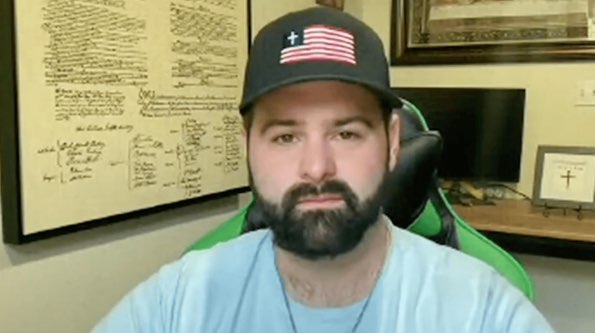
Andrew Torba – who describes himself as a Christian Nationalist – is the CEO of Gab News.
Picture Credit: https://www.vice.com/en/article/gab-andrew-torba-christian-nationalist/ (Fair Use)
OUR FRIENDS AT Free Speech: How Do We Protect It? have asked that we reproduce this article from Gab News, a US-based alternative social media platform that promotes free speech. They also asked that we produce it – https://news.gab.com/2026/08/
One reader – Brent Cheetham, a well-known free-speech advocate & NLP councillor for Cuffley, Hertfordshire – has already shared some thoughts, which we’ll also serialise from this article onwards. He has some general concerns about Gab News which ‘has been accused of promoting anti-Semitism & various conspiracy theories and describes itself as ‘Christian Nationalist’ – whatever that means, as no doubt many Christians would take issue with its contents.
It’s a site that does not endorse, in my view, liberal values. However, some of its comments about freedom of speech should be taken on board.’
We’d be interested in the views of other readers. Simply post them up when you see this article appear on the National Liberal Party Facebook site – https://www.facebook.com/
Readers who’re particularly interested in matters relating to free thought & free speech should read parts 1 https://nationalliberal.org/
It should also be noted that whilst Gab is a Christian organisation & Andrew Torba is a Christian Nationalist, both Free Speech: How Do We Protect It? and the NLP welcomes members & supporters from all religions and none. Also, it goes without saying that there are no links between Gab, Andrew Torba, Free Speech: How Do We Protect It? & the National Liberal Party. Please note that we’ve kept the original US spellings as they are.
.
Standing Firm Under Political Pressure
.
Gab has also faced extraordinary political scrutiny here at home. Following January 6, Gab became one of the technology platforms subjected to congressional scrutiny and demands for information, including from the January 6 Committee. The atmosphere surrounding that period was unlike anything we had previously experienced because technology platforms were increasingly being treated not simply as places where people communicated, but as institutions that could somehow be held politically responsible for the statements and actions of millions of independent users.
.
We rejected that premise because taken to its logical conclusion it makes genuinely open communication impossible. Gab did not organize January 6, nor did Gab control the actions of people in Washington. We operated a communications platform used by millions of individuals with different beliefs, motivations, backgrounds, and political opinions. If a platform becomes responsible for every statement made by every user, the only rational response for the platform is massive preemptive surveillance and censorship. The inevitable result is not a safer public square, but a digital environment where platforms aggressively suppress anything remotely controversial because permitting open discussion creates unacceptable political and legal risk.
.
That is precisely the Internet Gab was created to oppose. A genuinely free platform cannot exist if its operating principle is constantly asking what politicians, journalists, activist organizations, or government investigators might think about every conversation occurring on it. At some point you have to decide whether users are adults responsible for their own lawful speech or whether technology companies are expected to become private-sector speech police. For ten years, Gab has consistently chosen the former.
.
The COVID era demonstrated why these principles mattered in a way that few previous events had. Suddenly questions involving medicine, public policy, employment, education, religious liberty, and personal autonomy became deeply intertwined with online censorship. People were removed from platforms for questioning official claims, doctors and researchers found themselves punished or marginalized for presenting dissenting views, and families faced enormous pressure from employers, schools, universities, hospitals, and governments. Information that contradicted institutional consensus could be labeled dangerous before ordinary people were even permitted to evaluate it for themselves.
.
Gab remained open throughout that period, and our community used that freedom to share research, personal experiences, legal resources, religious exemption materials, and vaccine exemption documents that ultimately reached millions of people. For the families using those resources, these weren’t abstract arguments about content moderation. Their jobs, education, livelihoods, and ability to provide for their families were sometimes at stake. They needed somewhere to communicate with other people experiencing the same pressures and somewhere to access information that had become difficult to distribute through mainstream channels.
.
We did not believe then, and do not believe now, that unelected technology executives should determine which questions the public is permitted to ask about matters of enormous personal consequence. Scientific and public-policy disputes should be resolved through evidence, argument, scrutiny, and open debate rather than account suspensions and algorithmic suppression. Whatever someone thinks today about the specific disputes of that period, the broader lesson should be obvious: once we grant technology companies the authority to determine which side of a rapidly evolving public controversy is permitted to speak, we should not be surprised when that authority is eventually used against us.
.
When Elon Musk purchased Twitter, I knew that in many ways Gab Social’s original mission had been accomplished. Twitter, now X, is not perfect. Nothing ever is, and I don’t expect any platform run by human beings to be. But anyone who remembers what the Internet was like between 2016 and 2022 can see that the environment today is miles ahead of just how bad things had become. Ideas and conversations that would have resulted in immediate suspensions or algorithmic burial during that period are now discussed openly by millions of people, and the very concept of online censorship has become a mainstream political issue rather than something dismissed as a conspiracy theory.
.
Gab Social still has a dedicated and loyal community that I love, and Lord willing it will remain here for another decade and beyond. We built it to survive, and should widespread censorship return in the way we experienced during those years, Gab will still be standing as an independent home for free speech. I have no intention of abandoning that mission or the community that carried us through the darkest years of online censorship.
.
At the same time, leadership requires recognizing when the battlefield has moved. The censorship battle is not over, but the center of gravity is shifting away from social media and toward something that I believe will ultimately be far more influential on human minds than any social network ever was: artificial intelligence.
.
• To Be Continued.
.
• To find out more about Free Speech: How Do We Protect It? Check out their Facebook site here: https://www.facebook.com/


Date: October 11, 2026
Categories: Articles