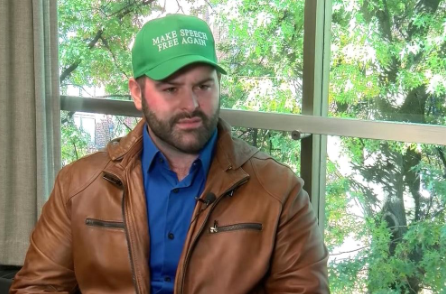
Andrew Torba, the CEO of Gab. Picture Credit: YouTube/PAHomepage.com (Fair Use)
TEN YEARS ago today Gab began with a simple conviction: ordinary people should be able to speak freely online without asking permission from governments, political activists, corporate gatekeepers, or a handful of unaccountable Silicon Valley executives. At the time that conviction seemed almost obvious. The Internet was still routinely described as this great decentralized force for human freedom, yet by 2016 it was becoming increasingly clear that the digital public square was consolidating in the hands of a small number of companies whose executives had tremendous power over what billions of people could say, see, share, and ultimately believe. Gab was our answer to that problem.
.
I don’t think any of us could have fully appreciated what the next ten years would bring. Gab has been banned from app stores, removed by hosting providers, cut off by payment processors, denied access to critical infrastructure, smeared relentlessly by the corporate press, targeted by activist organizations, dragged into congressional investigations, and pressured by governments both at home and abroad. There have been many moments when the conventional wisdom was that Gab was finished, and there were plenty of opportunities when surrendering would have been easier, safer, and probably much more profitable. We could have changed our rules, apologized to the right people, banned whoever we were told to ban, and slowly transformed ourselves into another sanitized corporate platform.
.
We chose to build instead and that decision has defined the first decade of Gab.
.
Gab’s history cannot be separated from deplatforming because deplatforming forced us to understand technological sovereignty years before most people were even thinking about it. In the early days of the Internet economy, the standard advice for building a technology company was to outsource practically everything that wasn’t your core product. You used somebody else’s cloud infrastructure, somebody else’s payment processor, somebody else’s app store, somebody else’s distribution network, and dozens of somebody else’s APIs and services. That model was efficient and convenient, but it contained an enormous hidden assumption: all of these supposedly neutral infrastructure providers would continue doing business with you.
.
We learned the hard way that this assumption was wrong. When companies decided they could remove Gab from their services because they disliked our mission, our users, or the speech taking place on our platform, we discovered that you don’t really control something when another company can shut it off with the flip of a switch. Free speech could not survive indefinitely on rented infrastructure controlled by people who were hostile to the very reason Gab existed, so we had to become more independent. We built systems ourselves, developed our own technology, established new relationships, eliminated dependencies where we could, and became more resilient with every attack.
.
Looking back, many of the things intended to destroy Gab ultimately made the company stronger. Every provider that abandoned us exposed another weakness we needed to address. Every coordinated pressure campaign taught us something about how technological power actually works. Every attempt to silence our community reinforced the importance of owning more of our infrastructure and reducing the number of institutions capable of exercising veto power over our existence. Out of those experiences emerged a principle that continues to shape everything we build today: never allow a single gatekeeper to become a single point of failure.
.
There is a fantastic recent essay called
The Closure of the Internet –
https://arctotherium.substack.com/p/the-closure-of-the-internet – that I encourage everyone to read because it documents, in extraordinary detail, the transformation we lived through during the years when Gab was fighting its hardest battles. The author traces how the Internet of the early 2010s where major platforms generally permitted almost anything lawful rapidly changed beginning around 2015 into an Internet governed by sprawling moderation systems, increasingly expansive definitions of “hate” and “misinformation,” pressure from governments and NGOs, demonetization, algorithmic suppression, and coordinated deplatforming.
.
Free speech is very easy to support when everyone agrees with what is being said. The principle becomes meaningful when speech is controversial, unpopular, politically inconvenient, offensive, or directed at people with enough power to make you suffer for permitting it. Gab has spent ten years living in that second category. We have defended the principle that lawful speech should remain free even when governments, journalists, activist organizations, corporations, and powerful interest groups demand otherwise, and doing so has come with tremendous costs.
.
We weren’t trying to build Twitter with a green logo. We were trying to demonstrate that Americans could still build institutions committed to the principle that free speech should not require ideological permission, and that mission inevitably meant accepting costs that companies without such a conviction would never tolerate.
.
• To Be Continued.