











National Liberal Trade Unionists – Marking The Centenary Of The 1926 UK General Strike (Part 1)
.
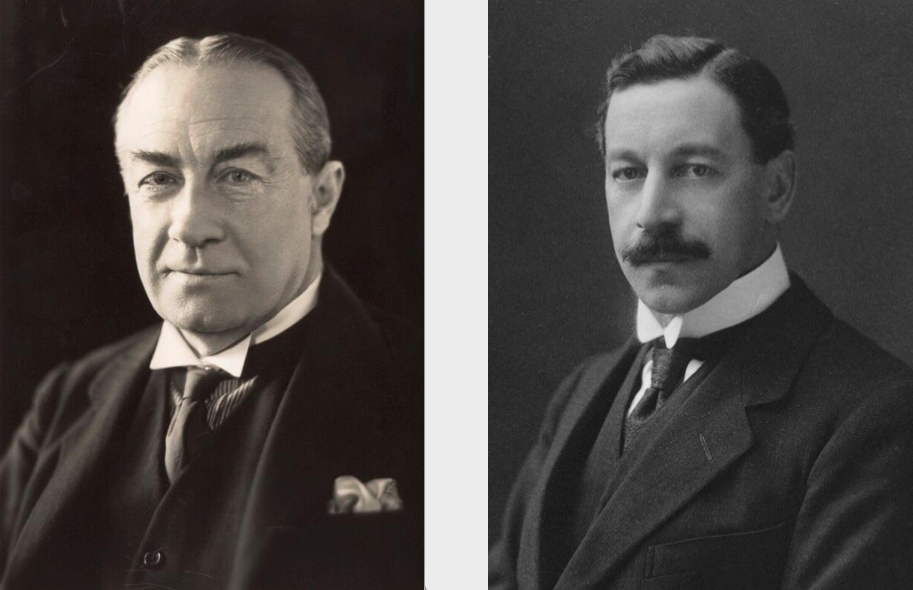
Stanley Baldwin (above left) was the Conservative Prime Minister during the period of the 1926 UK General Strike. Sir Herbert Samuel (above right) chaired the Royal Commission which looked into the coal industry.
Picture credits can be found under our article.
THE GENERAL STRIKE of 1926 was the only general strike in UK history. It took place from 4th to 12th May 1926 (nine days) and involved around 1.5 – 1.75 million workers. (However, it’s been estimated that – by the end of the strike – up to three million or more had downed tools in solidarity with the coal miners.)
.
The strike was called by the Trades Union Congress (TUC) in support of over a million coal miners who had been locked out by mine owners. Key sectors like transport, heavy industry, printing, docks, electricity, and gas joined the strike. It remains one of the largest coordinated labour-related actions in UK history.
.
BACKGROUND & CAUSES
.
So, what was the background to (and causes of) this massive & unprecedented industrial unrest? The strike originated in the declining British coal mining industry, which faced severe post-World War I challenges. They included:
.
-
WWI factor: During the war, coal mines operated at high intensity (often under government control). This depleted reserves while demand was artificially high.
-
Declining demand and exports: Post-war, Britain’s coal faced competition from oil and other fuels. For instance, the Royal Navy shifted from coal to oil. This reduced domestic demand. Coal exports had also fallen.
-
Foreign Competition: As we noted above, wartime production had depleted reserves, and intense foreign competition grew (from Germany, Poland, and the US). Cheaper coal from reparations deals (Germany supplied free coal to France and Italy under the Treaty of Versailles) was also available.
- Post-war slump: British mine owners were slow to modernise compared to competitors, and the industry was fragmented with many inefficient pits. The result was high unemployment with falling prices hitting the industry hard.
.
These factors led to lower production, falling prices, and profitability pressures. Mine owners sought to cut costs mainly by reducing wages and increasing working hours, while miners faced already tough conditions (dangerous work & poor pay).
.
During the war, the mines had been nationalised. However, they returned to private ownership in 1921. This only heightened tensions. Earlier disputes in 1921 and a near-strike in 1925 (sometimes known as ‘Red Friday’) showed how volatile the situation was.
.
1925 TENSIONS
.
As we noted earlier, the mine owners sought to reduce wages whilst instituting longer working hours. (They demanded longer working hours (from 7 to 8 hours) and significant pay cuts, varying by region.)
.
The government under Conservative Prime Minister Stanley Baldwin (1867 – 1947) provided a temporary nine-month subsidy to maintain wages and avoid an immediate strike.
.
A Royal Commission (Samuel Commission, chaired by Sir Herbert Samuel, who later became leader of the Liberal Party) was appointed to investigate the industry.
.
It reported in March 1926. It recommended reorganising the industry (via amalgamations), nationalising royalties, and — crucially — a 13–13.5% wage reduction plus ending the government subsidy. The Commission didn’t fully endorse owners’ demands but gave them leverage.
.
The mine owners, seemingly emboldened by the Samuel Commission, demanded significant pay cuts, an eight-hour day (up from seven), and district-level agreements (which could worsen variations). They rejected national negotiations.
.
WAGE REDUCTIONS & LONGER WORKING HOURS
.
It should come as no surprise that the Miners’ Federation of Great Britain (the forerunner to the National Union of Mineworkers – NUM) opposed the idea of wage reductions alongside longer working hours. Indeed, the MFGB coined the famous slogan “Not a penny off the pay, not a minute on the day.”
.
On 1st May 1926, owners locked out over one million miners when they refused the new terms. Negotiations between the TUC, government, and owners broke down (partly exacerbated by incidents like printers refusing to print an anti-strike article in the Daily Mail).
.
The Trades Union Congress (TUC), representing broader unions, supported the miners and called for a general strike in solidarity to begin at one minute to midnight on 3rd May.
.
THE STRIKE
.
The TUC viewed the miners’ fight as a test case for the broader labour movement. They called the strike not as a revolutionary move but to force the government to intervene and prevent wage cuts spreading across industries. It was framed as solidarity against an attack on workers’ living standards amid high unemployment and economic hardship in the 1920s.
.
TUC involvement saw many other key industrial sectors involved in the dispute. They included:
.
- Transport (railways, docks, road transport)
- Heavy industry (iron, steel, electricity, gas)
- Printing and other essential services
.
The strike brought much of Britain to a standstill: trains stopped, newspapers were limited, food deliveries delayed, and public services disrupted.
.
The strike remained peaceful overall, with no major violence. Indeed, strikers organising community efforts like volunteer services and football matches with police.
.
• In part 2 we will look at the government response & the overall impact of the strike.
.
Picture Credits:
.
Stanley Baldwin (Fair Use)
.
Sir Herbert Samuel (Fair Use)


Date: May 1, 2026
Categories: Articles