THIS IS the fifth and final part of a series entitled Trade Unionists Against Mass Immigration. It should be read directly on from part 1 http://nationalliberal.org/from-the-liberty-wall-–-national-liberal-trade-unionists-–-trade-unionists-against-mass-immigration-part-1 part 2 http://nationalliberal.org/from-the-liberty-wall-–-national-liberal-trade-unionists-–-trade-unionists-against-mass-immigration-part-2 part 3 http://nationalliberal.org/from-the-liberty-wall-–-national-liberal-trade-unionists-–-trade-unionists-against-mass-immigration-part-3 and part 4 http://nationalliberal.org/from-the-liberty-wall-–-national-liberal-trade-unionists-–-trade-unionists-against-mass-immigration-part-4 Originally called The Left Case Against Open Borders – https://americanaffairsjournal.org/2018/11/the-left-case-against-open-borders/– it was written by Angela Nagle for American Affairs, a ‘quarterly journal of public policy and political thought.’ Angela Nagle is a graduate from Dublin City University (DCU) in Éire.
As our name suggests, National Liberal Trade Unionists (NLTU) are not socialist trade unionists. But that doesn’t mean that we’re in favour of capitalism. Far from it! Indeed, we would describe ourselves as ‘neither capitalist nor socialist, neither left nor right.’ With this in mind, we’re interested in a variety of social & economic ideas such as Distributism, Guild Socialism, Social Credit, Syndicalism and Workers Co-Operatives to name just a few. We sincerely believe that a synthesis of these ideas would ensure freedom for all ordinary working folks.
The NLTU is opposed to mass immigration as we feel that it’s an exploitative event caused by capitalism. However, despite the NLTUs opposition to mass immigration we’ve nothing against individual immigrants simply because they wear a completely different style of clothing or pray to another God.
In Britain, mass immigration began in earnest in the years following WWII. Here, Afro-Caribbean, Asian and Eastern European folks have been used to plug holes in the British workforce. With Globalisation now in full swing, capitalism has responded and has imported huge numbers of people from the other side of the world to prop up its flagging economies. Whilst the capitalists may be happy with this, ordinary working folks are not. Massive population shifts have made existing economic & social problems much worse. Many areas suffer from great poverty – from the brutal Austerity policies of PIP and Universal Credit (which are destroying the welfare safety net) through to sink council estates that attract anti-social behaviour.
Angela Nagle’s article is important as it shows that some leftists are realising that it’s not ‘racist’ to want to restrict or limit immigration. The NLTU is weary of seeing middle class leftists carrying ‘refugees welcome here’ placards into poor working class areas. To add insult to injury, the middle-class left then tell locals that they’re all racists and fascists if they oppose the settlement of immigrants and/or refugees – all of which puts a further strain on the precious few resources available. Indeed, there’s nothing more galling than seeing ‘champagne socialists’ lecturing the most needy in society. By doing so, they’re unwittingly acting as recruiting sergeants for rightist organisations.
The NLTU might not agree with everything Angela Nagle writes. However, in the spirit of comradeship, free thought, free speech and open debate, we feature her article below. We invite our readers to share their thoughts when this article is reproduced on the NLTU Facebook site – https://www.facebook.com/groups/277840098977231/ – and the NLP Facebook site – https://www.facebook.com/NationalLiberalParty/ It goes without saying that there are no official links between Angela Nagle, American Affairs, the NLTU and the National Liberal Party. Please note that the NLTU has kept the original US spelling and phrases as they are.
.
The Left Case Against Open Borders – By Angela Nagle (Part 5)
Defending Immigrants, Opposing Systemic Exploitation
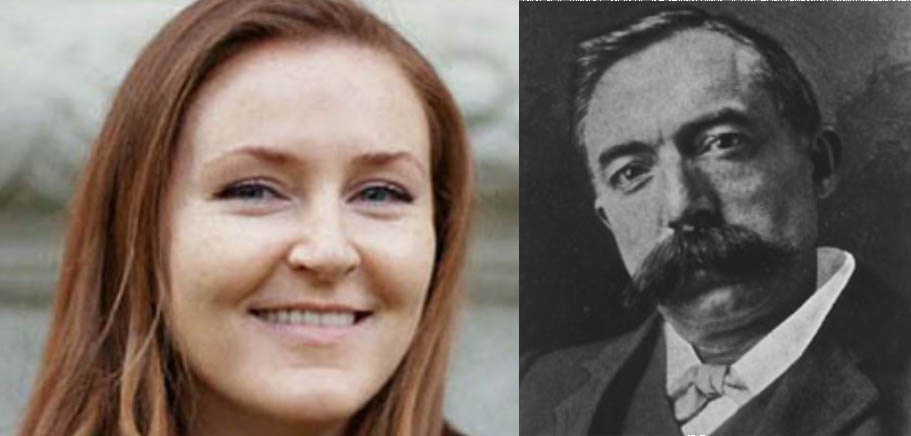
Angela Nagle (left) is a modern leftist who’s not afraid to talk about social & economic problems relating to immigration. In doing so, we believe that she follows in the footsteps of Robert ‘Bob’ Blatchford (1851 – 1943). Blatchford was a patriot, who described his ‘English’ Socialism thus: “English Socialism is not Marxian; it is humanitarian. It does not depend upon any theory of 'economic justice' but upon humanity and common sense." Blatchford founded and edited The Clarion, and wrote books such as Merrie England (1893) and Britain for the British ( 1902). The following quote from Blatchford gives a sense of his patriotic Socialism: “At present Britain does not belong to the British: it belongs to a few of the British who employ the bulk of the population as servants or as workers. It is because Britain does not belong to the British that a few are very rich and the many are very poor. It is because Britain does not belong to the British that we find amongst the owning class a state of useless luxury and pernicious idleness, and among the working classes a state of drudging toil, of wearing poverty and anxious care."
If open borders is “a Koch brothers proposal,” then what would an authentic Left position on immigration look like? In this case, instead of channeling Milton Friedman, the Left should take its bearings from its own long traditions. Progressives should focus on addressing the systemic exploitation at the root of mass migration rather than retreating to a shallow moralism that legitimates these exploitative forces. This does not mean that leftists should ignore injustices against immigrants. They should vigorously defend migrants against inhumane treatment. At the same time, any sincere Left must take a hard line against the corporate, financial, and other actors who create the desperate circumstances underlying mass migration (which, in turn, produces the populist reaction against it). Only a strong national Left in the small and developing nations—acting in concert with a Left committed to ending financialization and global labor exploitation in the larger economies—could have any hope of addressing these problems.
To begin with, the Left must stop citing the latest Cato Institute propaganda in order to ignore the effects of immigration on domestic labor, especially the working poor who are likely to suffer disproportionately from expanding the labor pool. Immigration policies should be designed to ensure that the bargaining power of workers is not significantly imperiled. This is especially true in times of wage stagnation, weak unions, and massive inequality.
With respect to illegal immigration, the Left should support efforts to make E-Verify mandatory and push for stiff penalties on employers who fail to comply. Employers, not immigrants, should be the primary focus of enforcement efforts. These employers take advantage of immigrants who lack ordinary legal protections in order to perpetuate a race to the bottom in wages while also evading payroll taxes and the provision of other benefits. Such incentives must be eliminated if any workers are to be treated fairly.
Trump infamously complained about people coming from third-world “shithole countries” and suggested Norwegians as an example of ideal immigrants. But Norwegians did once come to America in large numbers—when they were desperate and poor. Now that they have a prosperous and relatively egalitarian social democracy, built on public ownership of natural resources, they no longer want to (1). Ultimately, the motivation for mass migration will persist as long as the structural problems underlying it remain in place.
Reducing the tensions of mass migration thus requires improving the prospects of the world’s poor. Mass migration itself will not accomplish this: it creates a race to the bottom for workers in wealthy countries and a brain drain in poor ones. The only real solution is to correct the imbalances in the global economy, and radically restructure a system of globalization that was designed to benefit the wealthy at the expense of the poor. This involves, to start with, structural changes to trade policies that prevent necessary, state-led development in emerging economies. Anti-labor trade deals like nafta must also be opposed. It is equally necessary to take on a financial system that funnels capital away from the developing world and into inequality-heightening asset bubbles in rich countries. Finally, although the reckless foreign policies of the George W. Bush administration have been discredited, the temptation to engage in military crusades seems to live on. This should be opposed. U.S.-led foreign invasions have killed millions in the Middle East, created millions of refugees and migrants, and devastated fundamental infrastructure.
Marx’s argument that the English working class should see Irish nationhood as a potential compliment to their struggle, rather than as a threat to their identity, should resonate today, as we witness the rise of various identity movements around the world. The comforting delusion that immigrants come here because they love America is incredibly naïve—as naïve as suggesting that the nineteenth-century Irish immigrants Marx described loved England. Most migrants emigrate out of economic necessity, and the vast majority would prefer to have better opportunities at home, among their own family and friends. But such opportunities are impossible within the current shape of globalization.
Just like the situation Marx described in the England of his day, politicians like Trump rally their base by stirring up anti-immigration sentiment, but they rarely if ever address the structural exploitation—whether at home or abroad—that is the root cause of mass migration. Often, they make these problems worse, expanding the power of employers and capital against labor, while turning the rage of their supporters—often the victims of these forces—against other victims, immigrants. But for all Trump’s anti-immigration bluster, his administration has done virtually nothing to expand the implementation of E-Verify, preferring instead to boast about a border wall that never seems to materialize. While families are separated at the border, the administration has turned a blind eye toward employers who use immigrants as pawns in a game of labor shortage.
Meanwhile, members of the open-borders Left may try to convince themselves that they are adopting a radical position. But in practice they are just replacing the pursuit of economic equality with the politics of big business, masquerading as a virtuous identitarianism. America, still one of the richest countries in the world, should be able to provide not just full employment but a living wage for all of its people, including in jobs which open borders advocates claim “Americans won’t do.” Employers who exploit migrants for cheap labor illegally—at great risk to the migrants themselves—should be blamed, not the migrants who are simply doing what people have always done when facing economic adversity. By providing inadvertent cover for the ruling elite’s business interests, the Left risks a significant existential crisis, as more and more ordinary people defect to far-right parties. At this moment of crisis, the stakes are too high to keep getting it wrong.
This article originally appeared in American Affairs Volume II, Number 4 (Winter 2018): 17-30.
1 Krishnadev Calamur, “Why Norwegians Aren’t Moving to the U.S.,” Atlantic, Jan. 12, 2018.
2 Tracy Jan, “Trump Isn’t Pushing Hard for This One Popular Way to Curb Illegal Immigration,” Washington Post, May 22, 2018.
• ABOUT THE AUTHOR: Angela Nagle writes for the Atlantic, Jacobin, the Irish Times and the Baffler. She is the author of Kill All Normies: Online Culture Wars from 4chan and Tumblr to Trump and the Alt-Right (Zero Books, 2017).
• CHECK OUT THE National Liberal Trade Unionists (NLTU) here: https://www.facebook.com/groups/277840098977231/
• ALSO CHECK OUT issue 1 of Liberal Worker – Voice of the NLTU. To get hold of your FREE pdf copy, simply e-mail natliberal@aol.com