











Friday, 16 January 2026

Category » Articles

Devon Voice Debate (1) – Universal Basic Income For Devon? (Part 1)

DEVON VOICE – The Voice Of The National Liberal Party In Devon – is interested in creating a more just society based on the three principle of self-determination – National self-determination, Political self-determination and Economic self-determination

.

With the principle of Economic self-determination in mind, we’ve reproduced an article by
Brian Bergstein from
MIT Technology Review – see the original here
https://www.technologyreview.com/s/611418/basic-income-could-work-if-you-do-it-canada-style/
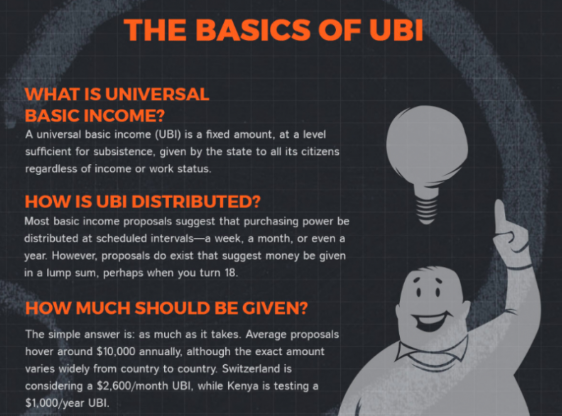
which looks at the introduction of a trial system of Universal Basic Income in Lindsay, Ontario, Canada. The Universal Basic Income (UBI) is generally understood to be a guarantee from the government that each citizen receives a minimum income which is enough to cover the basic cost of living. The UBI is also designed to provide financial security – particularly in the not-to-distant future where it can offset job losses caused by technology.


Originally called Basic Income Could Work – If You Do It Canada-Style, we’re reproducing it as Devon Voice is interested in alternative social & economic ideas such as Distributism and Social Credit. An important element of Social Credit is to match consumption to production via the issue of the National Dividend – new money which would be created and distributed by the government as purchasing power to the whole population. Put simply, this answers the age old question of what’s the point of producing goods and/or providing services if they cannot be bought or used? Whilst the Universal Basic Income and the National Dividend are not exactly the same, there are obvious similarities.


As always, debate is free with Devon Voice & the NLP. Therefore, we’d appreciate your views on this article (and the idea of Devon introducing the UBI) when it appears on either the National Liberals Facebook site – https://www.facebook.com/groups/52739504313/ – or the National Liberal Party Facebook site – https://www.facebook.com/NationalLiberalParty/ – It goes without saying that there are no official links between Brian Bergstein, MIT Technology Review, Devon Voice and the National Liberal Party. Please note that the NLTU has kept the original North American spelling and phrases as they are.

.

Basic Income Could Work – If You Do It Canada-Style (Part 1)

A Canadian province is giving people money with no strings attached – revealing both the appeal and the limitations of the idea.
Fresh Produce

MAJOR CH Douglas (left) developed the idea of Social Credit, which sought to disperse economic and political power to individuals. This would ensure absolute economic security for all. Devon Voice (right) hopes to explore Social Credit ideas – which offer an alternative to both capitalism and socialism – in future issues.

DANA BOWMAN, 56, expresses gratitude for fresh produce at least 10 times in the hour and a half we’re having coffee on a frigid spring day in Lindsay, Ontario. Over the many years she scraped by on government disability payments, she tended to stick to frozen vegetables. She’d also save by visiting a food bank or buying marked-down items near or past their sell-by date.

But since December, Bowman has felt secure enough to buy fresh fruit and vegetables. She’s freer, she says, to “do what nanas do” for her grandchildren, like having all four of them over for turkey on Easter. Now that she can afford the transportation, she might start taking classes in social work in a nearby city. She feels happier and
healthier—and, she says, so do many other people in her subsidized apartment building and around town. “I’m seeing people smiling and seeing people friendlier, saying hi more,” she says.

Jim Garbutt sees moods brightening, too, at A Buy & Sell Shop, a store he and his wife run on Lindsay’s main street. Sales are brisker for most of what they sell: used furniture, kitchen items, novelties. A Buy & Sell Shop is the kind of place where people come in just to chat—“we’re like Cheers, without the alcohol,” Garbutt says—and more and more people seem hopeful. “Spirits are up,” he says.

What changed? Lindsay, a compact rectangle amid the lakes northeast of Toronto, is at the heart of one of the world’s biggest tests of a guaranteed basic income. In a three-year pilot funded by the provincial government, about 4,000 people in Ontario are getting monthly stipends to boost them to at least 75 percent of the poverty line. That translates to a minimum annual income of $17,000 in Canadian dollars (about $13,000 US) for single people, $24,000 for married couples. Lindsay has about half the people in the pilot—some 10 percent of the town’s population.

The trial is expected to cost $50 million a year in Canadian dollars; expanding it to all of Canada would cost an estimated $43 billion annually. But Hugh Segal, the conservative former senator who designed the test, thinks it could save the government money in the long run. He expects it to streamline the benefits system, remove rules that discourage people from working, and reduce crime, bad health, and other costly problems that stem from poverty. Such improvements occurred during a basic-income test in Manitoba in the 1970s.

People far beyond Canada will be watching closely, too, because a basic income has become Silicon Valley’s favorite answer to the question of how society should deal with the massive automation of jobs. Tech investors such as Facebook cofounder Chris Hughes and Sam Altman, president of the startup incubator Y Combinator, are funding pilot projects to examine what people do when they get money with no strings attached. Hughes’s Economic Security Project will pay for 100 people in Stockton, California, to get $500 a month for 18 months. Y Combinator ran a small-scale test in Oakland, California, last year; beginning in 2019 it will give $1,000 a month to 1,000 people over three to five years, in locations still to be determined.

This momentum figures to keep building as AI and robotics make even more inroads. Legislators in Hawaii are beginning to study the prospects for a basic income. The lawmaker who has led the effort, Democrat Chris Lee, worries that self-driving cars and automated retail checkout could be the beginning of the end for a lot of human labor in Hawaii’s service-based economy. If machines can handle tasks in tourism and hospitality, Lee says, “there is no fallback industry for jobs to be created in.”

But there’s an important difference between that vision for a basic income and the experiment in Ontario. The Canadians are testing it as an efficient antipoverty mechanism, a way to give a relatively small segment of the population more flexibility to find work and to strengthen other strands of the safety net. That’s not what Silicon Valley seems to imagine, which is a universal basic income that placates broad swaths of the population. The most obvious problem with that idea? Math. Many economists concluded long ago that it would be too expensive, especially when compared with the cost of programs to create new jobs and train people for them. That’s why the idea didn’t take off after tests in the 1960s and ’70s. It’s largely why Finland decided not to extend a small basic income trial.

If any place can illuminate both the advantages of basic income and the problems it can’t solve, it will be Lindsay. The town is prosperous by some measures, with a median household income of $55,000 and a historic downtown district where new condos and a craft brewery are on the way. But that masks how tough it is for a lot of people to get by. Manufacturing in the surrounding area, known as the Kawartha Lakes, has declined since the 1980s. Many people juggle multiple jobs, including seasonal work tied to tourism in the summer and fall. Technology is part of the story too: robots milk cows now.

• ALSO CHECK OUT Caledonian Voice Debate (1) – Universal Basic Income For Scotland? http://nationalliberal.org/caledonian-voice-debate-1-universal-basic-income-for-scotland

Share:
  • Print
  • Digg
  • StumbleUpon
  • del.icio.us
  • Facebook
  • Yahoo! Buzz
  • Twitter
  • Google Bookmarks
  • Add to favorites
  • blogmarks
  • Blogosphere
  • Google Buzz
  • PDF
  • email
  • Live
  • MSN Reporter
  • MyShare
  • MySpace
  • Technorati
  • Webnews.de

Bedfordshire Says … English Parliament Now!

Share:
  • Print
  • Digg
  • StumbleUpon
  • del.icio.us
  • Facebook
  • Yahoo! Buzz
  • Twitter
  • Google Bookmarks
  • Add to favorites
  • blogmarks
  • Blogosphere
  • Google Buzz
  • PDF
  • email
  • Live
  • MSN Reporter
  • MyShare
  • MySpace
  • Technorati
  • Webnews.de

From The Liberty Wall – National Liberal Trade Unionists – Trade Unionists Against Mass Immigration (Part 5)

THIS IS the fifth and final part of a series entitled Trade Unionists Against Mass Immigration. It should be read directly on from part 1 http://nationalliberal.org/from-the-liberty-wall-–-national-liberal-trade-unionists-–-trade-unionists-against-mass-immigration-part-1 part 2 http://nationalliberal.org/from-the-liberty-wall-–-national-liberal-trade-unionists-–-trade-unionists-against-mass-immigration-part-2 part 3 http://nationalliberal.org/from-the-liberty-wall-–-national-liberal-trade-unionists-–-trade-unionists-against-mass-immigration-part-3 and part 4 http://nationalliberal.org/from-the-liberty-wall-–-national-liberal-trade-unionists-–-trade-unionists-against-mass-immigration-part-4 Originally called The Left Case Against Open Borders https://americanaffairsjournal.org/2018/11/the-left-case-against-open-borders/– it was written by Angela Nagle for American Affairs, a ‘quarterly journal of public policy and political thought.’ Angela Nagle is a graduate from Dublin City University (DCU) in Éire.


As our name suggests, National Liberal Trade Unionists (NLTU) are not socialist trade unionists. But that doesn’t mean that we’re in favour of capitalism. Far from it! Indeed, we would describe ourselves as ‘neither capitalist nor socialist, neither left nor right.’ With this in mind, we’re interested in a variety of social & economic ideas such as Distributism, Guild Socialism, Social Credit, Syndicalism and Workers Co-Operatives to name just a few. We sincerely believe that a synthesis of these ideas would ensure freedom for all ordinary working folks.


The NLTU is opposed to mass immigration as we feel that it’s an exploitative event caused by capitalism. However, despite the NLTUs opposition to mass immigration we’ve nothing against individual immigrants simply because they wear a completely different style of clothing or pray to another God.

In Britain, mass immigration began in earnest in the years following WWII. Here, Afro-Caribbean, Asian and Eastern European folks have been used to plug holes in the British workforce. With Globalisation now in full swing, capitalism has responded and has imported huge numbers of people from the other side of the world to prop up its flagging economies. Whilst the capitalists may be happy with this, ordinary working folks are not. Massive population shifts have made existing economic & social problems much worse. Many areas suffer from great poverty – from the brutal Austerity policies of PIP and Universal Credit (which are destroying the welfare safety net) through to sink council estates that attract anti-social behaviour.


Angela Nagle’s article is important as it shows that some leftists are realising that it’s not ‘racist’ to want to restrict or limit immigration. The NLTU is weary of seeing middle class leftists carrying ‘refugees welcome here’ placards into poor working class areas. To add insult to injury, the middle-class left then tell locals that they’re all racists and fascists if they oppose the settlement of immigrants and/or refugees – all of which puts a further strain on the precious few resources available. Indeed, there’s nothing more galling than seeing ‘champagne socialists’ lecturing the most needy in society. By doing so, they’re unwittingly acting as recruiting sergeants for rightist organisations.


The NLTU might not agree with everything Angela Nagle writes. However, in the spirit of comradeship, free thought, free speech and open debate, we feature her article below. We invite our readers to share their thoughts when this article is reproduced on the NLTU Facebook site – https://www.facebook.com/groups/277840098977231/ – and the NLP Facebook site – https://www.facebook.com/NationalLiberalParty/ It goes without saying that there are no official links between Angela Nagle, American Affairs, the NLTU and the National Liberal Party. Please note that the NLTU has kept the original US spelling and phrases as they are.

.

The Left Case Against Open Borders – By Angela Nagle (Part 5)

Defending Immigrants, Opposing Systemic Exploitation

Angela Nagle (left) is a modern leftist who’s not afraid to talk about social & economic problems relating to immigration. In doing so, we believe that she follows in the footsteps of Robert ‘Bob’ Blatchford (1851 – 1943). Blatchford was a patriot, who described his ‘English’ Socialism thus: “English Socialism is not Marxian; it is humanitarian. It does not depend upon any theory of 'economic justice' but upon humanity and common sense." Blatchford founded and edited The Clarion, and wrote books such as Merrie England (1893) and Britain for the British ( 1902). The following quote from Blatchford gives a sense of his patriotic Socialism: “At present Britain does not belong to the British: it belongs to a few of the British who employ the bulk of the population as servants or as workers. It is because Britain does not belong to the British that a few are very rich and the many are very poor. It is because Britain does not belong to the British that we find amongst the owning class a state of useless luxury and pernicious idleness, and among the working classes a state of drudging toil, of wearing poverty and anxious care."

If open borders is “a Koch brothers proposal,” then what would an authentic Left position on immigration look like? In this case, instead of channeling Milton Friedman, the Left should take its bearings from its own long traditions. Progressives should focus on addressing the systemic exploitation at the root of mass migration rather than retreating to a shallow moralism that legitimates these exploitative forces. This does not mean that leftists should ignore injustices against immigrants. They should vigorously defend migrants against inhumane treatment. At the same time, any sincere Left must take a hard line against the corporate, financial, and other actors who create the desperate circumstances underlying mass migration (which, in turn, produces the populist reaction against it). Only a strong national Left in the small and developing nations—acting in concert with a Left committed to ending financialization and global labor exploitation in the larger economies—could have any hope of addressing these problems.


To begin with, the Left must stop citing the latest Cato Institute propaganda in order to ignore the effects of immigration on domestic labor, especially the working poor who are likely to suffer disproportionately from expanding the labor pool. Immigration policies should be designed to ensure that the bargaining power of workers is not significantly imperiled. This is especially true in times of wage stagnation, weak unions, and massive inequality.


With respect to illegal immigration, the Left should support efforts to make E-Verify mandatory and push for stiff penalties on employers who fail to comply. Employers, not immigrants, should be the primary focus of enforcement efforts. These employers take advantage of immigrants who lack ordinary legal protections in order to perpetuate a race to the bottom in wages while also evading payroll taxes and the provision of other benefits. Such incentives must be eliminated if any workers are to be treated fairly.


Trump infamously complained about people coming from third-world “shithole countries” and suggested Norwegians as an example of ideal immigrants. But Norwegians did once come to America in large numbers—when they were desperate and poor. Now that they have a prosperous and relatively egalitarian social democracy, built on public ownership of natural resources, they no longer want to (1). Ultimately, the motivation for mass migration will persist as long as the structural problems underlying it remain in place.


Reducing the tensions of mass migration thus requires improving the prospects of the world’s poor. Mass migration itself will not accomplish this: it creates a race to the bottom for workers in wealthy countries and a brain drain in poor ones. The only real solution is to correct the imbalances in the global economy, and radically restructure a system of globalization that was designed to benefit the wealthy at the expense of the poor. This involves, to start with, structural changes to trade policies that prevent necessary, state-led development in emerging economies. Anti-labor trade deals like nafta must also be opposed. It is equally necessary to take on a financial system that funnels capital away from the developing world and into inequality-heightening asset bubbles in rich countries. Finally, although the reckless foreign policies of the George W. Bush administration have been discredited, the temptation to engage in military crusades seems to live on. This should be opposed. U.S.-led foreign invasions have killed millions in the Middle East, created millions of refugees and migrants, and devastated fundamental infrastructure.


Marx’s argument that the English working class should see Irish nationhood as a potential compliment to their struggle, rather than as a threat to their identity, should resonate today, as we witness the rise of various identity movements around the world. The comforting delusion that immigrants come here because they love America is incredibly naïve—as naïve as suggesting that the nineteenth-century Irish immigrants Marx described loved England. Most migrants emigrate out of economic necessity, and the vast majority would prefer to have better opportunities at home, among their own family and friends. But such opportunities are impossible within the current shape of globalization.


Just like the situation Marx described in the England of his day, politicians like Trump rally their base by stirring up anti-immigration sentiment, but they rarely if ever address the structural exploitation—whether at home or abroad—that is the root cause of mass migration. Often, they make these problems worse, expanding the power of employers and capital against labor, while turning the rage of their supporters—often the victims of these forces—against other victims, immigrants. But for all Trump’s anti-immigration bluster, his administration has done virtually nothing to expand the implementation of E-Verify, preferring instead to boast about a border wall that never seems to materialize. While families are separated at the border, the administration has turned a blind eye toward employers who use immigrants as pawns in a game of labor shortage.


Meanwhile, members of the open-borders Left may try to convince themselves that they are adopting a radical position. But in practice they are just replacing the pursuit of economic equality with the politics of big business, masquerading as a virtuous identitarianism. America, still one of the richest countries in the world, should be able to provide not just full employment but a living wage for all of its people, including in jobs which open borders advocates claim “Americans won’t do.” Employers who exploit migrants for cheap labor illegally—at great risk to the migrants themselves—should be blamed, not the migrants who are simply doing what people have always done when facing economic adversity. By providing inadvertent cover for the ruling elite’s business interests, the Left risks a significant existential crisis, as more and more ordinary people defect to far-right parties. At this moment of crisis, the stakes are too high to keep getting it wrong.


This article originally appeared in American Affairs Volume II, Number 4 (Winter 2018): 17-30.


1 Krishnadev Calamur, “Why Norwegians Aren’t Moving to the U.S.,” Atlantic, Jan. 12, 2018.

2 Tracy Jan, “Trump Isn’t Pushing Hard for This One Popular Way to Curb Illegal Immigration,” Washington Post, May 22, 2018.

• ABOUT THE AUTHOR: Angela Nagle writes for the Atlantic, Jacobin, the Irish Times and the Baffler. She is the author of Kill All Normies: Online Culture Wars from 4chan and Tumblr to Trump and the Alt-Right (Zero Books, 2017).

• CHECK OUT THE National Liberal Trade Unionists (NLTU) here: https://www.facebook.com/groups/277840098977231/

• ALSO CHECK OUT issue 1 of Liberal Worker – Voice of the NLTU. To get hold of your FREE pdf copy, simply e-mail natliberal@aol.com

Share:
  • Print
  • Digg
  • StumbleUpon
  • del.icio.us
  • Facebook
  • Yahoo! Buzz
  • Twitter
  • Google Bookmarks
  • Add to favorites
  • blogmarks
  • Blogosphere
  • Google Buzz
  • PDF
  • email
  • Live
  • MSN Reporter
  • MyShare
  • MySpace
  • Technorati
  • Webnews.de

Liberty & Nation Says Wherever You Live – Support Local Self-Employed Workers This Summer!

Share:
  • Print
  • Digg
  • StumbleUpon
  • del.icio.us
  • Facebook
  • Yahoo! Buzz
  • Twitter
  • Google Bookmarks
  • Add to favorites
  • blogmarks
  • Blogosphere
  • Google Buzz
  • PDF
  • email
  • Live
  • MSN Reporter
  • MyShare
  • MySpace
  • Technorati
  • Webnews.de

Liberty & Nation Says Wherever You Live – Shop Local This Summer!

Share:
  • Print
  • Digg
  • StumbleUpon
  • del.icio.us
  • Facebook
  • Yahoo! Buzz
  • Twitter
  • Google Bookmarks
  • Add to favorites
  • blogmarks
  • Blogosphere
  • Google Buzz
  • PDF
  • email
  • Live
  • MSN Reporter
  • MyShare
  • MySpace
  • Technorati
  • Webnews.de

From The Liberty Wall – National Liberal Trade Unionists – Trade Unionists Against Mass Immigration (Part 4)
THIS IS the fourth part of a series entitled Trade Unionists Against Mass Immigration. It should be read directly on from part 1 http://nationalliberal.org/from-the-liberty-wall-–-national-liberal-trade-unionists-–-trade-unionists-against-mass-immigration-part-1 part 2 http://nationalliberal.org/from-the-liberty-wall-–-national-liberal-trade-unionists-–-trade-unionists-against-mass-immigration-part-2 and part 3 http://nationalliberal.org/from-the-liberty-wall-–-national-liberal-trade-unionists-–-trade-unionists-against-mass-immigration-part-3 Originally called The Left Case Against Open Borders https://americanaffairsjournal.org/2018/11/the-left-case-against-open-borders/– it was written by Angela Nagle for American Affairs, a ‘quarterly journal of public policy and political thought.’ Angela Nagle is a graduate from Dublin City University (DCU) in Éire.

We feel that it’s important to stress that the NLTU is not a socialist trade union. But that doesn’t mean that we’re in favour of capitalism – in fact, we hate it with a vengeance! We are interested in (and promote) social and economic ideas like distributism and social credit which are neither capitalist or socialist. Indeed, we feel that capitalism and socialism are merely different sides of the same coin. National Liberal Trade Unionists are interested in distributism and social credit as they go way beyond capitalism and socialism. We seek economic self-determination, personal sovereignty and individual liberty for everyone. We’re not in favour of either big business or big business micro-managing how we lead our lives – and that includes what we can think and say. In short, we want freedom.

The NLTU might not agree with everything Angela Nagle writes. However, in the spirit of comradeship, free thought, free speech and open debate, we feature her article below. We invite our readers to share their thoughts when this article is reproduced on the NLTU Facebook site – https://www.facebook.com/groups/277840098977231/ – and the NLP Facebook site – https://www.facebook.com/NationalLiberalParty/ It goes without saying that there are no official links between Angela Nagle, American Affairs, the NLTU and the National Liberal Party. Please note that the NLTU has kept the original US spelling and phrases as they are.

.

The Left Case Against Open Borders – By Angela Nagle (Part 4)

Corporate Interests and Moral Blackmail

Angela Nagle (left) notes that the policy of open borders has no public mandate. And as the poster (right) clearly suggests, National Liberal Trade Unionists blames the capitalist system (and its agents of whatever political hue) for Britain’s social and economic problems. It cannot be stressed enough that the NLTU is bitterly opposed to the system of exploitation known as mass immigration. However, we’re not opposed to individual immigrant workers as both they - and indigenous workers - are being used as mere pawns in a game. The name of the game is excessive profit and immigrants are simply being used to plug holes in an increasingly ageing workforce. They’re increasingly becoming the new wage slaves and tax payers whose only real job is to keep the elites in the style they’ve been accustomed to. With this in mind, we oppose all forms of exploitation and hatred whereby ones race, ethnicity, nationality or religion is used to pit one worker against the other. Once again, the NLTUs anger is directed against the capitalist system and not immigrants themselves.

Open borders has no public mandate, but immigration policies that place the burden of enforcement on employers instead of migrants do attract overwhelming support. According to a survey by the Washington Post and ABC News, support for mandating use of the federal employment verification system (E-Verify), which would prevent employers from exploiting illegal labor, is at nearly 80 percent—more than double the support for building a wall along the Mexican border (1). So why do presidential campaigns revolve around building a vast border wall? Why do current migration debates revolve around controversial ICE tactics to target migrants—especially when the more humane and popular method of placing the burden on employers to hire legal labor in the first place is also the most effective? (2) The answer, in short, is that business lobbies have been blocking and sabotaging efforts like E-Verify for decades, while the open-borders Left has abandoned any serious discussion of these issues.


Recently, the Western Growers Association and California Farm Bureau Federation, among others, blocked a bill that would have made E-Verify mandatory, despite several pro-business concessions (3). Democrats seemed totally absent from this debate. As a result, workers from economies devastated by U.S. agriculture will continue to be invited in with the promise of work in order to be cheaply and illegally exploited. Lacking full legal rights, these noncitizens will be impossible to unionize and will be kept in constant fear of being arrested and criminalized.

It has now become a common slogan among advocates of open borders—and many mainstream commentators—that “there is no migrant crisis.” But whether they like it or not, radically transformative levels of mass migration are unpopular across every section of society and throughout the world. And the people among whom it is unpopular, the citizenry, have the right to vote. Thus migration increasingly presents a crisis that is fundamental to democracy. Any political party wishing to govern will either have to accept the will of the people, or it will have to repress dissent in order to impose the open borders agenda. Many on the libertarian Left are among the most aggressive advocates of the latter. And for what? To provide moral cover for exploitation? To ensure that left-wing parties that could actually address any of these issues at a deeper international level remain out of power?

The immigration expansionists have two key weapons. One is the big business and financial interests all working on their side, but an equally powerful weapon—wielded more expertly by the left-leaning immigration expansionists—is moral blackmail and public shame. People are right to see the mistreatment of migrants as morally wrong. Many people are concerned about the growth of racism and callousness toward minorities that often accompanies anti-immigration sentiment. But the open borders position does not even live up to its own professed moral code.

There are many economic pros and cons to high immigration, but it is more likely to negatively impact low-skilled and low-paid native workers while benefiting wealthier native workers and the corporate sector. As George J. Borjas has argued, it functions as a kind of upward wealth redistribution (4). A 2017 study by the National Academy of Sciences called “The Economic and Fiscal Consequences of Immigration” found that current immigration policies have resulted in disproportionately negative effects on poor and minority Americans, a finding that would have come as no surprise to figures like Marcus Garvey or Frederick Douglass. No doubt they, too, would have to be considered “anti-immigrant” by today’s standards for warning of this.

In a public speech on immigration, Hillary Clinton said: “I believe that when we have millions of hardworking immigrants contributing to our economy, it would be self-defeating and inhumane to try to kick them out” (5). In a leaked private speech delivered to Latin American bankers, she went further: “My dream is a hemispheric common market, with open trade and open borders, some time in the future with energy that is as green and sustainable as we can get it” (6) (though she later claimed that she only meant borders open to energy). These statements, of course, drove the anti-immigration, pro-Trump Right crazy. Perhaps more revealing, however, is the convergence between the open-borders Left and the “respectable” pro-business Right that Clinton’s remarks epitomized. In a recent National Review article responding to Trump’s “nationalism,” Jay Cost wrote, “To put matters bluntly, we do not have to like one another, so long as we continue to make money off one another. That is what will keep us together.” In this monstrous sub-Thatcherism, the Buckleyites sound exactly like the liberal “cosmopolitans”—but without the glamour or flair for moral self-delusion.

As the child of migrants, and someone who has spent most of my life in a country with persistently high levels of emigration—Ireland—I have always viewed the migration question differently than my well-intentioned friends on the left in large, world-dominating economies. When austerity and unemployment hit Ireland—after billions in public money was used to bail out the financial sector in 2008—I watched my entire peer group leave and never return. This isn’t just a technical matter. It touches the heart and soul of a nation, like a war. It means the constant hemorrhaging of idealistic and energetic young generations, who normally rejuvenate and reimagine a society. In Ireland, as in every high-emigration country, there have always been anti-emigration campaigns and movements, led by the Left, demanding full employment in times of recession. But they’re rarely strong enough to withstand the forces of the global market. Meanwhile, the guilty and nervous elites in office during a period of popular anger are only too happy to see a potentially radical generation scatter across the world.

I’m always amazed at the arrogance and the strangely imperial mentality of British and American pro–open borders progressives who believe that they are performing an act of enlightened charity when they “welcome” PhDs from eastern Europe or Central America driving them around and serving them food. In the wealthiest nations, open borders advocacy seems to function as a fanatical cult among true believers—a product of big business and free market lobbying is carried along by a larger group of the urban creative, tech, media, and knowledge economy class, who are serving their own objective class interests by keeping their transient lifestyles cheap and their careers intact as they parrot the institutional ideology of their industries. The truth is that mass migration is a tragedy, and upper-middle-class moralizing about it is a farce. Perhaps the ultra-wealthy can afford to live in the borderless world they aggressively advocate for, but most people need—and want – a coherent, sovereign political body to defend their rights as citizens.

1 “Immigration, DACA, Congress, and Compromise Washington Post, Oct. 20, 2017.

2 Pia M. Orrenius and Madeline Zavodny, “Do State Work Eligibility Verification Laws Reduce Unauthorized Immigration?,” IZA Journal of Migration 5, no. 5 (December 2016).

3 Dan Wheat, “Ag Groups Split over Latest House Labor Bill,” Capital Press, July 17, 2018.

4 George Borjas, “Yes, Immigration Hurts American Workers,” Politico, September/October 2016.

5 Borjas.

6 Chris Matthews, “What’s Important about the Clinton Campaign’s Leaked Emails on Free Trade,” Fortune, Oct. 11, 2016.

• ABOUT THE AUTHOR: Angela Nagle writes for the Atlantic, Jacobin, the Irish Times and the Baffler. She is the author of Kill All Normies: Online Culture Wars from 4chan and Tumblr to Trump and the Alt-Right (Zero Books, 2017).

• CHECK OUT THE National Liberal Trade Unionists (NLTU) here: https://www.facebook.com/groups/277840098977231/

• ALSO CHECK OUT issue 1 of Liberal Worker – Voice of the NLTU. To get hold of your FREE pdf copy, simply e-mail natliberal@aol.com
Share:
  • Print
  • Digg
  • StumbleUpon
  • del.icio.us
  • Facebook
  • Yahoo! Buzz
  • Twitter
  • Google Bookmarks
  • Add to favorites
  • blogmarks
  • Blogosphere
  • Google Buzz
  • PDF
  • email
  • Live
  • MSN Reporter
  • MyShare
  • MySpace
  • Technorati
  • Webnews.de

By continuing to use the site, you agree to the use of cookies. more information

The cookie settings on this website are set to "allow cookies" to give you the best browsing experience possible. If you continue to use this website without changing your cookie settings or you click "Accept" below then you are consenting to this.

Close