Wednesday, 21 January 2026

From The Liberty Wall – Nations without States Debate (3) – An English Parliament For The English People?

NATIONS WITHOUT STATES – NwS – exists to highlight the plight of peoples who aspire to nationhood. These might be based on peoples or tribes based within a state or even across borders that may or may not have been independently organised in the past. They might have a linguistic or historical separateness from their neighbours or fellow citizens. All will aspire to recognition, autonomy or independence.

To date, NwS has rightly looked at groups like the Flemish, Kurds, Sikhs and Tamils. However, what about the English? Don’t they deserve some form of Self-Determination? After all, Scotland, Ulster and Wales all have their own separate forms of government – why not England?

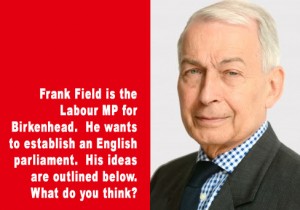
This question was recently highlighted in an article – http://www.express.co.uk/comment/expresscomment/834711/frank-field-english-parliament-constitutional-reform-brexit – in The Express by Frank Field, the Labour MP for Birkenhead.

We’ve reproduced the article (below) and feel that it lends itself to a new NwS debate. In particular, Self-Determinsits should consider the following questions:

• What form of Self-Determination should England strive for – autonomy, independence or something else?

• What ‘internal’ structure should England adopt? Should it effectively revert back to the seven traditional kingdoms (East Anglia, Essex, Kent, Mercia, Northumbria, Sussex and Wessex) of the Anglo-Saxon Heptarchy? If so, what powers would these ‘kingdoms’ hold?

• What do Self-Determinists make of Frank Field’s call for the House of Lords to be abolished and replaced by a ‘Common Senate’ which’ll consist of ‘the professions, arts and culture, industry, including both employers and trade unions’?

Self-Determinists are encouraged to post their thoughts in the comments section once they see this article appear on the NwS Facebook page https://www.facebook.com/groups/184919468292372/
It goes without saying that there are no official links between Nations without States, Frank Field MP, the Labour Party or The Express

.

Let us rule our England with an English parliament, says Frank Field MP

Establishing an English parliament was the inevitable outcome once the Bliar government began to give way to Scottish nationalism.

But just as it took much political heaving to get through the first devolution bill, the passage to establish an English parliament will be further hindered by Brexit fallout.

Politicians are scared of the constitutional changes that were set afoot by Scottish devolution.

They should give up worrying. Brexit will drive reform on the constitutional front, just as it will do through much of public life.
Once the Blair government began the process of devolution, particularly to Scotland, but also to Wales and Northern Ireland, we faced what was called the “West Lothian Question”.

The then MP for West Lothian, the late Tam Dalyell, posed the question thus: should MPs from Northern Ireland, Wales and Scotland be able to vote on matters which affect only England? Politicians have since sought to answer Tam’s question but with little success.

What has not been posed is a new question, but here it is: Isn’t the answer to the West Lothian question to establish an English parliament? The only rational conversation I had with Gordon Brown was when he questioned if I genuinely believed in an English parliament. I replied that I did.

“But how do you get over the size?” Gordon enquired. “England is so dominant that it makes devolution for England impossible.”
It is the size of England that makes devolution more, not less, important. But England’s size does put a price on success.

England, yet again, needs to be generous in establishing the new constitutional order.

There’s no problem with establishing an English parliament. The House of Commons as we know it today would be abolished. In its place would be the election of MPs to an English parliament that would sit in the House of Commons.

The English Parliament would therefore be on a par with parliaments in Scotland, Wales and Northern Ireland. A second move would be to abolish the House of Lords. We have a bigger second chamber than China, although our population of 65 million is dwarfed by China’s 1.3 billion.

In place of the Lords should be a “Common Senate” to which the Northern Irish, Welsh, Scottish and English parliaments would send legislation for scrutiny, just as now with the Commons sending its legislation to the Lords.

The Senate should be elected, but not by giving party whips the chance to stack it full again with their candidates who failed to get elected to the Commons. Elections there will be but the establishment of the Senate will reflect those great organisations – the professions, arts and culture, industry, including both employers and trade unions – which would get to elect one or two senators for a fixed term of 10 years.

Likewise, there would be elections of another group of senators based on geography.

British representation has always had a strong local basis. Again, these senators would be elected on a regional basis and would serve a 10-year term. The 10-year term would limit the power of any whipping system trying to control the business of the Senate.

Only the feeble-minded who managed to squeeze through the new devolved electoral system would be easy meat for the whips.

The legislation from the English parliament, and those from the other three parliaments, would be considered, revision offered, but the Senate would not have powers of outright rejection.

Sovereign constitutional powers would reside in each of the four UK parliaments.

English senators would have to work with other senators on major pieces of business.

The Senate would decide taxation, foreign affairs and defence, with all three shared between the four UK powers. Division of seats would ensure that English senators would succeed only if they had the support of other countries’ senators.

Election to the English parliament would be on a constituency basis, just as now. This constitutional change would not only empower voters but it would reduce the bill.

The Lords cost taxpayers £108million in 2015-2016. Cut to a third of its size its cost would similarly fall. While the cost would fall, the effectiveness would increase.

It would attract people who head their own sections of public life. Likewise, each senator would know that their term was limited, a move that should increase their sense of value and independence.


• CHECK out previous NwS debates here:
Nations without States Debate (1) – Why Do Our Oppressors Hate The Concept Of Self-Determination? http://tinyurl.com/jrj7dtl
Nations without States Debate (2) – How Can Self-Determinists Force Governments To Give Us Our Freedom? http://tinyurl.com/zbhv2ae

Share:
  • Print
  • Digg
  • StumbleUpon
  • del.icio.us
  • Facebook
  • Yahoo! Buzz
  • Twitter
  • Google Bookmarks

  • Add to favorites
  • blogmarks
  • Blogosphere
  • Google Buzz
  • PDF
  • email
  • Live
  • MSN Reporter
  • MyShare
  • MySpace
  • Technorati
  • Webnews.de

Coming Soon – Issue 3 of Caledonian Voice!

Share:
  • Print
  • Digg
  • StumbleUpon
  • del.icio.us
  • Facebook
  • Yahoo! Buzz
  • Twitter
  • Google Bookmarks
  • Add to favorites
  • blogmarks
  • Blogosphere
  • Google Buzz
  • PDF
  • email
  • Live
  • MSN Reporter
  • MyShare
  • MySpace
  • Technorati
  • Webnews.de

Liberal Future: Fermanagh, Armagh and Tyrone Youth Say … Choose Freedom – BreXit Now!

.
AS EVERYONE KNOWS last year voters went to the polls to vote in the EU Referendum.  The question on the ballot paper was very simple.  It asked ‘Should the United Kingdom remain a member of the European Union?’

The answer was simple as well – for nearly 17.5 million Britons voted to break the chains of EU enslavement.

But as we’ve noted many times, not everyone was happy about this vote.  The global elite – represented by the likes of multinational corporations and the banks – are deeply unhappy, to say the very least.  Ever since the vote was announced they, and their client politicians, have sought to oppose the popular will of the people and want to overturn democracy.

In Ulster, the main opponents of this democratic vote are Sinn Féin (who for some bizarre reason still claim to be a socialist and Irish republican political party) and the Social Democratic and Labour Party (the SDLP – sometimes known as the ‘Stoops’) and to a lesser degree, the Alliance Party.

The sheer hypocrisy is hanging out of them all – but Sinn Féin (SF) in particular.  They claim that because a majority in Ulster (or the ‘North’ as they call it) voted Remain, this vote should be respected.  However, this is a dramatic volte-face from a party that has never truly respected the wish of the majority of Ulster voters who want to remain part of the UK.  This was especially so when they effectively acted as cheerleaders for the IRA’s imperialist and, in parts, blatantly sectarian war against the nation and people of Ulster.

Also if we to follow Sinn Féin’s argument – about respecting the local vote – to its logical extent, surely all of Co. Antrim, East Belfast and parts of County Down, who voted Leave, should be allowed to quit the EU?

Liberal Future also notes that, until fairly recently, Sinn Féin opposed the EU.  It would be interesting to establish a time-line which examined their change of heart.  Was it in response to intense internal political debate – or could it be linked to various EU grants which just happened to benefit areas where SF have political representation?

To conclude, we’d like point folks in the direction of a previous article – http://nationalliberal.org/ulster-youth-say-brexit-now – we produced concerning SF.  It examined a case whereby they (and the Stoops) went to court in a vain effort to overturn the Brexit vote.  Here we noted:
‘This court case was odd to say the very least. Probably the most curious aspect was the sight of Sinn Féin and the SDLP going into a British court to try to force a country that they don’t really recognise (Ulster) to stay within the European Union! Why anyone – let alone so-called Irish republicans or nationalists – would want to surrender their nationhood to a supranational organisation is beyond us.’
• THIS ARTICLE should be read in conjunction with the following:
.
Liberal Future Says BreXit Now! http://nationalliberal.org/liberal-future-says-%e2%80%a6-brexit-now
.
Liberal Future: English Youth Say BreXit Now! http://nationalliberal.org/english-youth-says-brexit-now
Liberal Future: Scottish Youth Say BreXit Now! http://nationalliberal.org/scottish-youth-say-brexit-now
Liberal Future: Ulster Youth Say BreXit Now! http://nationalliberal.org/ulster-youth-say-brexit-now
Liberal Future: Welsh Youth Say BreXit Now! http://nationalliberal.org/welsh-youth-say-brexit-now
Liberal Future: Cornish Youth Say BreXit Now! http://nationalliberal.org/cornish-youth-say-brexit-now
Liberal Future: Guernsey, Manx and Jersey Youth Say BreXit Now! http://nationalliberal.org/liberal-future-guernsey-manx-and-jersey-youth-say-brexit-now
Liberal Future: Alderney & Sark Youth Say BreXit Now! http://nationalliberal.org/liberal-future-alderney-sark-youth-say-brexit-now

Share:
  • Print
  • Digg
  • StumbleUpon
  • del.icio.us
  • Facebook
  • Yahoo! Buzz
  • Twitter
  • Google Bookmarks
  • Add to favorites
  • blogmarks
  • Blogosphere
  • Google Buzz
  • PDF
  • email
  • Live
  • MSN Reporter
  • MyShare
  • MySpace
  • Technorati
  • Webnews.de

Autumn 2017: Liberty & Nation Says Wherever You Live SHOP LOCAL THIS AUTUMN!

Share:
  • Print
  • Digg
  • StumbleUpon
  • del.icio.us
  • Facebook
  • Yahoo! Buzz
  • Twitter
  • Google Bookmarks
  • Add to favorites
  • blogmarks
  • Blogosphere
  • Google Buzz
  • PDF
  • email
  • Live
  • MSN Reporter
  • MyShare
  • MySpace
  • Technorati
  • Webnews.de

Disability Update

MEMBERS and supporters of the National Liberal Party – NLP – may recall that we’ve featured a couple of articles written by West-Midlands based, Simon Stevens. Simon describes himself as an ‘independent inclusion issues consultant, trainer and activist’. He is regarded as one of Britain’s foremost disability advocates.

You can check out the articles we’ve previously carried here http://nationalliberal.org/disability-a-voice-for-change and here http://nationalliberal.org/from-disability-to-politics-%e2%80%93-does-the-media-have-its-own-agenda

In the very near future we’ll carry some more of his articles – all aimed at sparking debate relating to disability issues. In the meantime, readers can check out his new web-site http://www.simonstevens.com/ You can also find him on Facebook https://www.facebook.com/simonstevens74 or join the 21.5 thousand follows of his Twitter feed @simonstevens74


Please note that there is no official link between the National Liberal Party and Simon Stevens. Thus, it should not be taken that Simon endorses the NLP or that we unconditionally support everything that he writes. As we noted earlier, we’re simply interested in stimulating any debate relating to disability issues.

Share:
  • Print
  • Digg
  • StumbleUpon
  • del.icio.us
  • Facebook
  • Yahoo! Buzz
  • Twitter
  • Google Bookmarks
  • Add to favorites
  • blogmarks
  • Blogosphere
  • Google Buzz
  • PDF
  • email
  • Live
  • MSN Reporter
  • MyShare
  • MySpace
  • Technorati
  • Webnews.de

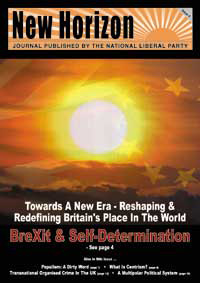
Read Issue 4 of New Horizon
.
ISSUE 4 of New Horizon – the ideological journal Of The National Liberal Party – is now available. To get hold of your FREE pdf copy click HERE.

Articles covered in this 24-page issue include Brexit and Self-Determination, populism, thoughts on a new multipolar democratic political system by the Russian writer, Nicholas Popov, and a look at Lujo Brentano (1844-1931) who was a major influence on liberal German trade unions. Coupled with a review of Mehr Seth’s Transnational Organised Crime In The UK and a thoughtful editorial, this issue of New Horizon makes for interesting – and in-depth – reading.

There are two very interesting factors relating to this issue of New Horizon.

The first is the link betwwen to two completely different articles – BreXit and Self-Determination and Populism – A New Dirty Word? Both have different authors but are linked by the fact that the Brexit vote was probably the greatest popular expression of anger (against the Global elite) ever experienced in British political history.

The second is the announcement of the birth of the Centre Alliance, founded as a campaigning and electoral coalition. The aim of the Centre Alliance – CA – is for likeminded ‘small parties, groups and independents’ to co-operate together ‘to reclaim the country for the benefit of the ordinary citizen’.

The CA will campaign on five central points:

1. Social Justice e.g. introducing a meaningful Living Wage.

2. Democratic Renewal/Electoral Reform e.g. a campaign on making referendums part of the political system e.g. ‘Initiatives’ as in Switzerland.

3. Anti-Globalisation e.g. opposition to TTIP

4. Anti-Corruption e.g. a campaign against the honours system per se or how constituted.

5. Consensus Politics e.g. encouraging pacts, coalitions and the Swiss style of government (cross-party National Council).

A more in-depth review of the latest New Horizon is currently being written. It’ll appear on the main National Liberal Party web-site – http://nationalliberal.org/ – as well as our two Facebook sites here https://www.facebook.com/NationalLiberalParty/ and here https://www.facebook.com/groups/52739504313/ in the very near future.

We’re also looking to encourage a culture of multiple reviews of all of our publications. Therefore, if you’d like to submit a review – good, bad or indifferent – on what we have to say, please feel free. As we always say, debate (and hence speech) is free with the NLP!

In the meantime we urge all National Liberals to promote this ‘mini-review’ as well as this promotional artwork http://nationalliberal.org/issue-4-of-new-horizon-ideological-journal-of-the-national-liberal-party-out-now via social media.

One last thing. A special mention must also be given to the striking – and very positive cover – relating to Brexit. When all is said and done, there’s no point in having an ideological journal if no-one is going to read it. We feel that the cover of issue 4 of New Horizon will have both convinced National Liberals and those curious about politics reaching for it. And today, where politics is dominated by the soundbite and milisecond media, that’s no mean feat!
Share:
  • Print
  • Digg
  • StumbleUpon
  • del.icio.us
  • Facebook
  • Yahoo! Buzz
  • Twitter
  • Google Bookmarks
  • Add to favorites
  • blogmarks
  • Blogosphere
  • Google Buzz
  • PDF
  • email
  • Live
  • MSN Reporter
  • MyShare
  • MySpace
  • Technorati
  • Webnews.de

By continuing to use the site, you agree to the use of cookies. more information

The cookie settings on this website are set to "allow cookies" to give you the best browsing experience possible. If you continue to use this website without changing your cookie settings or you click "Accept" below then you are consenting to this.

Close