





Saturday, 17 January 2026

Liberal Future: Glamorgan, Merioneth & Monmouthshire Youth Say … The Struggle Continues – BreXit Now!

.


.

‘Real democracy does not mean the democratic part of the people. It means all the people; even that disgusting part with which we do not agree.’

GK Chesterton

IT’S HARD TO BELIEVE that so much time has passed – and so much has happened – since our BreXit Now! article. Way back in May of last year we discussed how the Remainer (or Remoaner – take your pick!) British establishment was trying to control the Brexit narrative by demonising those who voted for Brexit, and, in turn, the vote itself. You can read the article here:

http://nationalliberal.org/liberal-future-carmarthenshire-denbighshire-flintshire-youth-say-…-ignore-the-establishment-media-narrative-–-brexit-now

We’ll continue with this theme in a future article as the subject of ‘narrative control’ is an important and ongoing one. However, Liberal Future would like to use this article to look at what’s happened Brexit-wise in the last eight months.

With the above in mind, it cannot have escaped anyone’s attention that Boris Johnson and the Conservative Party absolutely walked the general election of 12th December. We’d highly recommend this National Liberal Party – our parent organization – post-election analysis of the result: 2019 General Election Result – Never Trust A Tory! http://nationalliberal.org/2019-general-election-result-–-never-trust-a-tory

As the article notes, the clear driver of the election was Brexit – so much so that it became known as the ‘Brexit election.’ And as much as it pains us to say this – as we dislike all of the pro-capitalist Establishment parties, especially the Conservatives! – the Tories played an absolute blinder.

Labour’s famous ‘Red Wall’ (where it’s said that votes were weighed as opposed to being counted) turned Tory blue. This was especially so of ‘Leave’ constituencies across Northern England and here in Wales.

Here the Conservatives took six seats off of Labour (giving them a total of 14 seats) and gained 36.1% of the total vote, an increase of 2.5% from 2017.

Some people thought that Plaid Cymru (PC) might have got more of a hiding but as this report indicates – https://www.bbc.co.uk/news/election/2019/results/wales – voter loyalty meant that they held onto their four seats. In doing so PC obtained 9.9% of vote (down 0.5%).

It’s now more than a month after the election – and Plaid are still probably counting their lucky stars. As everyone knows Wales voted ‘Leave’ during the EU Referendum of 23rd June 2016. Here 854,572 (52.5%) voters supported Brexit, compared with 772,347 (47.5%) who wanted to remain within the EU.

Plaid Cymru – along with other ‘socialist’ and ‘nationalist’ parties like the Scottish National Party & Sinn Féin – campaigned to stay within the EU. All bizarrely want to leave a relatively small union (the UK) yet they’re more than content to remain chained to a much larger union – the EU. (Another thing that really concerns us about PC, the SNP and SF is their petty nationalism – in that they all appear to hate the English more than they love their own people.)

In respect of Wales, Plaid Cymru’s position doesn’t make sense to us. If four Plaid MPs can’t exert any influence over 650 MPs at Westminster, how on earth could Jill Evens – its sole MEP – ever hope to achieve anything within the EU?

To further put things into perspective, the 2011 census found that Wales had a population of just over 3 million. This is a fraction of the UKs population of nearly 68 million. It’s an even smaller fraction of the EU’s population of around 447 million. In terms of wielding power & influence, the numbers simply don’t add up. It’s simply delusional to think that the likes of Germany or France will be interested in what Wales has to say for herself.

The only way that Wales would even be noticed is if we were of some use to the EU – maybe in the form of some sort of bargaining chip. However, we’d be dropped like a hot potato once we’d outlived our usefulness (and we have a sneaking suspicion that this, sometime down the line, will happen to Éire once the UK leaves the EU for good). With all of this in mind, it begs the question why PC are so pro-EU?

So where does this all leave us respect of Brexit? To answer this we can do worse that take another look at the NLPs article from late December, 2019 General Election Result – Never Trust A Tory! Here we noted Boris Johnson’s lack of ideology and the fact that he’s miles away from the Thatcherite ‘small state, leave it to the market’ brand of Conservatism. He’ll also be different from Cameron and May.

With Brexit specifically in mind we noted:

‘To be honest, we think that the only real interest Boris has is in himself and how he would go down in history. With this in mind we think that he’d like to be known as the man who got Brexit done. It’ll now be his number one vanity project.’

In the month since the general election, Liberal Future hasn’t seen, read or heard anything that that has made us change our view. Therefore, we’re more than confident that we’ll formally leave the EU at 11pm on Friday – irrespective of whether Big Ben bongs or not! Indeed, we believe that many Welsh freedom lovers will be celebrating here. Others may even travel to London to join the main Brexit celebrations which’ll be held in London’s Parliament Square. We understand that some of the celebrations will be televised, so we’re hoping to see a few Red Dragon flags – Y Ddraig Goch – flying.

So far so good. However, Liberal Future wouldn’t trust Boris or the Tories as far as we could throw them. We intensely dislike the idea of a Tory Brexit – but frankly we have to blame the Labour Party for this. Why? Because Jeremy Corbyn originally said that they’d respect the referendum result. But when the vote went against the Establishment line, the back room political manoeuvring started and Labour altered its position. In fact, they altered their position so much so that – in the run up to & during last month’s election – nobody really knew where they stood.

So a Tory Brexit it is then. Serious horse trading has probably already began behind the scenes. The best we can ask for is to be fed the odd morsel of how negotiations are proceeding. Until we actually finally leave the EU, we’ll still continue using its BreXit Now! slogan as nobody really knows what way we’re leaving – and crucially what’ll be discussed and agreed behind closed doors.

With the above in mind Liberal Future would like to state that we’re not naïve enough to believe that once we’re out of the EU everything’s suddenly going to be Hunky Dory.

If we’re reading the Runestones correctly, a Tory Brexit will see the UK probably joining the World Trade Organisation (WTO) once the transition period is complete. As we understand it, the WTO grew out of the General Agreement on Tariffs and Trade, together with the World Bank and the International Monetary Fund. Therefore, to some extent, we’ll be jumping out of the fire into the furnace. However, we’ve never shared the jingoistic & over-simplistic view (mainly promoted by what we’d term as the ‘reactionary right’) that getting ‘our country back’ will be a simple matter of leaving the EU.

On the contrary, LF believes that the road to National Freedom & Social Justice would be an extremely long and hard one. We accept that – in this age of globalisation – we can’t achieve total sovereignty overnight. We also concede that we might have to leave one trading bloc – like to EU – only to have to join another one – like the WTO – until we do achieve total sovereignty.

We understand that this sounds counter-intuitive or even contradictory. However, we have to understand that Wales simply doesn’t have the capacity to become anything like self-sufficient overnight. Ironically, it would probably take something like another World War to achieve this!

Sadly, it’s a fact of life that we have to rely on imports for many every day items. These are goods that could, and should, be made here in Wales. Whether this reliance on others has occurred by accident or design is a question for another day. However, in the meantime, if we want true National Freedom & Social Justice we’ll need to start moving towards becoming as self-sufficient as possible – with a particular emphasis on food sovereignty.

Liberal Future will examine these ideas in future BreXit Now! articles. We’ll also return to the theme of how the Remainer British establishment were attempting to control the Brexit narrative by demonising those who voted for Brexit, and, in turn, the vote itself. We also anticipate reporting on the continuing twists and turns on the road to freedom. This’ll be particularly important because, as we’ve noted above, we’re now into the real nitty gritty of Brexit negotiations – and this will be carried out well away from the press and public.

Finally, we also feel that the time is right for LF to set out its own stall. Here we’ll provide some details of our (post-EU) social and economic vision for the future. Briefly stated, we have absolutely no problem with European Solidarity, in terms of the Nations of Europe co-operating with each other (indeed, we have no problem with the Nations of the world co-operating with each other). But this must be done on the basis of truly free & sovereign Nations co-operating with each other. However, to achieve this we feel that the EU has to be replaced with what we would describe as as something akin to a European Confederation of Nation States.

• THIS ARTICLE should be read in conjunction with the following:

Liberal Future: For A Europe Of Free Nations – BreXit Now!
http://nationalliberal.org/liberal-future-for-a-europe-of-free-nations-brexit-now

Liberal Future: County Londonderry, County Antrim & County Down Youth Say … Independence From the EU – BreXit Now!
http://nationalliberal.org/liberal-future-county-londonderry-county-antrim-county-down-youth-say-…-independence-from-the-eu-–-brexit-now

Liberal Future: Anglesey, Brecknockshire, Caernarfonshire & Ceredigion Youth Say … Blood Over Gold – BreXit Now!
http://nationalliberal.org/liberal-future-anglesey-brecknockshire-caernarfonshire-ceredigion-youth-say-…-blood-over-gold-–-brexit-now

Liberal Future: Carmarthenshire, Denbighshire & Flintshire Youth Say … Ignore The Establishment Media Narrative – BreXit Now!
http://nationalliberal.org/liberal-future-carmarthenshire-denbighshire-flintshire-youth-say-…-ignore-the-establishment-media-narrative-–-brexit-now

Share:
  • Print
  • Digg
  • StumbleUpon
  • del.icio.us
  • Facebook
  • Yahoo! Buzz
  • Twitter
  • Google Bookmarks
  • Add to favorites
  • blogmarks
  • Blogosphere
  • Google Buzz
  • PDF
  • email
  • Live
  • MSN Reporter
  • MyShare
  • MySpace
  • Technorati
  • Webnews.de

The National Liberal Party Says Shop Local In Alton!

Share:
  • Print
  • Digg
  • StumbleUpon
  • del.icio.us
  • Facebook
  • Yahoo! Buzz
  • Twitter
  • Google Bookmarks
  • Add to favorites
  • blogmarks
  • Blogosphere
  • Google Buzz
  • PDF
  • email
  • Live
  • MSN Reporter
  • MyShare
  • MySpace
  • Technorati
  • Webnews.de

From The Liberty Wall – Total Democracy – We Want Total Democracy!

SEVEN WEEKS AGO the Electoral Reform Society (ERS) –https://www.electoral-reform.org.uk/ – declared that December 5th 2019 was Democracy Day!

.

The date was chosen as it was only a week before the general election. The ERS were concerned that the main political parties were ‘worryingly silent’ about vitalissus relating to democracy or political reform. Indeed, the ERS noted that ‘This general election was called because the Westminster system had left the country in a deadlock. Yet too few are talking about how to fix it.’

.

The ERS also declared that ‘This has to be the last election held under Westminster’s ‘unjust and undemocratic First Past the Post system’. But for that to happen, we need to make the biggest noise possible for reform.’

.

Total Democracy– since day one – has shared the view of the ERS that there’s something thoughly undemocratic about the current voting system. And like the ERS we believe that ordinary people should reclaim politics.

.

With the above in mind, our first campaign has been to popularise the idea of having aNone Of The Above (NOTA) option available in all elections. The main aim of NOTA is to allow voters to withhold their consent to be ‘represented’ by any of the candidates listed on their ballot paper.

.

Witholding consent is completely different from either not voting at all or spoiling ones vote. To not vote is to ignore – and even potentially dishonour – the memory of those who fought to establish a modicum of democracy. Here we think of:

.

The signing of the Magna Carta – the Great Charter of the Liberties of England –at Runnymede in 1215 (whichset down the principle that the King is also subject to the law of the Land.)

.

We also look to the Glorious Revolution of 1689 which finally vanquished the doctrine of ‘the Divine Right of Kings’, as practised in France by the ‘Sun King’, Louis XIV. Louis was the absolute dictator of France and James II wanted to have the same dictatorial powers in England, Scotland and Ireland. In England, the principle had become well established that elected representatives of his subjects should check the King’s actions and that those representatives should be able to make laws. It was by no means truly democratic, but it was a significant step away from absolutism. It is not surprising that James encountered strong opposition, which led to his removal by William of Orange and his defeat at the Boyne.

.

Another example would be the Chartists, an organisation thatexisted in Britain from 1838 to 1857. Probably best described as a working-class malesuffrage movement, they campaigned for democracy via mass petitions and meetings. They had six demands, the main one being a ‘vote for every man twenty-one years of age, of sound mind, and not undergoing punishment for a crime.’

We also look toEmmeline ‘Emily’ Pankhurst (1858 – 1928) who formed the Women’s Social and Political Union (WSPU) in 1903. The WSPU was an all-female political movement which launched a militant campaign for ‘Votes For Women’. This was eventually granted via the then Conservative goventment’s Representation of the People (Equal Franchise) Act of 1928.

.

Those who throw their vote away should also bear in mind that many people lost their lives in the pursuit of democracy. Many of the above important and defining moments in our our history involved violence. (This is particularly so of state violence towards suffrgettes – it’s thought that Pankhurst died as a result of ill treatment she reveived whilst imprisoned.) However all were eventually successful in their ojectives to advance democracy. They all effectively said to establishment of the day: You’ve had our blood – now give us our rights!

.

With the above in mind – and as we noted earlier – there is a need to recognise the importance of consent to be ruled by others. As the pro-democracy group None of the Above UK (NOTA UK) have noted:

Consent is central to the concept of democracy – if you cannot withhold it, consent is immaterial. Abstaining does not constitute withholding consent, it is simply not participating and can be dismissed as ‘voter apathy’ with no further analysis. Spoiling the ballot is not withholding consent either as all spoilt votes are lumped in with those spoilt in error, the corresponding figure is therefore meaningless as a measure of voter discontent. The only way to meaningfully and formally withhold consent is via a formal NOTA option on the ballot paper. As such, it is a democratic pre-requisite.’ (1)

.

Total Democracy believes that NOTA UK have hit the nail on the head here. In addition, we feel that the First Past The Post – FPTP – system is probabably one of the worst voting sytems available. (In fact, it’s absolutely shameful that its used to elect any representatives, let alone for Westminster elections. We believe that it could be reasonably argued that FPTP is effectively an elected dictatorship – and that’s not even taking into account the corrosive influence of the Money Power!)

.

The inclusion of a None Of The Above option on the ballot paper will be a very first small step in the right direction. But Total Democracy means just that – so in future articles we’ll also be looking at ways that we can make politics more representative of the people. Thus we’ll look at Proportional Representation, Referendums, Preferendums and Voter Recall. The current electoral system is a sham and is not fit for purpose. It needs to go. It needs to be made truly democratic.

.

  1. https://nota-uk.org/2014/08/30/nota-uks-policy-proposal-to-be-debated-by-ers-at-their-agm/ • TOTAL DEMOCRACY was established in 2012. We describe ourselves as a body of like minded small parties, groups and Independents co-operating together to reclaim democracy for the nation. Check us out here: https://www.facebook.com/TotalDemocracyUK/

    • THE ELECTORAL REFORM SOCIETY campaignsfor democratic rights and a democracy fit for the 21st century. They work across the political divide with all the parties and civil society to put voters at the heart of British politics. Check them out here: https://www.facebook.com/electoralreformsociety/

Share:
  • Print
  • Digg
  • StumbleUpon
  • del.icio.us
  • Facebook
  • Yahoo! Buzz
  • Twitter
  • Google Bookmarks
  • Add to favorites
  • blogmarks
  • Blogosphere
  • Google Buzz
  • PDF
  • email
  • Live
  • MSN Reporter
  • MyShare
  • MySpace
  • Technorati
  • Webnews.de

Caledonian Voice, English Voice & Ulster Voice Say … Scrap Universal Credit!

.

UNIVERSAL CREDIT and Personal Independence Payment (PIP) are the cornerstone of this government’s austerity programme.


PIP was introduced by Iain Duncan Smith – the Tory Secretary of State for Work and Pensions from 2010 to 2016 – and was supposed to be rolled-out across Great Britain in October 2013. This was delayed due to problems with reliability, the length of time it took to assess claims and difficulty in recruiting assessors. Since its introduction it has been dogged by controversy – especially when new rules were introduced in 2017 which seemed to target the disabled. Many claimants feel that PIP is rigged against them.


In October, 2010, Iain Duncan Smith announced the introduction of a Universal Credit designed to simplify the benefit system and improve work incentives. It replaced Employment and Support Allowance (ESA), Jobseeker’s Allowance (JSA), Income Support, Child Tax Credit, Working Tax Credit (WTC) and Housing Benefit.


Like PIP, the introduction of Universal Credit has been roundly criticised from many quarters. A five-week delay in receiving the first payment has seen many people turning to food banks. Indeed, in April 2018 the Trussell Trust (which runs many food banks) reported that, areas where universal credit had been rolled out, had seen an average 52% rise in use of food banks compared to 2017.


Indeed, it’s been reported that many women turned to prostitution through delays in paying Universal Credit or because Universal Credit payments were insufficient to meet their basic needs.


We would encourage members & supporters of the National Liberal Party – in fact, anyone who believes in the concept of Social Justice – to help the fight against PIP and Universal Credit. A simple start would be to viral out these Scrap Universal Credit! e-posters via Social Media:


Caledonian Voice Says Scrap Universal Credit! http://nationalliberal.org/caledonian-voice-says-scrap-universal-credit


English Voice Says Scrap Universal Credit! http://nationalliberal.org/english-voice-says-scrap-universal-credit


Caledonian Voice & English Voice Say … Scrap Universal Credit! http://nationalliberal.org/caledonian-voice-english-voice-say-…-scrap-universal-credit RT

Ulster Voice Says Scrap Universal Credit! https://nationalliberal.org/ulster-voice-says-scrap-universal-credit


Share:
  • Print
  • Digg
  • StumbleUpon
  • del.icio.us
  • Facebook
  • Yahoo! Buzz
  • Twitter
  • Google Bookmarks
  • Add to favorites
  • blogmarks
  • Blogosphere
  • Google Buzz
  • PDF
  • email
  • Live
  • MSN Reporter
  • MyShare
  • MySpace
  • Technorati
  • Webnews.de

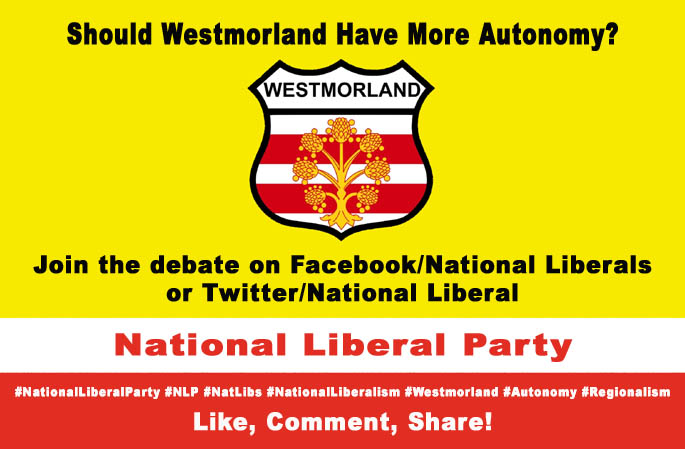
Should Westmorland Have More Autonomy? Join The Debate!

.

• TO FIND out more about the NLPs views on decentralisation read: Regionalism – Small Is Beautiful! http://nationalliberal.org/regionalism-–-small-is-beautiful


• CHECK OUT Autonomy, Regionalism & Localism – From Northumberland To Cumbria Via County Durham And The Tyne & Wear!
http://nationalliberal.org/autonomy-regionalism-localism-from-northumberland-to-cumbria-

via-county-durham-and-the-tyne-wear

• ALSO CHECK OUT Should Yorkshire Have More Autonomy? Join The Debate! http://nationalliberal.org/should-yorkshire-have-more-autonomy-join-the-debate

• TO FIND out more about Westmorland, check out https://www.britannica.com/place/Westmorland

Share:
  • Print
  • Digg
  • StumbleUpon
  • del.icio.us
  • Facebook
  • Yahoo! Buzz
  • Twitter
  • Google Bookmarks
  • Add to favorites
  • blogmarks
  • Blogosphere
  • Google Buzz
  • PDF
  • email
  • Live
  • MSN Reporter
  • MyShare
  • MySpace
  • Technorati
  • Webnews.de

Harrow Voice Debate (1) – What Do You Think Of Universal Basic Services?

WELCOME TO the first debate hosted by Harrow Voice – the voice of National Liberal Party in Harrow (Middlesex). Regular readers will be aware that our sister publications Caledonian Voice, Devon Voice and Welsh Voice have previously debated (see links below) the idea of a Universal Basic Income (UBI). The idea behind UBI is that each individual living in the UK would receive some form of regular income from the government. This money would be issued unconditionally, meaning that it wouldn’t be means tested.


Harrow Voice is deeply interested in the various ways that ordinary working families can be financially supported in the future – especially given the rapid advancements in Artificial Intelligence (AI) and robotics, which will lead to job losses.


This article – originally entitled Why UBI’s Cousin, UBS, Is Better https://medium.com/bigger-picture/why-ubis-cousin-ubs-is-better-c08778c7c865– was originally published last year in Medium, a US-based blog which publishes work by amateurs and professionals. Written by Inés Fernández, this thought-provoking article looks at the idea of providing Universal Basic Services (UBS) instead. Such services would guarantee a minimum standard of life and include free healthcare, education, democracy & legal services, housing, food, transport and information.

Harrow Voice invites everyone to read the article and answer this simple question: What Do You Think Of Universal Basic Services? Let us know via the National Liberals Facebook site – https://www.facebook.com/groups/52739504313/ – or the National Liberal Party Facebook site – https://www.facebook.com/NationalLiberalParty/


It goes without saying that there are no official links between Inés Fernández, Medium, Harrow Voice and the National Liberal Party. Please note that Harrow Voice has kept the original North American spelling and phrases as they are.

.

Why UBI’s Cousin, UBS, Is Better


Examining universal basic income vs. universal basic services


By Inés Fernández


THE INCREASING concerns over automation and the future of work have started to fuel the popularization of ideas like universal basic income (UBI) — a policy which would provide every citizen with a certain amount of money a month that they can spend however they want. Perhaps most notably, U.S. Democratic presidential candidate Andrew Yang is centering his platform around this idea (albeit his version excludes those outside the 18–65 age group and those receiving welfare services).


Implementing UBI, without a doubt, would be better than letting the millions of workers who will lose their jobs to automation perish. However, there are some points that make UBI less preferable than its less flashy alternative: universal basic services (UBS), which, as its name suggests, entails that all necessary basic services (defined differently by every proponent, but could include healthcare, housing and utilities, transportation, education, and a meal plan) be publicly funded and made free at the point of service. If you are a UBI proponent, allow me to make the case to you as to why this is so.


UBI (or at least any UBI program that is not in addition to UBS, like Andrew Yang’s) will, at the end of the day, go towards paying for these services, but is less effective at it. This is because, by providing the services directly, if someone’s total cost in all these areas is $500, the government would spend $500 on that person, while if another person’s costs are $1000, it would spend $1000. But with UBI, the government would give the same amount to both people — if it is under $1000, then one has insufficient money to cover their basic needs, and if it is over $500, then one of them is receiving excess money. Evidently, this is a more inefficient use of funds than just covering people’s needs.


The biggest challenge with UBI, as any UBI advocate knows, is that it is difficult to pick the perfect amount. No matter the number, some people will receive too much, and some people will receive too little. This is why UBS ensures no one will go without the essential services they need in a way that UBI will never be able to.


Don’t get me wrong, a UBI on top of UBS would be great, and if feasible, I would probably support it. But a UBI in place of UBS (or in place of welfare programs, which are just non-universal basic services) is unacceptable. Many progressives fear that UBI is a neoliberal excuse to underfund these programs, and if implemented in this manner, their concerns would likely be justified.


With UBS, since people would have these expenses covered for them (remember — the money would come from the same place UBI money is intended to), they would save thousands of dollars and to re-invest in the things that UBI advocates dream of: consumer spending and starting small businesses. Also, they would be more prone to take business risks, knowing they have this safety net and won’t end up homeless or unable to pay for their kids’ education if it goes wrong. In other words, all the benefits that are supposed to be achieved through UBI — a healthier and more educated population, a reduction in homelessness, an increase in mental health due to alleviated financial distress, a safety net on which to rely on while going through job retraining, a reduced dependency on salary and consequent empowerment of workers — would be achieved, except more efficiently, since it is more targeted and provides each person with exactly what they need. Not a cent less, not a cent more.


Furthermore, counterintuitively to many UBI proponents, it is even possible to make the case that UBS is less bureaucratic — instead of the government giving citizens money and citizens providing it to the service, it is provided to the service directly, cutting out the middleman. It is more politically feasible, since most governments already have these programs reserved for a select few, and UBS would simply require expanding them to everybody as opposed to starting a whole new program.


Perhaps more importantly, though, providing services through a UBS program would be cheaper than through UBI, not just because of the increased dollar-per-person efficiency, but for the same reasons that healthcare and education are cheaper per capita in every other developed country than in the United States — the government has more bargaining power than any individual citizen, and would it be able to negotiate down the prices with the entity that is providing them.


Of course, any candidate proposing UBS would have to figure out the details of how exactly they would go about it, including whether they want the government to run these services or merely fund them (I suspect many would prefer the latter) and whether they want to offer the services as an opt-in option or as the sole provider (I suspect many would prefer the former). But I personally support UBS because, independently of all the economic and practical arguments, I think that in a society that can offer them, it is immoral to deny people access to any of these services on the grounds that they cannot afford them. It would not only have positive repercussions on society, but it is the humane thing to do.


If you agree with this ideal but disagree with its implementation, I would love to hear why (be it in the comments or on Twitter). Nevertheless, whether through UBI, UBS, or another policy, one thing is clear: We must find a way to cultivate a more modern relationship to work, because if survival depends on salary, it is very likely that automation will wreck havoc on our society.


• READERS interested in Universal Basic Income – UBI – should also check out the following debates:


Caledonian Voice Debate (1) – Universal Basic Income For Scotland? http://nationalliberal.org/caledonian-voice-debate-1-universal-basic-income-for-scotland

Welsh Voice Debate (1) – Who Really Stands To Win From Universal Basic Income? http://nationalliberal.org/welsh-voice-debate-1-who-really-stands-to-win-from-universal-basic-income


Devon Voice Debate (1) Universal Basic Income For Devon? (Part 1) http://nationalliberal.org/devon-voice-debate-1-–-universal-basic-income-for-devon-part-1


Devon Voice Debate (1) Universal Basic Income For Devon? (Part 2) http://nationalliberal.org/devon-voice-debate-1-–-universal-basic-income-for-devon-part-ii


Devon Voice Debate (1) Universal Basic Income For Devon? (Part 3) http://nationalliberal.org/devon-voice-debate-1-–-universal-basic-income-for-devon-part-iii

Share:
  • Print
  • Digg
  • StumbleUpon
  • del.icio.us
  • Facebook
  • Yahoo! Buzz
  • Twitter
  • Google Bookmarks
  • Add to favorites
  • blogmarks
  • Blogosphere
  • Google Buzz
  • PDF
  • email
  • Live
  • MSN Reporter
  • MyShare
  • MySpace
  • Technorati
  • Webnews.de

By continuing to use the site, you agree to the use of cookies. more information

The cookie settings on this website are set to "allow cookies" to give you the best browsing experience possible. If you continue to use this website without changing your cookie settings or you click "Accept" below then you are consenting to this.

Close