 The Internet has been a liberating force in the interests of free speech and truth. The alternative viewpoint, the small party and dissidents are able to expose orthodox politicians and corporations to a scrutiny that the establishment media does not. Of course, it is also used by the mischievous and ‘trolls’ who aim to spread disinformation too! Nevertheless, it does allow a viewpoint the chance of being heard by thousands, possibly millions of people that otherwise wouldn’t be exposed to the message.
One of the spin-offs has been a growing social media e.g. Facebook where people interact to discuss all manner of things. Groups also have a chance to discuss matters of interest instantly and to a wide audience. The National Liberals presently have two facebook groups, one largely to highlight stories on our website http://www.facebook.com/pages/National-Liberal-Party/160937907279184, the other to debate ideas at http://www.facebook.com/#!/groups/52739504313/ Feel free to join.–
–
Q&A

There are also other groups that provide debating services for all parties and ideas. One such is the popular and growing site Politics UK at http://www.facebook.com/#!/PoliticsUK The site is not only ‘open-minded’ but ‘libertarian’ in that it tries not to censor views and prevents extremists from hijacking or suppressing debate. A member of the National Liberal Steering Committee, Graham Williamson, was asked to take part in their ongoing Q&A series for political parties. We thought you might be interested in his answers to some set questions.
–
1. What are the you’re party’s 3 main policies?
Referendums – The National Liberal Party feels that it is not right that Governmental decisions are taken without regard to the wishes of the people. The only way of course, to test those wishes would be via a public vote, a referendum(s). In Switzerland, arguably one of the most successful democracies in the world, referenda is regularly used, which proves beyond all doubt, consulting the people, and not ignoring them, can definitely work.
We have recently launched a petition entitled ‘Consult the People’ http://www.gopetition.com/petitions/consult-the-people.html which specifically calls for referendums to be used to ascertain the people’s view. This is, in our view, the basis of any genuine democracy.
Civil Liberties – For National Liberals the defence of personal liberty is a core policy. Governments struggle, at best, to resist the lure of power and often seek to centralise authority into their hands. This will inevitably impact upon individual freedoms. In times of heightened threats to national or personal security, Authority will seek to restrict their citizens movements and expression. What are and are not acceptable restrictions are of supreme importance to many. Outside of power/influence, National Liberals must be part of societies ‘civic conscience’. With power/influence, they must ensure the ‘correct balance’ is struck between personal freedom and collective security and responsibility. To assist in this, we call for a specific Civil Liberty watchdog, with some executive blocking powers, to ensure our civil liberties are maintained in the face of private or public threats.
Renewable Energy – A developed society such as ours consumes a great deal of energy. Much of that is presently of a finite quality or pollutes. Since we reject the nuclear option as expensive and dangerous, we should invest more heavily in cleaner ‘fossil fuel’ and renewable energy technology. We would, for example, ensure all properties included solar panelling (which is becoming more efficient). Technology can of course be used to produce cleaner (as well as more of any) energy.
2. Should smaller parties have a “vision” or a manifesto?
It should have both. The vision represents the ‘goal’ i.e the type of society they envisage whilst the policies (Manifesto) describe the ‘tools’ they will use to achieve it. We are presently heavy on vision and light on policy but our Steering Commission will be unveiling a Statement of Policy (manifesto) in the New Year.
3. Should we have a referendum on the EU, if yes, when?
Given that we believe in the use of Referendums as a principle then the answer has got to be yes! However, we do believe that, despite what Europhiles and Eurosceptics say, that it might be possible to renegotiate the UK’s (or any country’s) relationship within the EU.
As has been stated many times and by all but the most pro-Europeans (who conveniently remain silent on the matter) the UK joined and later voted to remain in a Common Market i.e. a trading bloc. It was even presented as such by Europhiles and there was no talk of it evolving. Of course, anyone who has studied the motive and agendas of the European Commission and their party political supporters, especially on the Continent, will be aware that that was never going to be the end of the matter. For them everything is a stepping stone to a United States of Europe.
That said there is no reason why a largely trading relationship (plus some Regional co-operation on matters of common necessity) could not be worked out for those European countries that don’t wish to be absorbed by an ‘ever closer Union’? After all, countries outside the EU are not at ‘war’ with members and bilateral relations are good.
It is true that the Eurocrats are determined to continue with centralising power. Indeed, in reaction to the problems of the Eurozone, they (and most of the political leaders) are demanding that members budgets and taxation regimes are brought into line and threatened an all or nothing reaction (in or out of the EU!) to Greece if they had been allowed to vote to reject the bailout proposals.
However, most of these threats are idle and the upshot of the crisis is likely to further centralisation (in the Eurozone). This in effect is leading to a ‘two-tier’ Europe and thus offers a window of opportunity for the ten countries outside to negotiate a new (trading) relationship within the EU. If our Government has the will to do so (and Cameron has talked about ‘clawing back powers’) we believe an acceptable deal could be brokered.
If so a referendum, offering a Yes to one of the three questions (In, Out, New Deal), as put crudely by the recent House of Commons motion, should take place as soon as a deal is brokered. If there was no acceptable deal offered, the referendum would simply offer an In or out of the EU. Under such circumstances we would recommend withdrawal.
4.What is you’re party’s “route” into mainstream politics (e.g. local elections, Scottish, Euros…)
Initially, it is to highlight our position in political society, to show to liberals (and their critics) that the desire to protect personal freedoms and liberties is not the preserve of out-of-touch ‘do gooders’ but is (or should be) the concern of all of us and to show to ‘patriots’ (and their critics) that preserving the nation-state is also important in preserving our liberties and protecting us from the designs of big business or ‘big politicians’.
Thereafter, it will be to build the party from the bottom-up by electing councillors independently or in partnership. Without PR it will be very difficult to elect someone on a higher level so we would see partnership as the best way to cover that next phase. This will involve the creation of a ‘Coalition of the Centre’ that will include small parties of centre-left and right that will co-operate in campaigns and maybe elections, whilst retaining their independence. Such partnerships are the future for small parties.
5. Would you say you are on the left, the right, the center or another third way?
We believe we are part of the (radical) centre as we believe in some fundamental changes to our political system i.e. a Swiss style democracy, but see this occurring through political evolution rather than revolution.
6. What is you’re policy on ‘votes at 16‘?
Despite the legal adult age being 18, most 16 year olds are treated as adults in practice so having the vote seems logical. As an aside, however, I am not sure that giving 16 year old’s the vote will break the cycle of apathy since many adults over 18 year old’s are equally apathetic/disaffected despite having the vote!
What we sorely miss in this country is any real attempt at inculcating a sense of citizenship (as apart from brainwashing!) in the public. We in the UK have, unlike many other countries, always treated politics as something ‘someone else’ does. This apathy is encouraged, in my opinion, by professional politicians who are only interested in the public every so often at voting times and would rather keep the masses in ignorance, lest they actually support change! Once upon a time children were taught British Constitution lessons, thoroughly turgid but better than nothing. And nothing seems to be on the cards as the now named Citizenship lessons are under threat.
A young man from Bethnal Green however is campaigning to keep lessons and is petitioning the Education Secretary and can be supported by visiting his website or on facebook at Hands up who’s bored. He deserves backing since calls to reduce the voting age, while increasing those voters political ignorance, just doesn’t make sense!
7. What is you’re own personal view on ‘benefit tourism’?
Clearly there is a problem of fraud everywhere in life. Some people try and get something for nothing. BT, I believe refers to EU nationals moving to Britain in order to obtain more generous benefits. There are also those who arrive specifically to benefit from our overworked and underfunded NHS for treatment or to give birth. Of course, it is exploitation and should be restricted. I would include it as part of any renegotiation of our EU relationship.
8. Under you’re leadership, where do you see the party in a year’s time?
Well I am not the ‘leader’ as such for we are presently run by a four man Steering Committee, pending a new constitution in the new year. Nominally, the nearest position we have to a leader would be our National Secretary, Glen Maney, who is an ex-Liberal Democrat activist. That said, I would like us to have re-established in the political milieu the philosophy of National Liberalism, based upon the ideas of an ‘alternative liberal’ tradition (in the 19th century it was THE main strand of liberalism throughout Europe) as personified by figures such as Hoare-Belisha, Chamberlain and Roseberry, who combined a patriotism with their liberalism. .
9. Why should people join you’re party?
If they believe that our personal freedoms are under threat and need to be protected, that our democracy is too reliant upon professional politicians and should be ‘devolved’ to the people and that our nation-state should be maintained and protected from the excesses of globalisation or the designs of supra-national bodies such as the EU, then they can promote these principles via the NLP.
10. What one thing would you change about the british political system?
Apart from introducing referendums based upon the Swiss system I would introduce PR into elections. The present system is not representative of the electorate. It is of course designed to create an Authority (Westminster/Council) based upon a single party but in doing so prevents the views of many being represented in these bodies. It is not surprising there is a growing apathy when the system is designed to strangle independent and diverse opinion from gaining recognition. PR will re-energise political life.








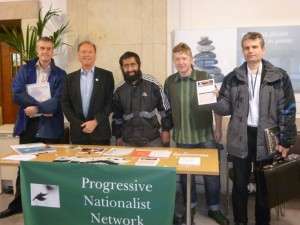 pressure group) ran a stall recently at a meeting concerning the Constitution and discussing how aspects of common law (including – innocent until proved guilty, Habeas Corpus – no detention without charge/trial – and the Jury system) are being ignored and have become superseded by a corporate legal system and, lately, a move towards introducing elements of Continental Civil Law (guilty until proven innocent, no Hab Corpus and politically appointed judges rather than juries). As liberty lovers, these aspects of our society concern us and we support those who are trying to protect our fundamental rights that, it seems, some governments and bureaucracies cannot resist (trying to) remove!