Wednesday, 21 January 2026

Category » Articles

Devon Worker Highlights Bad Housing and Anti-Social Behaviour

EARLY JANUARY saw Glen Maney – National Secretary of the National Liberal Party – issued a wide ranging statement in respect of the economy, Britain’s involvement in foreign wars and Trade Unions. (1)

Here he called for the Con-Dem government to stop its ‘slash and burn’ policy. Instead Cameron and Clegg should concentrate on creating – and not destroying – jobs.

Glen called upon the government to implement several measures, all of which would tackle unemployment. These included a system of limited protectionism, meaningful training schemes, apprenticeships and a jobs creation programme.

He also reiterated that the National Liberal Party was opposed to Britain’s role in foreign wars. “The money spent interfering in the internal affairs of sovereign nations would be better spent bailing out Britain.”

He then went on to call upon ordinary workers (especially those who would regard themselves as nationalist and liberal) to join Britain’s only independent, patriotic and libertarian Trade Union – Solidarity.

He noted that Solidarity Trade Union is “free-thinking and non-dogmatic in outlook” and that it represented all British workers and doesn’t “discriminate on grounds of race, nationality, ethnicity, sex, religion or politics.”

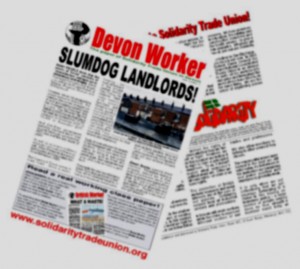
With this in mind the National Liberal Party has welcomed the appearance of the union’s first regional publication, Devon Worker.

Devon Worker’s main article – Slumdog Landlords! – looks at social problems that revolve around bad housing and associated Anti-Social Behaviour (ASB). The paper says:

“Bad housing in Devon comes in many forms. Some is public housing – but much of it is found in the private rented sector. Take Torbay, for instance. Here many tenants with young families are forced to live in unsafe, appalling conditions. Unfortunately, some greedy and unscrupulous landlords only care about their income. They have little consideration for their tenants and neighbours.”

A smaller article – Read a real working class paper! – promotes STUs main paper, British Worker. It notes that the “great thing about British Worker is that it says what you think. There’s no Politically Correct rubbish and its articles are direct and straight to the point. As such, it’s the real voice of ordinary British working class families.”

The NLP would encourage all members and supporters in Devon (and beyond!) to get hold of a copy of Devon Worker. Furthermore, we would ask anyone who wants to help produce a publication either for their nation, region or trade to get in touch with Solidarity as soon as possible.

To get hold of your FREE pdf copy of issue 1 of Devon Worker simply e-mail solidaritygb@aol.com and ask!

(1) http://nationalliberal.org/?p=3535

Share:
  • Print
  • Digg
  • StumbleUpon
  • del.icio.us
  • Facebook
  • Yahoo! Buzz
  • Twitter
  • Google Bookmarks
  • Add to favorites
  • blogmarks
  • Blogosphere
  • Google Buzz
  • PDF
  • email
  • Live
  • MSN Reporter
  • MyShare
  • MySpace
  • Technorati
  • Webnews.de

State of the Union:

The Union, Independence or Devo-Max
– What Future For Scotland?

The Scottish Constitutional Referendum – is it simply a choice between the union or independence? The NLP believes that Devo-Max must also be included on the ballot paper as the ‘third option’.

THE SCOTTISH GOVERNMENT is facing a difficult choice. How many choices does it give the electorate in the long awaited 2014 referendum?

Everyone expects the main question to revolve around whether Scotland should remain within the union or should it seek independence. However, there’s now talk of another choice being offered – whether Scotland should stay within the UK but have the power to raise (and spend) its own taxes. This third option is popularly known as Devo-Max.

Devo-Max is, in effect, the next and final step in the long process of devolution. It represents the maximum power that can be devolved to Scotland from Westminster. Scotland will control their tax collections (full fiscal autonomy) and what services they spend it on. Westminster will only look after ‘UK wide’ services, such as Defence and Foreign Affairs.

When Tony Blair introduced devolution in 1997 he did so to protect the Labour party from a growing SNP. He did not believe in proper devolution. If he did he would have introduced it for ALL the UK’s nations; Scotland, Wales, Ulster and England.

Blair’s fudged settlement meant that Scots will have to wait another two years before it can obtain full devolution. In the meantime, the English are still waiting for their voices to be heard!

FUDGED DEVOLUTION

However, the National Liberal Party proposes to deal with the current fudged devolution settlement through the creation of a federal UK.

First of all, an English Parliament would have to be created. Then greater powers – Devo-Max – would be devolved to the houses of all four home nations. This means that all of the nations of the United Kingdom would have a greater say in their own destiny.

This would also allow a reduction in the number of MP’s currently being sent to Westminster. The role of Westminster would mainly be concerned with defence and issues of national (involving all the home nations) and international affairs. Internal affairs (within each home nation) would then be the responsibility of each devolved government. This is the nature of a proper federal state and will ‘square the circle’ of the present imbalance.

PUT DEVO-MAX TO THE VOTE!

The National Liberal Party is one of true democracy. We will support whatever the people decide! However, our view is that the Scottish referendum will only be truly democratic if Devo-Max is offered as an alternative to independence and unionism.

The inclusion of this ‘third option’ is necessary in the interests of democracy. It’s also a practical option as it allows Scots REAL power without losing the ‘British’ link.

THE National Liberal Party will be producing leaflets in support of the idea of including the ‘third option’ – Devo-Max – on the Scottish referendum ballot paper. They will be specifically designed for distribution in Scotland. Look out for further news on this new initiative in the not too distant future!

For more information relating to the future constitutional make up of the United Kingdom, NLP members and supporters are encouraged to read the following articles:
State of the Union – Do Scots want to leave the UK and is Federalism the answer? http://nationalliberal.org/?p=3391
State of the Union – A Federal Vision. http://nationalliberal.org/?p=3340

Share:
  • Print
  • Digg
  • StumbleUpon
  • del.icio.us
  • Facebook
  • Yahoo! Buzz
  • Twitter
  • Google Bookmarks
  • Add to favorites
  • blogmarks
  • Blogosphere
  • Google Buzz
  • PDF
  • email
  • Live
  • MSN Reporter
  • MyShare
  • MySpace
  • Technorati
  • Webnews.de

Get your FREE copy of 4WR!

LATE LAST YEAR saw the re-launch of Fourth World Review.

John Papworth (4WRs founder, former Editor and now Editorial Board member) confirmed that it would still be promoting the “argument first put forward by Professor Leopold Kohr over half a century ago in his epochal Breakdown of Nations, later popularised in Fritz Schumacher’s Small Is Beautiful. They were simply arguing that the origins of the modern crisis lay in the fact that governments and institutions (including industries), had become so large as to be uncontrollable under any political label, and that the genuine democratic target lay in making them smaller so people could control them”.

The National Liberal Party would recommend 4WR to its members and supporters as its views are similar to our own.

Details on how to obtain a FREE pdf copy of the magazine are given below.

ISSUE 153 of Fourth World Review includes a series of exciting (and wide-ranging) interviews. Those interviewed include:

TIM BRAGG: Tim has been described as “a provocative intellectual renegade.” He is an accomplished musician, published author, Green thinker and activist.

J. NEIL SCHULMAN: As a supporter of Agorism, J Neil Schulman is an advocate of counter-economic activism. He is also the author of Alongside Night.

PETER CHALLEN: Peter is a member of the Christian Council For Monetary Justice. He also co-authored Seven Steps to Justice.

JOHN PAPWORTH: John is the Founder and Patron of Fourth World Review. He has written several books and was the founder of Resurgence magazine.

4WR also includes an article on the Luddites by Kirpatrick Sale, the director of the Middlebury Institute (“for the study of separatism, secession, and self-determination”).

Two articles on the theme of Raising a Voice for Small Nations include a plea to

Stop the Genocide of the Tamils and an overview of Sicilian independence.

The Reviews pages cover subjects such as economics, the environment, small nations & local history

You’ll not want to miss this issue of 4WR which is only available in e-zine format. To get hold of you copy, simply e-mail John Papworth at papworthjohn@yahoo.co.uk and ask for a FREE pdf copy of issue 153.

Share:
  • Print
  • Digg
  • StumbleUpon
  • del.icio.us
  • Facebook
  • Yahoo! Buzz
  • Twitter
  • Google Bookmarks
  • Add to favorites
  • blogmarks
  • Blogosphere
  • Google Buzz
  • PDF
  • email
  • Live
  • MSN Reporter
  • MyShare
  • MySpace
  • Technorati
  • Webnews.de

Liberal Nationalism against Left and Right Politics in Africa

Over the last year we have been approached by a number of persons outside the UK keen on exploring, even promoting, the ideology of National Liberalism. Given that it first emerged as an active force in continental Europe in the mid 19th century, contacts from there was not surprising. However, we have received interest from further afield in areas with no blatant NL tradition such as Africa.

One person making contact is Tarig Anter, a retired civil engineer based in Khartoum, Sudan. He says his main project is the design of new form of national democracy and system of governance, which he calls “Three Dimensional Democracy”. (XYZ democracy), in contrast to the Western democratic system which he says has corrupted the region’s politicians. He is part of a new breed of African who is trying to understand why his continent is suffering so much. He places much of the blame on the US and the ‘New World Order’ and their quest to control the world’s resources. But, he says he doesn’t “blame the USA or Europe but rather I blame the powers that are controlling them and I feel that Europeans are Americans are either victims or tools, but not the shakers and makers of their systems which are wrongly described as democratic and mistakenly considered models.”

In his/their quest for an alternative, we hope they will turn, not to dictatorship or authoritarianism, but to a creed that seeks to preserve a nation’s meaningful independence and its’ people’s liberties and welfare – National Liberalism. In that spirit he has written a short article about the prospects of National Liberalism (and in particular its’ twin Liberal Nationalism) in Africa.

Liberal Nationalism against Left and Right Politics in Africa

As a prelude for discussing the needs and prospects of Liberal Nationalism in Africa, this personal opinion is trying to define the ideology of Liberal Nationalism in comparison to other forms of nationalism; and its challenges against right and left social and economic politics. Ironically, Nationalism is systematically accused of being leftist and rightist by the both globalist camps at the same time although many experts have found that placing Nationalism on a conventional left-right political spectrum is difficult and wrong.

The opinions stated here are personal and does not represent the NLP; they might be critical and even controversial; but that is why they are liberal.

First, it is important to note that Liberal Nationalism (one variation is also called Civic Nationalism) is a new advanced form of nationalism; while National Liberalism appeared in the West since the 19th century as a variant of liberalism. Liberal Nationalism is about establishing resilient governance based on social and economic justice and solidarity; while National Liberalism believes in a stronger national presence on the international stage, mainly through economic and cultural liberalism.

A constructive form of liberalism first (originating in about 1650–1700) became a powerful force rejecting several practices of government, such as nobility, established religion, absolute monarchy, and the Divine Right of Kings.

On the other hand, classical nationalism is a very ancient collective identification of a multitude of individuals within or without ethnic and tribal groups that are working together to preserve and strengthen their various essential interests.

There are a number of different types of Nationalism and types of Liberalism. Many of these forms and practices are unsustainable and aggressive while the principles of both ideologies contain many positive attributes. The most famous African and Asian examples of liberal nationalism so far, are manifested by the South African National Congress Party (ANC) and the Indian National Congress (INC). The closest form of liberalism to Liberal Nationalism is National Liberalism; which is fundamentally different from Social Liberalism (classical liberalism with a social welfare tone).

Other forms of nationalism are: Ethnocentrism; Social Nationalism; Pan-nationalism. All forms of nationalism are anti-colonialism; anti-imperialism; and anti-corporate-globalism. Opposition to Liberal Nationalism comes from Communism; Ultra-nationalism; Socialism; Capitalism; neo-Liberalism; Liberal International; Africa Liberal Network; and religious brotherhoods, in addition to international secret societies.

To promote the principles of Democracy and Liberties together with Nationalism on continental and global levels, international organizations need to be established. These networks shall strengthen Liberal Nationalism in Africa and around the world. Liberal Democracy and Social Democracy are penetrating the world as a result of their institutional organization and support, yet Liberal Nationalism has all the qualities and reasons to succeed all over the world. Such a much needed federation should be tasked with the following:

Coordinating between Liberal Nationalist groups.

Encouraging solidarity among member groups.

Establishing sharing of information and experiences.

I invite you to read and debate on articles at my Tarig Anter blog; such as:
Why Africa Must Trash Western Liberal Democracy?…..& Their Way of Life Too?
Swindles of Modern Liberal Democracy”Swindles of Modern Liberal Democracy
Three-dimensional Democracy (XYZ Democracy)
Neoliberal Corporations & Sunnite Islamism Attacking Nationalism
The Swadeshi Movement

The current developments in Europe; South America; and the USA – and in different aspects in Africa and Asia – are good signs (on top of the list: debts and social injustices). But these crises call for greater and coordinated actions and expositions.

Liberal Nationalism has two main fields for engagement in Africa; the first is to expose the failures of the conventional democratic system as being hijacked and corrupted by liberal and social democracy for global hegemony. The second goal is to propose and call for different national genuinely democratic governance electoral systems where truly Africans have “As much government as necessary, as little government as possible.”

I assume that it is most important for Liberal Nationalism to make the public very aware of the fundamental differences between the various ideologies and trends of liberalism on social; individual/community; economic; and political domains.

Let me add few words about yet another brilliant spirit in liberal nationalism uncommonly seen and may be ignored in an Indian humble movement called “Swadeshi”:

Let me tell you about the Swadeshi movement:

“Spirit Of Swadeshi; (Source: Mani Bhavan Gandhi)

Swadeshi is that spirit in us which restricts us to the use and service of our immediate surroundings to the exclusion of the more remote. Thus, as for religion, in order to satisfy the requirements of the definition, I must restrict myself to my ancestral religion. That is, the use of my immediate religious surrounding. If I find it defective, I should serve it by purging it of its defects.

In the domain of politics, I should make use of the indigenous institutions and serve them by curing them of their proved defects. In that of economics I should use only things that are produced by my immediate neighbors and serve those industries by making them efficient and complete where they might be found wanting. It is suggested that such Swadeshi, if reduced to practice, will lead to the millennium.. . .”

The hostilities towards any form of nationalism, meek or aggressive, were very strongly coming from financiers and bankers in the USA and their communist twin in Moscow, a deceptive polarity aiming at nationalism from both directions. (Social) liberalism (a vacuum cleaner) and communism were and still are the most racist, anti-human rights and totalitarian systems, despite of all the slogans and pretences.

Tarig Mohamed Mohamed-kheir Anter

Khartoum, Sudan
Share:
  • Print
  • Digg
  • StumbleUpon
  • del.icio.us
  • Facebook
  • Yahoo! Buzz
  • Twitter
  • Google Bookmarks
  • Add to favorites
  • blogmarks
  • Blogosphere
  • Google Buzz
  • PDF
  • email
  • Live
  • MSN Reporter
  • MyShare
  • MySpace
  • Technorati
  • Webnews.de

DISTRIBUTISM: A SOLUTION TO NEO-LIBERALISM?

As with our ‘political’ policies, National Liberals seek to find the right economic balance and thus support a mixed economy. State ownership therefore would only exist where it was absolutely necessary in the public interest e.g. a state bank to compete with private institutions to bring down the cost of borrowing (as a state bank wouldn’t charge interest).

In principle however, we believe that the greater the spread of business ownership the greater the productivity, happiness and spread of wealth. We would favour for example, the self-employed, small businesses and cooperatives. This is sometimes explained as ‘Distributism’, an idea founded in the 1920’s, and is a key principle in the NLP’s economic thinking (on political economy).

After many years in the doldrums a new generation is beginning to rediscover this idea and none morseo than in Romania. Below we reproduce an abridged version of an article written for the journal the Distributist Review by one of the leading thinkers, Dr. Ovidiu Hurduzeu, explaining the situation there. Sadly he also says that “liberalism has been entirely hijacked by neoliberals and internationalists in favor of Big Business, the EU and local mafias. Nationalists are more or less ethnic nationalists without a clear economic doctrine. I don’t see any national-liberals in the old inter-war vein in Romania.” Still, perhaps one day, this new generation of activists will expand their thinking and embrace national liberalism in full?

The newly-formed Romanian Distributist League “Ion Mihalache” (see http://www.facebook.com/notifications#!/groups/192652520759544/) marks a first victory for Distributism in Romania. It should come as no surprise that Distributism is being touted as the best vehicle for radical change in this post-communist country.

In the post-World I period, Distributism e.g. increasing land ownership found concrete success in Central and Eastern Europe. After the World War, Eastern European countries, except Hungary, adopted democratic institutions and enfranchised the peasant both politically (by the universal vote) and economically (by the land reform). “Peasant parties,” writes George D. Jackson, Jr., “having been suddenly thrust to the pinnacle of power by the new electoral laws professed their devotion to democracy, anti-Bolshevism, and significant social and economic reforms.” It was a period of hope and enthusiasm. The “vast victory for the peasant” came at a time when new national states in Eastern Europe were created. After 1918, Romania also rejoiced national statehood as she came to include all provinces with an ethnic Romanian majority. Peasants had no accumulated grievances against their governments and stayed immune to the Bolshevik internationalist propaganda (In Romania, for instance, the National Peasant Party vehemently rejected a Comintern-inspired “single great union of workers’ and peasants’ republic in the Balkans”). “The vast victory for the peasant” was short-lived; by the end of the thirties, the agrarian regimes were ended by dictatorship.

Analysis of those movements however show a connection between the agrarian project in Eastern Europe to the aims and principles of Distributism. Like the distributists, the Eastern European agrarians viewed their doctrine and practice as a Third Way, neither capitalist nor socialist. They shared the Distributist antagonism to Big Business, Big Finance, trusts, cartels and the unlimited accumulation of wealth. They were ahead of their time when they advocated sustainable industrialization–industries to be scattered widely in smaller units across the land—and rejected large-scale heavy industries, depending on the interests of foreign investors and the mercantilist national state.

In line with the Distributist view, the agrarians in Eastern Europe believed that humans became free and independent through well-distributed productive property, that is, through ownership and work. Concentration of property and power in the hands of a few was considered degrading to human dignity and disruptive to the social order; it ran against the peasant’s democratic nature–agrarians considered the peasant a “democrat by nature”–and against the peasants’ compelling desire for a sane and stable social order. The keen desire for social stability made the agrarians resist violent changes and revolutionary trends and turned them, in most cases, into pacifists.

Eastern European agrarians were not much less anti-statist than the distributists. They placed emphasis on decentralization, local-self government and the idea of building a state from the bottom up. The agrarians viewed occupational organizations and cooperatives as ideal vehicles, both in securing social stability and organizing the economy of peasant farming. They believed cooperative principles, private property, responsibility towards the community and cooperation in voluntary associations, were valid for all of society. Most programs of the peasant parties demanded that workers should share in the ownership of factories and own their homes.

The prospects of a Distributist order in Central and Eastern Europe (put on hold by dictatorship – Ed) were finally brutally destroyed by communism. Communist rule embodied what the agrarians hated most: giantism, dictatorship, slavery, violence, no God. In Romania, the members of the National Peasant Party were persecuted, murdered or condemned to many years in prison. And yet, the longing for the Distributist order envisaged by the agrarians in the inter-war period is more alive than ever among the Romanians. John Médaille’s (a leading American distributist) visit to Romania and the publication, in that country, of an anthology of Distributist texts, edited by John Médaille and myself, made a breach in the wall of false beliefs and justifications. Many Romanians now realize there is life beyond neo-liberalism, globalism, consumerism, and other delusional “isms” recklessly imported to their country after 1990. Distributism opened their eyes to alternatives they did not even dare to imagine.

Today, if Distributism is to be successful in Romania, and hopefully in other Eastern Orthodox countries, it has to take a somewhat different path from both today’s neo-distributism in the West and the agrarianism of the past. First of all, it has to be rooted in the Orthodox tradition and envisage the world, neither in individualistic nor collectivistic, but personalist terms. Only grounded in the anthropological model of a dialogical personalism can Distributism become an active force in reforming Eastern European societies. Distributism is best equipped to oppose the dehumanizing schemes of both neo-liberals and neo-communists since it never subordinates ends to means. In Romania, neo-liberals, socialists and bureaucrats from Brussels all plan to destroy the “unproductive” peasants, turning them into wage-slaves or commercial farmers, that is, into something other than peasants. The distributists, like the agrarians of yesteryear oppose such a “market revolution” in the village. They offer instead their own economic model, based on co-ops and other forms of voluntary associations.

In Romania, distributists face the daunting task of saving a country from total ruin. To implement their RRR (remoralize the market, relocalize economy and recapitalize the poor), distributists must first repersonalize the economic and social life which became “profane” under communism and Economic Liberalism (capitalism). There is no such thing as a separate, isolated and autonomous economy. Like the England of the “Chesterbelloc”, Romania has no peasant class left to mobilize. The villages are underpopulated and the typical Romanian peasant is an old poor person. The countryside cannot trigger a “vast peasant uprising” (Mitrany) as it did in the 1920’s. And yet there is hope. The 99% of the Romanians do have accumulated grievances against the neo-communist kleptocracy, Big Business–transnational corporations, foreign banks, hedge funds, “strategic investors,” the IMF and the European Union. They now realize the dice are loaded. The crisis has strengthened the already stifling neo-liberal mechanisms and the anarcho-tyranny which grinds down the people at the behest of foreign bankers and local oligarchs. Under the circumstances, Distributism is not an alternative solution. It is the solution, pure and simple.

A fuller version of this article can be found at http://distributistreview.com/mag/2011/12/distributism-in-eastern-europe/

Share:
  • Print
  • Digg
  • StumbleUpon
  • del.icio.us
  • Facebook
  • Yahoo! Buzz
  • Twitter
  • Google Bookmarks
  • Add to favorites
  • blogmarks
  • Blogosphere
  • Google Buzz
  • PDF
  • email
  • Live
  • MSN Reporter
  • MyShare
  • MySpace
  • Technorati
  • Webnews.de

Spare a Thought – a poem for Christmas
Spare a Thought
Gift wraps under X’mas trees,
Colour lights lit bright homes,
Food brimful of dining rooms –
A common scene in our shires.
Yet for a moment, spare a thought
For the ones who ill-afford such comfort’.
Rights denied, captive behind bars,
Terrorised daily in torture chambers.
Marching together amid machine gun fire,
Hoisting freedom flag high into the air.
Thousands fight daily to enjoy liberty,
Making lofty sacrifices to live in dignity.
Bahrain, Russia, Syria, Sri Lanka,
Name of living hells, come to fore.
Raise your voice to erase their sufferin’
Praise their courage, and rally to do somethin’
To make a common stand, on behalf of them
So all nations on earth, may enjoy the freedom.
Jasan
15 December, 2011.
© All rights reserved. Requests for permission to reproduce or translate-whether for sale or non-commercial distribution, should be addressed to E.Jesuthasan, 28 Rutland Road, Ilford, IG11ER.
Share:
  • Print
  • Digg
  • StumbleUpon
  • del.icio.us
  • Facebook
  • Yahoo! Buzz
  • Twitter
  • Google Bookmarks
  • Add to favorites
  • blogmarks
  • Blogosphere
  • Google Buzz
  • PDF
  • email
  • Live
  • MSN Reporter
  • MyShare
  • MySpace
  • Technorati
  • Webnews.de

By continuing to use the site, you agree to the use of cookies. more information

The cookie settings on this website are set to "allow cookies" to give you the best browsing experience possible. If you continue to use this website without changing your cookie settings or you click "Accept" below then you are consenting to this.

Close