Wednesday, 21 January 2026

Category » Articles

Policies Key to Winning Future Elections

Our resident poet, Jasan, doesn’t just delight us with his prose for he has political insight too! He recently sent us his thoughts on what he regards as some of the key contemporary issues facing the UK. We thought we’d share it with you. We certainly agree with his sentiments!

The British electorate – the stake holders of the mother of Parliamentary Democracy – are at present getting the worst deal on several fronts from the current parties in power.

Whoever has bold and new political thinking and vision to address the key issues afflicting British Society, will do well and can, in my opinion, win power.

Key issues include:


1. Parliamentary Reform (Upper House, Proportional Representation, Sleaze-less chambers etc)


2. Pension Reform (see below – Guardian Article*) as to how pensioners are being ripped off by the Pension Fund Holders


3. Banking Industry Reform to make small banks, including regional ones (as in Swiss Cantonal Banks), flourish and cut down the dominance of the City and the existing large banks


Jason

* The row broke out after the Labour leader cited research by the House of Commons library which showed that a monthly contribution of £50 over 40 years with a 0.5% annual fee would lead to a pension of £32,398. But the pension would halve in value to £15,964 if a higher annual fee of 4% is levied.

Consumer group Which? has found that Neptune UK Mid Cap Fund, one of the top 10 pension funds, imposes fees of 3.96%. Neptune says on its website: “We believe that a high standard of client service is an essential part of what we do.” (They would wouldn’t they – Ed).

Share:
  • Print
  • Digg
  • StumbleUpon
  • del.icio.us
  • Facebook
  • Yahoo! Buzz
  • Twitter
  • Google Bookmarks
  • Add to favorites
  • blogmarks
  • Blogosphere
  • Google Buzz
  • PDF
  • email
  • Live
  • MSN Reporter
  • MyShare
  • MySpace
  • Technorati
  • Webnews.de

The Night Before

Our resident poet Jason reflects upon the death of another of our soldiers in Afganistan which many (including us) believe is a pointless and certainly un-winnable war. Patriotism doesn’t mean slavishly supporting a war just because it is carried out under our name. Reflect upon whether the Government is justified in risking these young lives?

A news item of a soldier’s body arriving back from Afghanistan triggered this poem which explores the various emotional introspection’s of a professional soldier on the night before his departure to the battle front.

Soldiers are brave yet the thought of having to leave his loved ones (here his wife) may create doubts in the mind of a soldier, as after all, he is human too.

Poem is a discourse on the mind of a solder “The Night Before” his journey to the battle front.
Hope it aptly expose the melancholy behind a soldier’s life.

I AM NOT GLORIFYING WARS, ONLY TRYING TO GRASP SOME OF THE SEVERAL EMOTIONAL STRANDS BEHIND WARS.

Hope it justifies its own poetical existence.

Jason

The Night Before ……

Neither am I a passionate patriot
Nor am I a knee-jerk coward
Morrow I am to head to the front
Where the destiny will decide the fore word
To my life

Here I lie next to the woman I love
Sleep embrace me not while my soul
Drooled on the events to unfurl
Once I leave the woman I adore

The flag I honour wearily flutter
In the windswept vast space
Posting an invite to the death laden gutter
To live or fall in the name of peace

Dichotomies plenty buried in fear
Fear not I the enemy or the death
Fear I do the morrows for the one I love dear
For country and family, hope destiny spare my breath

Seconds edge away, I wish I could delay
Them ticking away; my hand softly I lay
On the forehead of my darling wife
To wake in the dawn to the call of fife

Gently I rise to east-lit light rays
Today I leave to the front to stray
Into the battle field to fight with dignity
For the land and woman I love dear for eternity

Jason

© All rights reserved. Requests for permission to reproduce or translate-whether for sale or non-commercial distribution, should be addressed to Jason @ e-mail jason_jesuthasan@yahoo.com.

Share:
  • Print
  • Digg
  • StumbleUpon
  • del.icio.us
  • Facebook
  • Yahoo! Buzz
  • Twitter
  • Google Bookmarks
  • Add to favorites
  • blogmarks
  • Blogosphere
  • Google Buzz
  • PDF
  • email
  • Live
  • MSN Reporter
  • MyShare
  • MySpace
  • Technorati
  • Webnews.de

From the Liberty Wall – National Liberal Trades Unionists

NLTU to research liberal involvement in the early trade union movement.

The LIBERTY WALL exists so that the National Liberal Party can host pages and links to campaigning groups sponsored or supported by the party.

One of these is the National Liberal Trade Unionist group. According to the NLTU, it “aims to promote a non-socialist trade unionism i.e. building employee protections rather than class revolution. The group will support the principles of liberty e.g. the protection of all individual employees, and patriotism e.g. the defence of workers from globalisation, and promote a liberal e.g. supporting greater employee share ownership agenda.”

Those interested in finding out more about non-socialist trade unionism should check out the NLTU Facebook page here: http://www.facebook.com/groups/277840098977231

SOME FOLKS may be aware that many of the ‘founding fathers’ of the wider labour and trade union movement were patriotic socialists. Men like Robert (‘Bob’) Blatchford, Henry M. Hyndman and William Morris all fought to improve the plight of the ordinary man and woman.

Interestingly, their views wouldn’t be tolerated in today’s modern – and Politically Correct – Labour Party. For instance, they were all men of principle as well as being radical patriots. They remained true to their roots – and are probably now spinning in their graves at the thought of millionaires like ‘Red’ Ed Miliband ‘representing’ ordinary British working families.

However, not all those involved in the early labour and trade union movement were socialists. Many were non-socialist liberals. Indeed, between 1830-1900 more trade unions were led by Liberals rather than socialists.

One group which intends to document this ‘lost period’ of trade union history is the National Liberal Trade Unionist group. It hopes – in time – to fully research this 70 year period and produce an archive consisting of books and papers relating to this era. It will also look at individual liberals like Joseph Chamberlain MP, who was himself supported by the trade unions.

The NLTU group also intends to investigate why Christian and Liberal Trade Unions were so powerful in Europe before and after WWII.

One of those who’re extremely interested in all of these areas of research is Graham Williamson. Graham is a member of the National Liberal Party’s Steering Committee, editor of New Horizon, the NLPs ideological magazine, and joint editor of Fourth World Review. (Regular readers will know that 4WR is a radical independent magazine which advocates that ‘Small is Beautiful!’)

Graham told us:

“I’ve read a reasonable amount about the early trade union movement and was really interested to find out that many early leading trade unionists were also liberals.

The period between 1830–1900 fascinates me. I hope that the research proposed by the NLTU group will shed more light on the development of the early trade union movement in general and liberal involvement in particular.”

This research is scheduled for some time in the future. However, in the meantime, Graham has written a brief article which – in passing – briefly touches on the subject of liberal trade unionists. We reproduce it below

Once upon a time the Trade Union movement in Britain was largely part of the Liberal movement. The majority of officials were even members of the Liberal Party. This continued from when the first unions were formed up until the turn of the century. The, then new, ideology of socialism took hold amongst many officials who believed that the future of politics was a class struggle and that only a working class party could represent or even deliver power to that class. Thus the Labour party was formed and Trade Unions became synonymous with the party.

In the present day workers still require the services of a union, whether as individuals or as a collective. In the short run, jobs are under threat and employee rights are under attack. In the medium term, workers face the negative effects of globalisation e.g. wage depression or unemployment.

Many however feel that those unions in the TUC, wedded to a confrontational class-based politics, are ill-equipped to respond to these problems.

For example, socialism is no longer popular. The TUC’s ‘workers of the world unite’ slogan rings hollow to British workers losing jobs overseas. Class politics is the exception to the rule and the ‘working-class’ no longer automatically regard the Labour party to be their natural representatives.

In Europe there has always been an alternative trade unionism, either ‘Christian’ or Liberal, and this often resulted in separate unions that reflected their ethos. In the UK such groups failed to found their own unions and slowly shrank in importance within existing ones.

We believe in a Liberal (and patriotic/national) unionism that seeks to protect the interests of its’ members at work rather than as an arm of political or class revolution. In this way unions can focus their energies in the workplace rather than frittered away trying to control the Labour party. A separate liberal union could effectively influence ALL political parties to adopt policies to protect employees in the workplace.

Whether via its own union or within another(s) our supporters will support the principles of liberty (putting the individual member first) and patriotism (defending workers from the negative efects of globalisation), whilst being liberal (increasing employee share ownership) and economic (focusing activity in the workplace) in practice.


Share:
  • Print
  • Digg
  • StumbleUpon
  • del.icio.us
  • Facebook
  • Yahoo! Buzz
  • Twitter
  • Google Bookmarks
  • Add to favorites
  • blogmarks
  • Blogosphere
  • Google Buzz
  • PDF
  • email
  • Live
  • MSN Reporter
  • MyShare
  • MySpace
  • Technorati
  • Webnews.de

CPRE Report Points The Way!

A RECENT REPORT by the Campaign to Protect Rural England (CPRE) has indicated that local economies can support jobs and generate millions of pounds.

A CPRE study – From field to fork: Faversham – looks at Faversham’s “local food web, the network of relationships between food producers, outlets and consumers.”

The report shows that public demand for locally sourced food comes from nearly 40 shops. The CPRE estimates that shops in the area support over 160 jobs and a further 250 jobs come from local suppliers. They also believe that food contributes to the character and identity of Faversham, an ancient market town in Kent.

Thea Platt, a local CPRE representative noted:

“The food web supports around 410 local jobs in farming, food production and at outlets and contributes to a turnover of £9 million in the economy of the local food supply area.

“Local food businesses also add to community life, help local good causes and support diversity in farming and the local countryside.”

The CPRE report makes interesting reading for those – like the National Liberal Party – who would advocate a move away from the big cities towards a more rural way of life. Here, we would like to see as many Britons as possible truly owning their homes and land.

To read From field to fork: Faversham simply click here: http://www.cpre.org.uk/resources/farming-and-food/local-foods/item/2857-from-field-to-fork-faversham

To read another take – this time by Transition Town Totnes – on the CPRE report, click here: http://www.transitiontowntotnes.org/2012/06/transition-town-totnes-bulletin-june-2012/

Share:
  • Print
  • Digg
  • StumbleUpon
  • del.icio.us
  • Facebook
  • Yahoo! Buzz
  • Twitter
  • Google Bookmarks
  • Add to favorites
  • blogmarks
  • Blogosphere
  • Google Buzz
  • PDF
  • email
  • Live
  • MSN Reporter
  • MyShare
  • MySpace
  • Technorati
  • Webnews.de

Party leader finds his natural political home….
Many people seem to flit from one small ‘radical’ party to another, trying to make a difference but often leaving in disappointment. There are many reasons, some personal, some political. One obvious one, but mostly overlooked, is temperament. For example, many members in the NLP, whilst agreeing with social liberals on matters of social justice, electoral reform etc feel uneasy on their acceptance of globalism. Others might be sympathetic to the euro-scepticism of UKIP or the fairness of campaigns for an English Parliament, yet baulk at the inherent conservatism that many such people hold. National Liberals like to find the right political balance on issues and don’t temperamentally rush to extremes. Also, being ‘libertarian light’ we strongly believe in the rights of indviduals to choose their lifestyle and levels of without state interference. This stems more from a temprement than policy.
Below we reprint a message from the leader of a small party who, coming across the party, realised it was his natural poltical home. There will be thousands of others who have yet to find us, yet.

My name is John Botting and I live in Kent. I have always had a keen interest in politics but couldn’t actually take part as I was a police officer. In 1997 a political leaflet came through my door at the same time as I left the force, so I joined that party.
That party was UKIP. I was with them for the next 12 years becoming a branch official, including chairman, standing in two General Elections and numerous local elections. I used to go to their national conference and County committee. However, in the mid 2000’s I had become much more of an English Nationalist and I co-founded a campaign group with-in UKIP called the 1997 Group. This happened in 2008. The idea was to get UKIP to support and campaign for an English parliament. However, knowing the UKIP membership was generally stanchly unionist I knew it would be a hard struggle. It was!

Around this time I was also introduced to the English Democrats and joined them in 2009. Sadly, I soon realised I had made a big mistake as many of its activists were very right wing, some quite unsavoury.

So, what could I do? I had never truly felt at home in UKIP, partly due to my lifestyle, which was at odds with the majority of its members. You see I am gay, and in a civil partnership with an Asian man. That made me a target!

So, with a couple of others we decided that the only way was to set up our own party. So we did, and in October 2009 One England was formed, campaigning for English Independence from the Union, and actually had very National Liberal policies at its core (although I wasn’t aware of this at the time). We were keen to build bridges with other non racist nationalist parties, but we failed to do so. One England struggled for the next couple of years to gain any momentum or really any membership. Although passionate about its message, I started to realise that we were stagnating. I made it known to the party NEC my feelings, but others wanted to keep going. However I started to look around at options. This is when I discovered the NLP.


On looking at the NLP’s statement of principles and other things I had seen I knew that the party was aligned to my own views greatly. However I had some concerns about the party’s history. I spoke to a senior party member and on speaking together and listening to what he had to say I just knew that I had found my political home. I particularly liked the fact that the party was very much thinking “outside the box” and looking to work with other middle of the road parties to try and move this country out of the present stale-mate of 3, well really 2, party state. Although we can never find any party that we can agree with on all its policies (and I don’t agree with some of the party’s greener policies), I do agree with most of what the NLP stand for.

So, I have decided to stand down as Party Leader of One England. I wish the party well. I believe that being a micro party in politics is just not worth it. It is an impossible task. That is why for me the only option is to join forces with a more established party and build on stronger, firmer and larger foundations. I know that the majority of our fellow country folk are sick and tired of politicians and the main 3 political parties. I believe there is an opportunity for a middle of the road, plain talking sensible Liberal party to move rapidly up behind UKIP. Many people hold their noises and vote UKIP because it is the only viable protest vote. Certainly at the EU elections it is a guaranteed way of giving the ruling parties a bloody noise. But, people are just not comfortable in going to a general vote with them. Enter the National Liberal Party!!!!

This is how I see the future for the party and that is why I walked away from the one I co-founded. I want to make a difference; I was unable to with One England. I believe that given time I will be able to, and the NLP party will be able to make that difference.

I would urge like minded people to do the same and join us in the fight for our countries. By that I mean my country of England, but also the UK as a whole.

Share:
  • Print
  • Digg
  • StumbleUpon
  • del.icio.us
  • Facebook
  • Yahoo! Buzz
  • Twitter
  • Google Bookmarks
  • Add to favorites
  • blogmarks
  • Blogosphere
  • Google Buzz
  • PDF
  • email
  • Live
  • MSN Reporter
  • MyShare
  • MySpace
  • Technorati
  • Webnews.de

Why acknowledging our liberties is so important
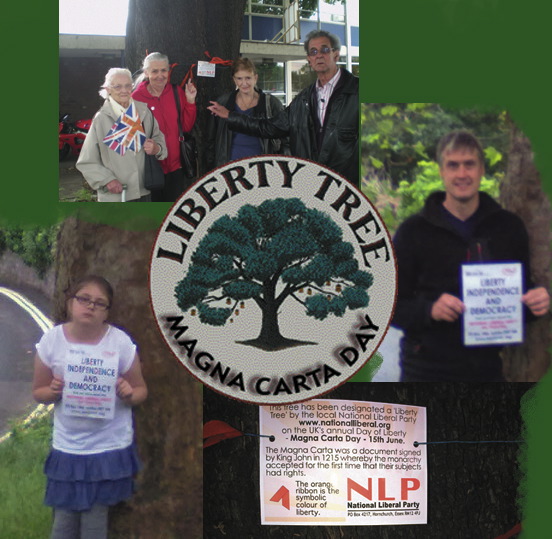
National Liberals throughout the UK celebrated Magna Carta Day (15th June) by decorating designated ‘Liberty Trees’ (trees symbolically representing life and freedom).
The Magna Carta (Great Charter) also symbolically represents liberty, being the first acknowledgement in our country’s history that someone other than a Monarch had rights. Since then we have seen the growth in Parliamentary democracy which sees the monarchy relegated to a ceremonial rather than legislative function. We have a universal suffrage where everyone from 18 years old can vote and there are moves afoot to finally reform the House of Lords. And yet….

In recent times Governments have been looking to extend their ability to monitor if not control their subjects. Suspending the right to trial in certain circumstances and the collecting of data on innocent citizens has become de rigour. The latest, amongst similar schemes over the last decade, is to allow the Police to monitor ALL our communications. The MP David Davis said of his own Government’s plans that it would create a “nation of suspects”. Those of us who love our liberties must be eternally vigilant and campaign and resist any moves to take them away.

National Secretary Glen Maney said “Whilst the signing of the document was in another age matters of privacy and liberty are as relevant today as then. The Home Secretary’s latest proposal that ALL our communications be stored for possible monitoring shows just how important such issues are in our lives and we drop our guard at our peril. Campaigners have decorated ‘Liberty Trees’ as symbols of freedom (in society or in the wild) over the centuries and we wish to restore that tradition.”

The National Liberal Party believe certain measures should be introduced to ensure the protection of individual rights:
  • Introduce a Bill of Rights (an updated Magna Carta) to be enshrined in a constitution,
  • Create a Civil Liberties Watchdog to monitor infringements of liberties and privacy,
  • Run a ‘Celebrating the Magna Carta’ series of activities both in public and in schools explaining the meaning and significance of the Magna Carta i.e. that all citizens have rights and freedoms.
Share:
  • Print
  • Digg
  • StumbleUpon
  • del.icio.us
  • Facebook
  • Yahoo! Buzz
  • Twitter
  • Google Bookmarks
  • Add to favorites
  • blogmarks
  • Blogosphere
  • Google Buzz
  • PDF
  • email
  • Live
  • MSN Reporter
  • MyShare
  • MySpace
  • Technorati
  • Webnews.de

By continuing to use the site, you agree to the use of cookies. more information

The cookie settings on this website are set to "allow cookies" to give you the best browsing experience possible. If you continue to use this website without changing your cookie settings or you click "Accept" below then you are consenting to this.

Close