




Monday, 19 January 2026

Category » Articles

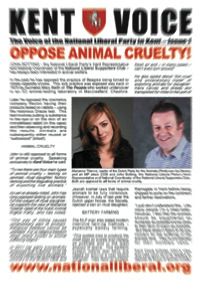
Review of Kent Voice (Issue 1)

ISSUE 1 of Kent Voice (KV) came out in February of last year and looked at the issue of animal cruelty. KV1 – the ‘Voice of the National Liberal Party in Kent’ – examined the barbaric nature of testing on animals, ritual slaughter, factory farming and exporting live animals. These practices demonstrate that there “doesn’t seem to be any concern for the suffering of the animals here. They’re just abused for their monetary value.” Thus Kent Voice called for opposition to all forms of animal cruelty.

This review of Kent Voice has been written by Liam Clarke. As with his other reviews, this is full of passion, sincerity and is highly personal.

To read Liam’s review of Caledonian Voice (the Voice of the National Liberal Party in Scotland) click here: http://nationalliberal.org/review-of-caledonian-voice

To read his review of English Voice (the Voice of the National Liberal Party in England) click here: http://nationalliberal.org/review-of-english-voice

To read his review of the Isle of Wight Voice (the Voice of the National Liberal Party on the Isle of Wight) click here: http://nationalliberal.org/review-of-isle-of-wight-voice-issue-1

AS SOMEONE who cares very deeply for the rights of animals, I believe that it’s essential that we in the National Liberal Party make clear our beliefs regarding this issue. We shouldn’t throw it on the ‘back burner’ going into May’s European elections, as many of the main parties will do. (I saw Nigel Farage recently being interviewed by Andrew Neil on BBC2s Daily Politics show. I Neil read some of UKIP’s policies from its 2010 manifesto – and Nigel ‘Mein Führer’ Farage looked stunned at some of the things that were coming from it. We must make sure that we do not fall to the same kind of idiocy that Nigel did.)

Personally speaking, I believe that charities such as the RSPCA should be given wider reaching powers – similar to that of the police – in cases of animal abuse or neglect. When people are accused of abusing children (and this is a subject that has been very much in the news recently) there is a general outcry by the public. People accused of such disgusting acts are to be deplored.

But shouldn’t this also be true of those who abuse animals? Sure you can read about it in your local newspaper and think “Why would a human being do such a thing?” and you may even have a discussion with your family about it. So why are people not given the same treatment for abusing animals as they do young children? We are all living breathing living organisms, living on a floating rock in space so surely we are all entitled to a standard of living where we are not abused by our fellow animals?

One thing that I cannot comprehend is the testing of make up on animals. To me those who are willing to see this happen have selfish and depraved minds. How they can countenance a defenceless animal being abused – and enduring absolute agony – is beyond me. This is especially so when we think that if we were to put a human in their place the question of morality would shoot from zero up to the high heavens! (You often see the messages of hate towards paedophiles and murders saying they should be tested on or hung in public and so on – yet it is perfectly acceptable for the same torture being dished out to an innocent animal as it is a guilty human being!)

A further point on this issue is the simplicity that vets seem to have in saying that a pet can be put down. I recall reading (in the The Sun) about a lady who refused to have her dog put down three times after it attacked her. She said “You wouldn’t put down a child for lashing out.” It’s a point which I think needs to be explored more.

However, there is one area in Kent Voice where we may need to ‘edge on the side of caution.’ And that’s in terms of religious practice and freedoms. This is a question to which we must apply considerable care and neutrality. I am sure there are many atheists and indeed people of faith who will be reading this review, and to you all I say is nothing. For you are all entitled to beliefs of a varying kind, just because one is religious does not mean that they would allow an animal to be sacrificed as part of some ‘wacky’ ritual just as an atheist is not automatically able to condemn it. As part of the NLP strategy we should indeed promote the idea that a ritual killing is not to be accepted. However, we must not adopt an ‘imperialist’ tone here. Indeed, I think that we must always ask ourselves the question: who are we, as democrats and believers in freedom, to question the rights and beliefs of those not bound by our law?

• To get hold of issue 1 of Kent Voice, simply e-mail natliberal@aol.com and ask for your FREE pdf copy! We hope to have issue 2 of KV out later this year.

Share:
  • Print
  • Digg
  • StumbleUpon
  • del.icio.us
  • Facebook
  • Yahoo! Buzz
  • Twitter
  • Google Bookmarks
  • Add to favorites
  • blogmarks
  • Blogosphere
  • Google Buzz
  • PDF
  • email
  • Live
  • MSN Reporter
  • MyShare
  • MySpace
  • Technorati
  • Webnews.de

Vote Social Media!

WHEN BARACK OBAMA became American President in 2008 it was said that he was the first politician to use Social Media to achieve major success in a political campaign. In a fast moving world it’s crucial those with a message, especially of a political persuasion, utilise every tool available to them to have maximum impact.

The traditional methods of delivering leaflets, television debates and party political broadcasts just don’t have the same impact anymore. Generation Y want information now – and holding the key to election success is Social Media.

With more ‘friends’ on Facebook and ‘followers’ on Twitter than his rivals, Barack Obama reached out to America in every way possible. The campaign will be remembered less for a televised debate and more for the number of likes, comments and shares he received. Forget the ‘clapometer,’ the time of the Facebook ‘insight’ is upon us. Television was dead and Social Media reigned. This watershed moment signified a completely different tact for politicians in how they campaign.

Social Media has also revolutionised the face of the marketing industry. Facebook and Twitter have become the number one marketing tool for companies worldwide, and it’s free to use! With 100% return on investment just for sharing content on the Social Media platforms it’s a no brainer to engage with a directory with over a billion subscribers, all waiting for content to hit their news feeds.

When we look at the type of content to share we are not talking about lengthy dichotomies on your manifesto or reasons why people should vote for you (save that for your website) we are talking about snippets of information designed to quickly engage, even amuse, your online followers. Put yourself in the shoes of the voter. As Dave Kerpen discusses in his book Likeable Social Media, “the internet is nothing like it was five years ago, when people endlessly surfed the Web. Many people just don’t access information on the Web in that way anymore. If anything, users surf Facebook, Twitter, and other social networks looking for relevant and recommended content.” They also want it instantly and interesting enough they will ‘share’ with their online friends.

Why is a ‘share’ or ‘retweet’ important? Imagine going to a restaurant that served you the best meal you’ve ever eaten – chances are you will probably want to tell your friends about this culinary paradise and chances are quite a few of them will want to visit themselves. This is because word of mouth is that much more powerful than direct advertising. Now, taking that same notion and thinking about Social Media, if we were to ‘share’ our experiences on there it rings true that others will trust this form of recommendation from an actual human than a faceless advert, the kind of which you probably think clutters your news feed. And it costs you nothing! The average person on Facebook has 125 friends if they were to share your political messages think of the size of audience you would be getting, instantly.

As of 2010 one-quarter of all Internet page views were on Social Media. Imagine no more long cold Sunday afternoon’s spent hand delivering leaflets, around your constituency, fearing your fingers being bitten off by a residents dog as your drop your latest mail shot through the letterbox. Rather, imagine running your whole campaign sat behind a keyboard in a warm home simply delivering messages to people’s news feeds.

You have to be active though. A simple rule is to post no more than three status updates on Facebook and tweets on Twitter per day. You want to stay in voters minds but not ‘spam’ them. Keeping your audience engaged will lead to more likes and followers and also remain at the top of the news feed. Ask your audience what they think of your policies and keep the discussion rolling. Communication is key.

In the UK we are yet to see a political party really use social media to their advantage. Set the benchmark and you can be Britain’s next Obama!

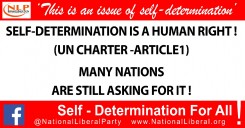
• THE National Liberal Party intends to stand eight candidates in London to fight the European elections. These will be held on 22 May. The main theme of our campaign will be Self-Determination For All! Self-Determinists can keep in touch with our campaign via a Twitter feed and two Facebook sites:

• Twitter @Self_Determ_Day

• Facebook/Nations without States: https://www.facebook.com/groups/184919468292372/

• Facebook/Self-Determination Day: https://www.facebook.com/events/232679183580785/

Share:
  • Print
  • Digg
  • StumbleUpon
  • del.icio.us
  • Facebook
  • Yahoo! Buzz
  • Twitter
  • Google Bookmarks
  • Add to favorites
  • blogmarks
  • Blogosphere
  • Google Buzz
  • PDF
  • email
  • Live
  • MSN Reporter
  • MyShare
  • MySpace
  • Technorati
  • Webnews.de

Time to de-criminalise drugs? – A message from Russell Brand

As a former drug addict I never miss an opportunity to harp on about drugs. Below this email are some links to articles I’ve written on my own addiction, the death of Amy Winehouse and lately Philip Seymour Hoffman.

I assume you’ve read all three and are well acquainted with my tragic condition and brave graciousness in the face of adversity. Thank God. We can now focus on what’s important. Right.

My belief is that addiction is a disease and making it illegal to have a disease makes a bad situation worse. We all know someone affected by addiction to drink or drugs, even if they’re just some discarded human casualty we step over on the street.

The truth is this is a situation that we can improve by working together. Here are some facts:

Almost 2,000 young people die in the UK each year from taking illegal drugs of uncertain potency, that they can only get hold of on the illegal market. Leading police, doctors, and politicians agree prohibition has completely failed to curb addiction and instead is costing the UK £3 billion a year.

Over 100,000 Britons are arrested every year for using drugs – and of course it is the poor and minority users who are targeted, not the rich and powerful.

You may as well know that I believe contemporary democracy to be a meaningless charade designed to placate and distract – but I’m willing to be proved wrong. There’s a chance to start the debate, begin a sane and effective policy and save lives: Nick Clegg says he wants reform (at the moment- so act quick before he changes his mind) and the anomalously trustworthy MP Caroline Lucas has started a campaign to call for a full review of UK drugs policy. But we only have days to get 100,000 of us to join her so the government will be forced to debate it in Parliament. It will take 90-100 seconds (depending on typing skills). Please sign this thing:

http://www.avaaz.org/en/uk_epetition/?bHWScbb&v=35792

Other countries have tried sensible policies based on something called evidence— Portugal eliminated criminal penalties for drug users more than a decade ago. Since then, the number of teenagers who take illegal drugs has gone down, the number of addicts who undergo rehab up, and there’s been a big drop in drug users who become infected with HIV. Switzerland, too, has seen crime plummet and drug-related deaths fall since bringing in more progressive and tolerant drug laws.

The e-petition is easy: if 100k of us sign up, the drugs policy will be debated in Parliament. This in turn will help get the government to change the failing drug laws and save lives.

I’ve signed it and I hate signing things, it reminds me of school and I feel like participating makes me a tedious square and no better than them slimey battery-pod people from the Matrix (Neo before rescue) however I have done it as this is a war I know we can win. Prohibition is an idea that is dying, let’s kill it now with unified defiance so we lose as few people to drugs and their related problems as possible. Cheers.

http://www.avaaz.org/en/uk_epetition/?bHWScbb&v=35792

Russell Brand

MORE INFORMATION:

Russell Brand: my life without drugs (The Guardian)
http://www.theguardian.com/culture/2013/mar/09/russell-brand-life-without-drugs

Russell Brand on Amy Winehouse: ‘We have lost a beautiful, talented woman’ (The Guardian)
http://www.theguardian.com/music/2011/jul/24/russell-brand-amy-winehouse-woman

Russell Brand: Philip Seymour Hoffman is another victim of extremely stupid drug laws (The Guardian)
http://www.theguardian.com/commentisfree/2014/feb/06/russell-brand-philip-seymour-hoffman-drug-laws

The lesson from Latin America: we need to rethink the drugs war
http://www.theguardian.com/commentisfree/2014/feb/08/nick-clegg-latin-america-lessons-drugs-debate


Support the Avaaz Community!
We’re entirely funded by donations and receive no money from governments or corporations. Our dedicated team ensures even the smallest contributions go a long way.
Donate Now
Share:
  • Print
  • Digg
  • StumbleUpon
  • del.icio.us
  • Facebook
  • Yahoo! Buzz
  • Twitter
  • Google Bookmarks
  • Add to favorites
  • blogmarks
  • Blogosphere
  • Google Buzz
  • PDF
  • email
  • Live
  • MSN Reporter
  • MyShare
  • MySpace
  • Technorati
  • Webnews.de

From The Liberty Wall – Total Democracy – NOTA Update

TOTAL DEMOCRACY (TD) is a campaigning body that seeks co-operation between centralist political parties, independent groups and individuals.  TD describes itself as a “co-operation of interested groups who work together on specific campaigns, you opt into the ones that match your values and ignore the ones that don’t.” It was founded by four organisations – the Democratic Reform Party, People’s Democratic Party, Popular Alliance and the National Liberal Party.  In October 2013 the British Senior Citizens Party – led by Robin Macfarlane – joined TD.

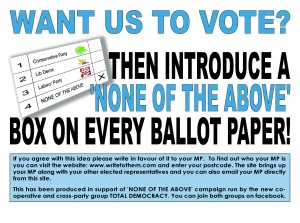
Total Democracy’s first campaign is to introduce a None Of The Above (NOTA) box on our ballot papers.  TD feels that the NOTA option will help to increase turnout as voters can express their disapproval until a REAL political alternative can gain traction!

At the moment, the main focus of TD is to raise awareness of NOTA.  TD feels that it needs to explain how a bonafide None Of The Above option would work in practice and why it is so necessary to have one in any truly functioning democracy.

With this in mind, the NOTA campaign was discussed in some detail at a National Liberal Party meeting held towards the end of last year.  Also last year a NOTA representative from a separate group appeared on national radio (Eddie Mair’s PM show on BBC Radio 4) to talk about the campaign.  Despite only being alotted a couple of minutes, the main points of the campaign were broadcast to a large audience.

As we understand it, this was the most high profile mention of NOTA in the mainstream media to date at that time.  Since then, however, Newsnight anchor Jeremy Paxman, has announced his support for a bonafide NOTA option on BBC One’s primetime show The One Show.

It’s probably fair to say that the concept of NOTA is now much more on the radar of the general public and the mainstream media that it was a few months ago.  This is a huge achievement, not just for the NOTA campaign itself, but for all those campaigning for a more democratic system of government.

To find out more about Total Democracy, click here:  https://www.facebook.com/TotalDemocracyUK?fref=ts


Share:
  • Print
  • Digg
  • StumbleUpon
  • del.icio.us
  • Facebook
  • Yahoo! Buzz
  • Twitter
  • Google Bookmarks
  • Add to favorites
  • blogmarks
  • Blogosphere
  • Google Buzz
  • PDF
  • email
  • Live
  • MSN Reporter
  • MyShare
  • MySpace
  • Technorati
  • Webnews.de

ISLE OF WIGHT VOICE

I was an Isle of Wight resident for six years and my family still live there. I have a love of the Island and think anyone who stays there for any length of time will feel the same.

The Island has been heavily affected by the recession but in all honesty its tourist trade was falling before the recession hit.

The biggest problem in my humble opinion is that the two ferry companies who service the Island notably Wightlink and Red Funnel charge exorbitant prices for both cars and foot passengers to both visit and leave the Island.

This is not only a restrictive cost to holiday makers and one that I know has put many people off visiting the Island, but basically a restriction of trade for Islanders wanting to work on the mainland and vice versa. We at the National Liberal Party have written to WightLink and Red Funnel asking them to introduce a £30 a week daily return ticket (requiring a photocard) to make it cost effective for people to work on and off the Island and thus inject both skills and much needed money from the mainland into the Island’s economy. As yet we’ve had no response from the companies in question.

Now let’s remember that this is meant to be a holiday Island and keep this in mind when we look at the latest events in the Island’s finances and the money saving proposals.

The Isle of Wight County Press reported this week that SAVAGE service cuts, parking hikes and mass redundancies are on the cards as the cash-strapped Isle of Wight Council looks to plug a £28m black hole in its budget over the next three years.

Following repeated warnings services would have to be radically overhauled, farmed out to parish councils and community groups or simply axed as a result of further reductions in government funding and rising costs, the sheer scale of the budget crisis emerged this week with the publication of papers ahead of next week’s cabinet meeting.

Savings proposals due to be considered by the cabinet on January 9, and full council on January 15, reveal how many services are under threat. The full report can be viewed below.

All non-statutory services — including the maintenance of parks, beaches and cemeteries, school crossing patrols, leisure centres, youth services and Medina Theatre — could be farmed out to third parties, if anyone is willing to take them on.

Charges for the Cowes floating bridge will be reviewed, with a view to generating an extra £900,000 over the next three years, and parking charges look set to rise, generating £600,000. Proposals include increasing short-stay charges by 20 per cent and long-stay charges by ten per cent, scrapping free parking at leisure centres, ditching the blue badge concession in car parks and introducing more on-street charges.

The number of community safety and environment officers could be reduced, which means there would no longer be any monitoring of toilet and beach cleaning contracts, or enforcement of fly tipping, graffiti or littering, and the Fairway Athletics Track could be closed.

Other proposals include increasing charges for bereavement services, scrapping emergency phones at beaches and free swimming for children in the summer holidays and axing funding for Dinosaur Isle, the Youth Island Games, Walking Festival and Cycling Festival.

Social care cuts, including increasing charges for respite care and reducing personal budget payments, residential care admissions and funding for adult and community learning, are also on the cards.

Redundancies look likely across the board — from strategic directors and heads of service, to senior and middle managers through to support and back office staff.

It is proposed an HR1 notice, where the potential exists for more than 100 redundancies in 90 days, be issued.

Last week, as revealed by the Isle of Wight County Press, Unison warned there could be as many as 300 compulsory redundancies over three years.

Members will consider increasing council tax by two per cent, which equates to £26 per year on a Band D property, raising £600,000.

Further options to be considered in more detail include merging the Isle of Wight Fire and Rescue Service with another authority and squeezing extra £1m worth of savings from the new waste contract.

A proposal to use £5m from balances and reserves during the next financial year, to buy the authority some time, has already been agreed.

Given the budget is due to be set by full council on February 26, a question mark hangs over the council’s ability to make the necessary savings in time. Many of the proposals are subject to reviews and public consultations before services can be cut, and staff will need to be consulted prior to redundancies being made.

Proposals include:

• Reducing the number of senior and middle managers, saving £1.1m over three years.

• Increasing parking charges, saving £600,000, and reducing the number of traffic wardens, saving £60,000.

• Transferring the provision of school crossing patrols to schools and parents, saving £230,000.

• Reducing the number of environment officers, saving £400,000.

• Reducing the maintenance of council-owned parks, cemeteries and beaches, or seeking third parties to take them on, saving £1.4m.

• Increasing bereavement service charges, saving £120,000.

• Scrapping the provision of beach safety equipment, such as emergency phones, saving £100,000.

•Scrapping sport development and support for the Youth Island Games, saving £280,000.

• Encouraging the West Wight Sports Centre to operate independently, potentially leading to its closure, saving £148,000.

•No longer running the Walking and Cycling festivals, and seeking third parties to take them on, saving £152,000.

• Reviewing floating bridge charges to increase income, saving £900,000.

• Seeking to operate all leisure centres (The Heights, Medina and Westridge) at nil cost to the council, saving £1m.

• Re-introducing fees for children’s swimming in the school holidays, saving £90,000.

• Handing the management of the Fairway Athletics Track to the athletics club or school, or closing it, saving £46,000.

• Seeking a third party to take on Medina Theatre, saving £138,000.

• Seeking more NHS funding for community and residential care provision, saving £2.1m.

• Reducing personal budget payments, saving £1.3m.

• Reducing admissions to residential care, saving £2.1m.

• Increasing charges for respite care, saving £450,000.

• Reducing funding for adult and community learning, saving £300,000.

• Scrapping funding for Dinosaur Isle, saving £60,000.

• Reducing library administration costs, saving £120,000.

• Implementing a new senior management structure, including the deletion of strategic director and heads of service posts, saving £2.2m.

• Reducing support services and back office posts, saving £1.3m.

• Reducing support services, saving £6.6m.

• Reducing the number of community safety officers, saving £110,000.

• Restructuring administrative support and reducing spend on external consultants, in relation to the highways PFI, saving £480,000.

• Reducing youth service spend, saving £600,000.

• Reducing procurement spend, by scrapping the courier contract and reducing mobile phone usage, saving £423,000.

Frightening isn’t it? And what has Andrew Turner MP the Island’s Conservative Member of Parliament done about securing jobs and securing an additional £28 million over three years to make sure that the jobs are secured and services remain up to a level where the Island is still work visiting ? The answer as per usual with Mr. Turner is a pretty unimpressive NOTHING.

Let’s put the Island’s THREE year shortfall into perspective shall we?

£28 million pounds is approximately Three times the amount spent on a funeral for a certain Margaret Thatcher!

+£28 million pounds IS THE ESTIMATED cost of keeping the British military in Helmand province for TWO DAYS!

The UK Government estimates it has spent 11 billion pounds in fighting in Iraq.

*The war in Afghanistan has cost Britain at least £37bn and the figure will rise to a sum equivalent to more than £2,000 for every taxpaying household, according to a devastating critique of the UK’s role in the conflict.

Since 2006, on a conservative estimate, it has cost £15m a day to maintain Britain’s military presence in Helmand province. The equivalent of £25,000 will have been spent for every one of Helmand’s 1.5 million inhabitants, more than most of them will earn in a lifetime, it says.

By 2020, Britain will have spent at least £40bn on its Afghan campaign, enough to recruit over 5,000 police officers or nurses and pay for them throughout their careers. It could fund free tuition for all students in British higher education for 10 years.

# Much of this war finance comes from the Government’s ‘Special Fund’ currently estimated to be £8 billion pounds for this financial year.

I’m asking Islanders, whether they are National Liberal supporters or not to write to Andrew Turner asking him to go to his war loving Government and ask that as the Island is a special case in that it is hindered by the most expensive to cross small section of sea in Europe and is an area of natural beauty that the UK should be proud of could his Government fill the £28 million pound hole from the ‘Special fund’ as this is a ‘special’ case.

He can be emailed at mail@IslandMP.com

Let’s make 2014 the year we get our elected representatives to work for and actually help GOVERN instead of blindly following parties who just don’t care.

Glen Maney

National Secretary of The National Liberal Party

*Frank Ledwidge, author of damning study Investment in Blood,

+Wikipedia

#Casi.org.uk

All other information is copied from the Isle of Wight County Press.

Share:
  • Print
  • Digg
  • StumbleUpon
  • del.icio.us
  • Facebook
  • Yahoo! Buzz
  • Twitter
  • Google Bookmarks
  • Add to favorites
  • blogmarks
  • Blogosphere
  • Google Buzz
  • PDF
  • email
  • Live
  • MSN Reporter
  • MyShare
  • MySpace
  • Technorati
  • Webnews.de

From The Liberty Wall – Nations without States – Independence For Ulster?
WAYNE GILMOUR is a 19-year-old unemployed Protestant from North Belfast. At school he studied Irish history as well as British, Irish and American politics. It was during this period that he became interested in the concept of an independent Ulster and started to research the idea.

He thought that independence was – politically and morally – the most logical way forward. Indeed, he views it as the only way that there may ever be some form of normality in Ulster.

Wayne describes his own political outlook as “a strange mix of socialism and conservative views.” He believes that everyone has the right to express their ideas – so long as they don’t deny this same right to others.

This is his very first article promoting his personal ideas relating to an independent Ulster. He is more than happy to debate his views – and provide (a no-holds barred) young working-class Protestant view on current events in Ulster.

Therefore if anyone wishes to provide a constructive critique please post it on the Nations without States Facebook page: https://www.facebook.com/groups/184919468292372/
Independence For Ulster?

The Ulster Independence flag – more correctly known as the Second Ulster National flag - is generally flown by those who support the concept of ‘Ulster a Nation.’ They want their nation to stand on its own two feet, free from the shackles of both Westminster and Dublin.

IN ALL aspects – politically, socially and economically – Ulster has been broken for many years. This is because our liberties and identity have been stripped away because of the Government’s perverted policy of enforcing ‘equality.’ Normality isn’t an option as we’re still divided. The same old Orange and Green (1) format remains.

Therefore I believe the only way to ensure a viable existence beyond the old arguments is to develop an Ulster identity – and to fight for our right to be a nation.

I would still describe myself as a Unionist/Ulster Loyalist. I still believe in maintaining the link with the Crown. However I don’t believe in blind religious hate. Nor do I like to see Ulster having to pander to Westminster or Dublin when all decisions should be made in Belfast.

I want to see a new dawn rising over the land I love so much. I’d like to see the many of the Hoods (2) who sit in power removed. So what is this Ulster nation I speak of? I’d like to see:

• An independent state under the crown. It would have full powers over its own affairs

• A place where people regard themselves as Ulidian (3) as opposed to British or Irish

• A free society where there is civil and religious liberty for ALL

• A place where Terror doesn’t gain you political authority

• A place where a set of traditions and values are maintained allowing a people to live in peace and gain a sense of ‘belonging’

• Full governmental accountability

• Freedom to maintain our own laws free from Dublin/Westminster involvement

• Ending political policing and scrapping all forms of Religious ‘affirmative action.’

In my view, if an Ulster nation were to rise, it would see the death of militant Irish republicanism whilst making loyalism safe in its ‘own house.’ And this would slowly normalise politics within Ulster.


Listed below are some of the publications and a web-site which have influenced my thinking:

Ulster A Nation. Ulster Vanguard . 1972.

Community of the British Isles. Ulster Vanguard . 1972

Beyond The Religious Divide. New Ulster Political Research Group. 1979.

Common Sense. Ulster Political Research Group. 1987.

(1) In Ulster the colours ‘Orange’ and ‘Green’ are used to denote someone’s religion and politics. Orange generally refers to a Protestant whilst ‘Green’ is used to describe a Catholic.

(2) A ‘Hood’ refers to a criminal or a gangster.

(3) Ulster is referred to in many ancient texts as Uladh, Ulaid and Ulidia. Some Ulster patriots prefer to use the phrase ‘Ulidian’ when describing the people of their land.
Share:
  • Print
  • Digg
  • StumbleUpon
  • del.icio.us
  • Facebook
  • Yahoo! Buzz
  • Twitter
  • Google Bookmarks
  • Add to favorites
  • blogmarks
  • Blogosphere
  • Google Buzz
  • PDF
  • email
  • Live
  • MSN Reporter
  • MyShare
  • MySpace
  • Technorati
  • Webnews.de

By continuing to use the site, you agree to the use of cookies. more information

The cookie settings on this website are set to "allow cookies" to give you the best browsing experience possible. If you continue to use this website without changing your cookie settings or you click "Accept" below then you are consenting to this.

Close