Saturday, 11 July 2026

Category » Articles

ASLYUM SEEKERS
.
Some members of the pressure group Nations without States and it’s sponsor (The National Liberal Party) are from the various self-determinist Diasporas that live in the UK. Some of them have claimed political asylum as to be returned to their homeland may lead to their imprisonment and/or death.
.
Traditionally Asylum has been given by countries, such as the UK, to those individuals whose political activities have put their lives in jeapody. This is because we as a country have always prided ourselves in supporting and practicing freedom of speech and association. Giving asylum helped highlight the contrast between our principles and those of countries where activists were fleeing from. This is why in the 19th century the UK gave refuge to such disparate figures as Mazzini and Marx.
.
WIDENING THE DEFINITION
.
Today those seeking and those giving asylum have widened the scope to those claiming persecution as a collective group regardless of whether they were personally under threat. The definition of persecution has also widened to include personal lifestyle or alternatively danger i.e. from war. Those claiming the latter are usually described as refugees e.g. Syrians, but technically all those given asylum are ‘refugees’. Globalisation has also facilitated the ability of individuals to physically claim asylum. Few are expected to return and are effectively resettled.
.
POLITICAL ASYLUM
.
Unfortunately the loosening of the Asylum definition, the abuse of it by those who might be described as ‘economic’ migrants and the sheer numbers, have confused and discredited the whole concept in the eyes of many. Somehow we need to reclaim and distinguish the genuine from the bogus. We will nevertheless always support those genuine political asylum seekers but not those who seek to use it as a cover.
Share:
  • Print
  • Digg
  • StumbleUpon
  • del.icio.us
  • Facebook
  • Yahoo! Buzz
  • Twitter
  • Google Bookmarks
  • Add to favorites
  • blogmarks
  • Blogosphere
  • Google Buzz
  • PDF
  • email
  • Live
  • MSN Reporter
  • MyShare
  • MySpace
  • Technorati
  • Webnews.de

Hierarchy of Societal Needs
.
.
Amongst social theories of motivational behaviour Abraham Maslow’s ‘hierarchy of need’ stands out. Essentially he classified the ‘needs’ of individuals e.g. Physiological to ego to goals.
.
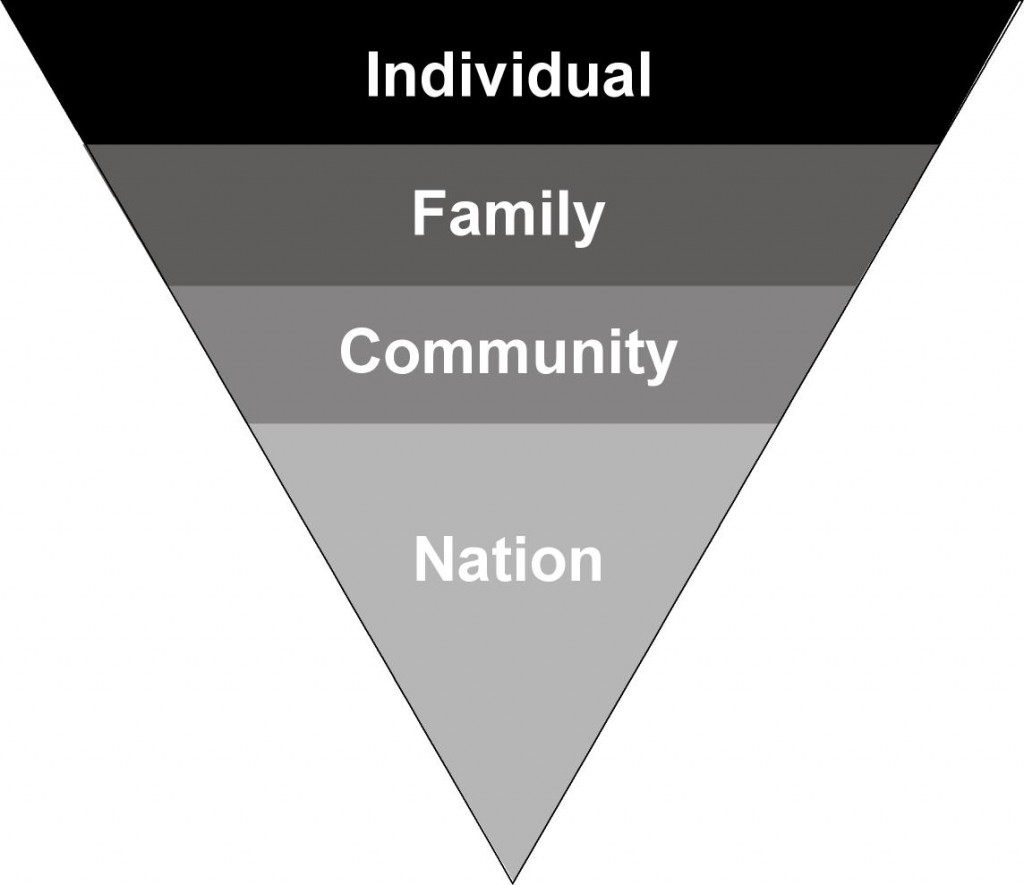
In the same way we believe there is a hierarchy of societal needs that the average human being ‘signs’ up to. In simple terms these are the Individual – Family – Community – Nation/Country.
.
Individual
.
Some are introverted some extroverted. Some are social some prefer their own company. All however like some level of ‘independence’ and the freedom to choose their own opinions, likes and dislikes.
.
Family
.
Straight or Gay, most are part of a living family and value their relations both present and those that will live beyond them.
.
Community
.
These include friends and acquaintances and beyond. It might be religious or political but is most usually locational i.e. a district or council area, where most people interact, shop, work and play.
.
Nation/Community
.
All, enthusiastically or otherwise, belong to that widest of communities sharing a common history and culture. People make sacrifices to a nation (and to family and community) that they wouldn’t beyond it e.g. pay taxes, give to charity and some even serve in various national forces.
.
These are the basic building blocks of society. Like Maslow there is a ‘pyramidal’ structure but inverted i.e. the level of significance seen through the prism of human beings. We must cherish and protect these needs for generations to come.
Share:
  • Print
  • Digg
  • StumbleUpon
  • del.icio.us
  • Facebook
  • Yahoo! Buzz
  • Twitter
  • Google Bookmarks
  • Add to favorites
  • blogmarks
  • Blogosphere
  • Google Buzz
  • PDF
  • email
  • Live
  • MSN Reporter
  • MyShare
  • MySpace
  • Technorati
  • Webnews.de

Distributism As A Means of Achieving Third Way Economics (Part 3)

THIS is the third in a five part series about Distributism. The original was written by Richard Howard in 2005 and appeared on the web-site – http://www.hsnsw.asn.au/index.php – of the Humanist Society of New South Wales..

This article should be read directly on from part 1 http://nationalliberal.org/distributism-as-a-means-of-achieving-third-way-economics-part-1 and part 2 http://nationalliberal.org/distributism-as-a-means-of-achieving-third-way-economics-part-2

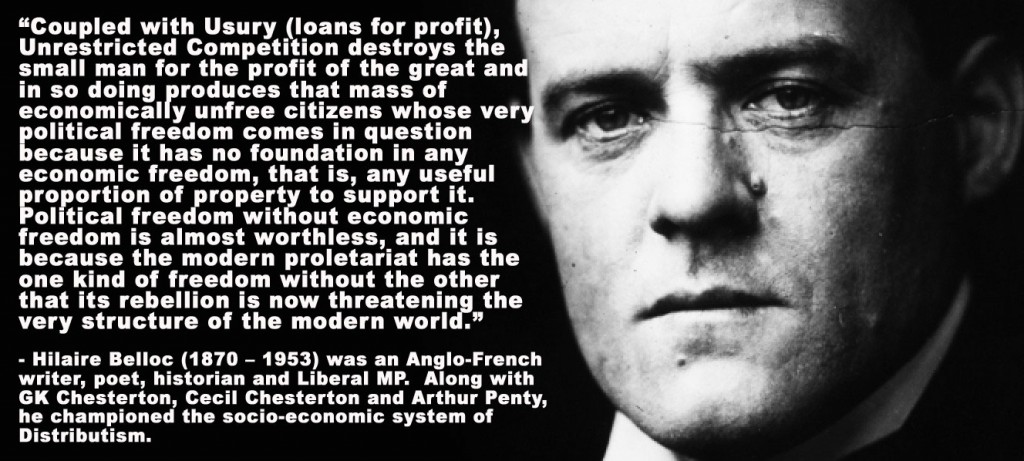
Distributism remains a key influence on National Liberal ideas. This is because Distributism offers social and economic self-determination for our people – or a form of personal freedom. Distributism recognises that both socialism and capitalism are very similar because both systems place the means of production into the hands of a minority at the expense of the masses. In capitalism, land and capital are controlled by a small number of powerful business people, while in socialism that same power was held by a small number of politicians. In these scenarios, the vast majority of citizens had little control over their own economic fortunes.

We invite our readers to share their thoughts when this article is reproduced on our Facebook site https://www.facebook.com/groups/52739504313/ It goes without saying that there are no official links between Richard Howard, the Humanist Society of New South Wales and the National Liberal Party. Readers will note that this article uses the phrase ‘Third Way.’ Here it is used in a context that distinguishes it from capitalism and socialism – indeed, it refers to an economic position that goes way beyond both capitalism and socialism.

.

Distributism As A Means of Achieving Third Way Economics (Part 3)

.
“Under capitalism, man exploits man. Under communism, it’s the other way around.”
.
Distributism versus socialism
.
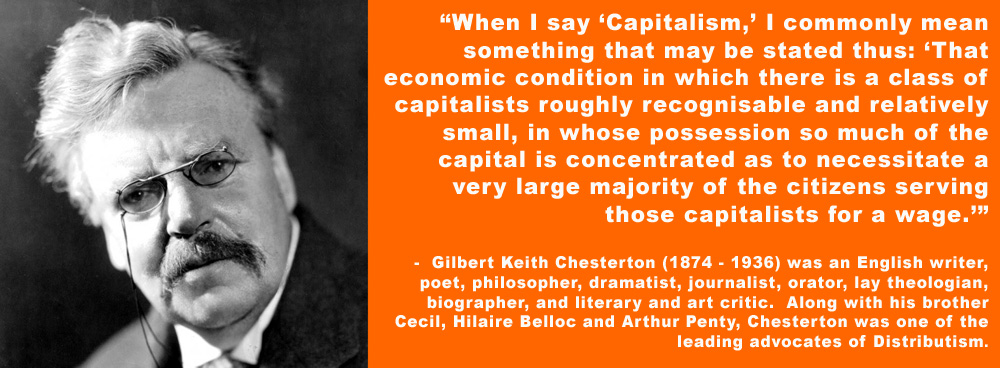
In Das Kapital, Karl Marx’s analysis of capitalism led to his Labour Theory of Value – that the value of a good or service lay exclusively in the labour required to produce it. From this premise Marx concluded that those who made a profit from employing others had unjustly appropriated the surplus value of this labour – the difference between what workers were paid and what the product of their labour was sold for. Marx’s solution was the collectivization of the means of production, distribution and exchange – including property and the elimination of the supposedly parasitic class of employers and property-owners – so that workers would all receive the benefit of this surplus value rather than have it taken from them.
While superficially sounding reasonable, we can now look back on a century of untold misery and tyranny as various efforts to implement Marx’s ideas led not only to the destruction of whole societies, but ironically to the impoverishment and death of countless millions of the very workers that Marxism purported to champion!
The oft-repeated truism is that communism is fine in theory but fails in practice, as it does not account for human nature. In fact, I would argue that this is not only arrant nonsense but almost an oxymoron!
State socialism was a failure because Marx’s analysis was flawed – because his theory was just wrong.
Valid theories work in practice. Its invalid theories that don’t work!
Understanding where Marx went wrong is central to understanding the ideological underpinnings of distributism because the founders of the movement – Belloc, Chesterton and others – were themselves mostly socialists who developed distributism in response to the theoretical problems which they had come to see Marx’s analysis.
The most fundamental issue is the Labour Theory of Value.
That doing work is a path to improving value cannot be disputed. To take wood and brick and concrete and tiles and build a house creates a product that has greater value than that of the materials that comprise it. That making a pair of shoes from leather and stitching creates a product, which obviously has more value than the leather and stitches themselves. That creating steel out of iron ore produces a product of much greater value than the simple cost of its constituents is equally self-evident. In each case, the added ingredient is labour. So far, so good for Marx.
But let’s take this analysis a little further. How is this increased value realized? Only at the point of sale.
Up to the point when someone else is prepared to hand over the cash, that house, that steel bar, that pair of shoes has an expected value, but the value is only actually set at the point of sale. Between building a house and selling it, interest rates could rise and demand for housing drop, lowering its expected value. Between mining iron ore and smelting, new producers could flood the market with product, decreasing price by increasing supply relative to demand. In the time it takes to make several hundred pairs of shoes, fashions could change or an early start of summer shift demand to open sandals, decreasing the value of the cobbler’s shoes.
The common factor in all cases is demand. Labour contributes to value but it is demand that sets it.
And what if a deranged cobbler made two hundred left shoes rather than a hundred pairs of shoes? Labour and material contributions are the same but try to sell them and he’ll quickly discover that two hundred left shoes have a fraction of the value of one hundred pairs.
Once again all that differs is demand. Since most people have two feet, most demand is for pairs of shoes!
If demand rather than labour content is the basis of value, then Marx’s whole edifice falls apart. Employers, salesmen and property owners aren’t necessarily exploiting workers, because if demand and not labour is the basis of value, their activities are contributing to demand just as much as workers.
If the bourgeoisie aren’t by definition parasitic exploiters, then the whole concept of class warfare becomes a nonsense.
If class warfare is a nonsense then what can revolution achieve except cruelty, injustice and a changing of ruling elites?
Yet, if Marx’s analysis is wrong, the very real issues that he sought to address remain unanswered.
In an age in which State socialism has been discredited, the tendency is to see this as a vindication of what went before, to simply throw the baby out with the bathwater.
That it is untrue to say that employers, landlords and middlemen necessarily exploit workers is not to say that their involvement is exclusively beneficial. That the value of a good or service is not solely based on its labour content is not to say that, all other factors being equal, it does not substantially derive from it.
And most importantly, while I argue it is false to claim that surplus value is unjustly appropriated by those employers, landlords and middlemen who are contributing to the value of a good or service, it is undoubtedly true that those who work for them, rent from them or sell to them would be financially better off if they could keep the financial benefit of this transaction – the surplus value – for themselves.
This in a nutshell is what distributism is all about.
Distributism is not trying to make the poor rich by making the rich poor, but empowering the poor and the not-so-rich to accumulate more of the demand-based value of their labour, more of the demand-based value of their produce, more of the demand-based value of their accommodation.
Achieving this by giving as many people as possible the means to employ themselves or own dividend-paying equity in their employer, to have the opportunity to sell their produce directly to consumers and to be able to buy their own home is distributism’s aim.
Share:
  • Print
  • Digg
  • StumbleUpon
  • del.icio.us
  • Facebook
  • Yahoo! Buzz
  • Twitter
  • Google Bookmarks
  • Add to favorites
  • blogmarks
  • Blogosphere
  • Google Buzz
  • PDF
  • email
  • Live
  • MSN Reporter
  • MyShare
  • MySpace
  • Technorati
  • Webnews.de

Trump Isn’t Another Hitler. He’s Another Obama. (Part 4)

THIS IS THE LAST in a series of articles looking at current US President, Donald Trump. Written by Caitlin Johnstone for the US on-line publication Medium – https://medium.com/@caityjohnstone/trump-isnt-another-hitler-he-s-another-obama-51ea7db498b4 – the broad thrust of her argument is that Trump is no different to Obama as they’re both in hoc to the US Military-Industrial complex.

.

The only real difference between Trump and Obama is that of presentation. Obama was media savvy and media friendly. Trump, on the other hand, is not. He’s abrasive, straight talking and to the point. He’s politically incorrect and appears that he runs the White House like he runs his personal businesses.

.

However, he’s just the latest in a long line of presidents – both Republican and Democrat – who works for the Yankee Dollar. As President, he’s a mere figurehead. The real power resides with the US Military-Industrial complex. They’re pulling the strings and are responsible for the never-ending round of US imperialist adventures. They claim that they act to preserve the US way of life, freedom and democracy. But this is a lie – they’re only making the world safe for big business.

.

This article should be read directly on from part I http://nationalliberal.org/trump-isn%27t-another-hitler-he%27s-another-obama-part-1 part 2 http://nationalliberal.org/trump-isn’t-another-hitler-he’s-another-obama-part-2 and part 3 http://nationalliberal.org/trump-isn’t-another-hitler-he’s-another-obama-part-3 It goes without saying that there are no official links between Caitlin Johnstone, Medium and the National Liberal Party. If you wish to comment on this article, check out our Facebook page https://www.facebook.com/groups/52739504313/

.

Trump Isn’t Another Hitler. He’s Another Obama. (Part 4)

These young people really are our best new humans. They are so committed to the highest interest that they would put aside their self-interest to do so. Do you know how rare that quality is in a human? And these young people are being taken from us young, whether that be by death or by destroying their beautiful minds as they are warped by the war machine into thinking that evil is good. Taken and used to pump up the egos of a selfish few.

In a healthy culture, the highest interest would dictate the desires of these young men and women. Unfortunately, the “highest interest” which should be assessed by the will of the people, is not being heard. It is not being enacted. The will of the people has repeatedly said that it does not want to send these young people off to kill another country’s young people to shore up the share portfolios of a few cancerous beings. The will of the people consistently says no to that, but it has been corralled by a small group of bloodthirsty vampires, parasites who will happily lay any amount of young bodies to waste to win their tiny dick battles until they are finally satisfied with the amount of zeroes on their bank statements.

Spolier alert: they never will be.

Americans talk about “seeing through the partisan bullshit” of US politics like it’s some kind of magical superpower, but it’s not. Both parties act in slightly different ways toward the exact same ends, working together like the jab-cross combinat ion of a boxer (1) to advance the same warmongering, corporatist oligarchic agendas, and there’s no reason to believe any of them about anything. America has two corpratist war parties who serve a plutocratic class of elites; one of them wears a cowboy hat, the other has pink hair. That’s it. That’s all you need to see to free yourself from the illusion.

Please stop attacking one another for the evils that have been inflicted on you by this small group of sociopaths, America. Stop buying into the two-party good cop/bad cop schtick that the elites use to turn urban Americans against rural Americans and turn your anger toward your real enemies.

(1) https://medium.com/@caityjohnstone/dems-and-gop-work-together-like-a-boxers- 1-2-punch-to-knock-you-out-edbbefc92bf8

Share:
  • Print
  • Digg
  • StumbleUpon
  • del.icio.us
  • Facebook
  • Yahoo! Buzz
  • Twitter
  • Google Bookmarks
  • Add to favorites
  • blogmarks
  • Blogosphere
  • Google Buzz
  • PDF
  • email
  • Live
  • MSN Reporter
  • MyShare
  • MySpace
  • Technorati
  • Webnews.de

Distributism As A Means of Achieving Third Way Economics (Part 2)
THIS IS THE second part of an article written by Richard Howard way back in 2005. It originally appeared on the web-site – http://www.hsnsw.asn.au/index.php – of the Humanist Society of New South Wales.
.
The National Liberal Party feels that Distributism offers a way of ensuring economic self-determination for our people. This is because Distributism regards property ownership as a fundamental right and that property and the means of production should be spread as widely as possible. This is in stark contrast to property and the means of production being controlled by the state – Socialism – or by an elite of powerful owners – Capitalism. Here, it can be seen that both Capitalism and Socialism equate to centralisation whilst Distributism equates to freedom.

.
We invite our readers to share their thoughts when this article is reproduced on our Facebook site https://www.facebook.com/groups/52739504313/ It goes without saying that there are no official links between Richard Howard, the Humanist Society of New South Wales and the National Liberal Party. You can read the original article here http://hsnsw.asn.au/Distributism.html Readers will note that this article uses the phrase ‘Third Way.’ Here it is used in a context that distinguishes it from capitalism and socialism – indeed, it refers to an economic position that goes way beyond both capitalism and socialism.

.

.

Distributism As A Means of Achieving Third Way Economics (Part 2)

.
“Under capitalism, man exploits man. Under communism, it’s the other way around.”
.
Distributism Defined
.
Distributism is a political philosophy based on the contention that a just and sustainable social order can only exist in which the ownership of property and the means of production, distribution and exchange are widespread.

The Distributist Movement thus seeks to achieve this end both by means of the democratic political process and by non-state mutual organizations of individuals that facilitate widespread private ownership through not-for-profit lending for private purchase and co-operative enterprise.

In Britain of the 1920s and 30s, the distributists sought the restoration of family and individual liberty by a revival of smallholder agriculture and small business and an end to grasping landlords, by attacking monopolies and trusts and denouncing what they saw as anonymous and usurious control of finance.

Opposed to laissez-faire capitalism, which distributists argued leads to a concentration of ownership in the hands of a few and to state-socialism in which private ownership is denied altogether, distributism was conceived as a genuine Third Way, opposing both the tyranny of the marketplace and the tyranny of the state, by means of a society of owners.

Like socialism, distributism is concerned with improving the material lot of the poorest and most disadvantaged. Unlike socialism, which advocated state ownership of property and the means of production, distributism seeks to devolve or widely distribute that control to individuals within society, rejecting what it saw as the twin evils of plutocracy and bureaucracy.

Early 20th century distributism saw the concentration of ownership in a few hands as the primary source of social ills but saw the removal of control from all private hands as even worse.

Subsequent history certainly seems to have supported their contention.
Share:
  • Print
  • Digg
  • StumbleUpon
  • del.icio.us
  • Facebook
  • Yahoo! Buzz
  • Twitter
  • Google Bookmarks
  • Add to favorites
  • blogmarks
  • Blogosphere
  • Google Buzz
  • PDF
  • email
  • Live
  • MSN Reporter
  • MyShare
  • MySpace
  • Technorati
  • Webnews.de

The National Liberal Party Says Shop Local In Alford!

Share:
  • Print
  • Digg
  • StumbleUpon
  • del.icio.us
  • Facebook
  • Yahoo! Buzz
  • Twitter
  • Google Bookmarks
  • Add to favorites
  • blogmarks
  • Blogosphere
  • Google Buzz
  • PDF
  • email
  • Live
  • MSN Reporter
  • MyShare
  • MySpace
  • Technorati
  • Webnews.de

By continuing to use the site, you agree to the use of cookies. more information

The cookie settings on this website are set to "allow cookies" to give you the best browsing experience possible. If you continue to use this website without changing your cookie settings or you click "Accept" below then you are consenting to this.

Close