Saturday, 11 July 2026

Category » Articles

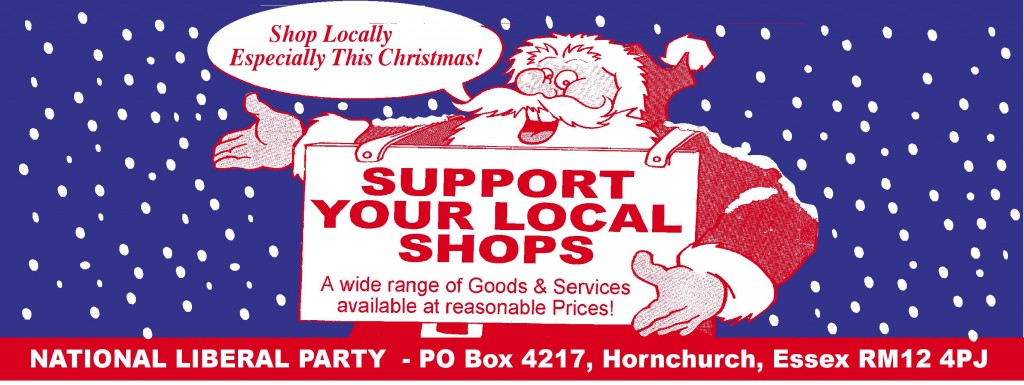
Christmas 2018 – Support Your Local Shops!
.
.
YES it’s that time of year again – Christmas is coming! But in your haste to do the shopping, don’t forget the local shops and businesses in your area. Give them an early Christmas present by shopping locally today.
.
The National Liberal Party knows that times are hard and price considerations are obviously very important, but many small shops depend on their Christmas trade to see them through much of the following year. At present, many shopkeepers are hit hard by the recession which was brought on by ‘casino capitalism’ – a mixture of greed and mistakes made by the politicians, bankers, ‘fat cats’ and speculators. Shopkeepers are also hit hard by high interest rates, the criminal bank debt-system, out-of-town outlet centres and on-line shopping.
.
The shopkeeper, as a self-employed businessman or woman, plays a vital role in the local economy. (And don’t forget that these small shops collectively employ hundreds of thousands of workers throughout the length and breadth of Britain). Local shops are not only important for the elderly and young mothers, but are part of the glue that helps to maintain community spirit – a place to bump into friends, neighbours and relatives.
.
If we don’t support our local shops and businesses today, we may lose them forever. Then people will have no other choice to travel directly into the nearest city or town centre for the smallest of items. This may be ok if you have your own transport and are fit and healthy. However, the elderly or young mothers wouldn’t really look forward to beating a path through the massive Saturday shopping crowds found in our large towns and cities.
.
The message is clear. For the community spirit to survive and prosper, we must give local shops as much trade as possible. The National Liberal Party says support your local shops, shopkeepers and shop workers. Shop locally this Christmas!
Share:
  • Print
  • Digg
  • StumbleUpon
  • del.icio.us
  • Facebook
  • Yahoo! Buzz
  • Twitter
  • Google Bookmarks
  • Add to favorites
  • blogmarks
  • Blogosphere
  • Google Buzz
  • PDF
  • email
  • Live
  • MSN Reporter
  • MyShare
  • MySpace
  • Technorati
  • Webnews.de

Social Justice & The Failure Of Capitalism

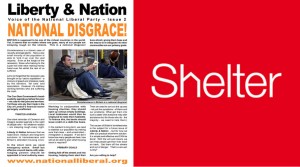
(Left) Issue 2 of Liberty & Nation – the voice of the National Liberal Party – described homelessness as a ‘National Disgrace!’ and advocated short, medium and long-term measures to tackle this problem. (Right) The logo of Shelter – the housing and homelessness charity. A report issued by Shelter revealed that there are currently around 320,000 people homeless in England and Wales.

NATIONAL LIBERALS believe that everyone – regardless of wealth or social background – has the right to decent housing, proper medical care and generous provision for old age. With this in mind, we feel that one of the greatest failures of capitalism is its inability to deliver any meaningful form of social justice to our people.


This failure of capitalism was brought into sharp focus when the housing charity Shelter recently revealed that there are around 320,000 people homeless in England and Wales today.

According to an article in the Guardianhttps://www.theguardian.com/society/2018/nov/22/at-least-320000-homeless-people-in-britain-says-shelter?fbclid=IwAR3ltCFOJ3U3wHu6JzpTD3labqDjlsY-qa6HGKUb7StNL78AuzZFugEBt4Q– from late last month, this figure included rough sleepers and people in temporary accommodation. However, the real figure is likely to be higher because of the plight of the ‘hidden’ homeless. This would include people ‘such as sofa-surfers, and others living insecurely in sheds or cars, for example.’

The estimate provided by the housing and homelessness charity Shelter suggests that nationally one in 200 people are homeless. Worryingly, this figure sky-rockets in London. For instance, in Newham, East London, at least one in every 24 people are in a position of housing insecurity.

The Guardian article of 22nd November also noted that:

‘In the capital as a whole, 170,000 people – equivalent to one in 52 – have no home. Westminster had the most rough sleepers, 217, followed by Camden, with 127. In Kensington and Chelsea, the UK’s richest borough, there were over 5,000 homeless people – equivalent to one in every 29 residents.’

Whilst homelessness is at its highest in London, other areas also suffer. Indeed, high rates of homelessness rates were recorded in Birmingham, Luton, Brighton & Hove, Slough, Dartford, Milton Keynes, Harlow, Watford, Epsom, Reading, Broxbourne, Basildon, Peterborough and Coventry.

The article also noted that this ‘is Shelter’s third annual analysis of homelessness. In 2016, it estimated there were 255,000 homeless people in England alone, a figure it subsequently adjusted to 294,000 for Britain. This rose to 307,000 in 2017.’

Sheter’s chief executive, Polly Neate summed up the findings when she noted:

“Due to the perfect storm of spiralling rents, welfare cuts and a total lack of social housing, record numbers of people are sleeping out on the streets or stuck in the cramped confines of a hostel room. We desperately need action now to change tomorrow for the hundreds of thousands whose lives will be blighted by homelessness this winter.”
National Liberals would agree with her view that “spiralling rents, welfare cuts and a total lack of social housing” are to blame for the housing crisis. However, as we indicated above, we would go much further than that and blame the capitalist system itself. This should come as no surprise as capitalism is a ‘dog-eat-dog’ system based on greed and exploitation, which views humans as mere economic pawns.

On saying this, we don’t have any confidence whatsoever in socialism to solve the housing crisis. Socialists of various hues – in the shape of successive Labour governments – have had numerous chances to put things right.

It seems that homelessness in England & Wales is a problem that neither capitalism (represented by the Tories) or socialism (represented by Labour) cannot – or will not – solve.

Therefore, we believe that we need a system that is neither capitalist nor socialist (indeed, a system which goes way beyond these old positions) to bring about change. And such a system must have true social justice – and, in particular, the right to own property, at its core.


O THE NATIONAL LIBERAL PARTY would urge its members and supporters to get involved in local charities and initiatives that seek to tackle social problems – such as homelessness – at grass-roots level.

O CHECK OUT issue 2 of Liberty & Nation – the voice of the National Liberal Party – which looks at the ‘National Disgrace’ of homelessness. To get hold of your FREE pdf copy, simply e-mail natliberal@aol.com
Share:
  • Print
  • Digg
  • StumbleUpon
  • del.icio.us
  • Facebook
  • Yahoo! Buzz
  • Twitter
  • Google Bookmarks
  • Add to favorites
  • blogmarks
  • Blogosphere
  • Google Buzz
  • PDF
  • email
  • Live
  • MSN Reporter
  • MyShare
  • MySpace
  • Technorati
  • Webnews.de

Welsh Voice Debate (1) – Who Really Stands To Win From Universal Basic Income?

WELCOME to the first debate hosted by Welsh Voice – the voice of the National Liberal Party in Wales.


It’s fairly well-known that the National Liberal Party wholeheartedly supports the idea of social justice for all. For most Welsh folk, social justice means that there should be a fair and just relationship between the individual and the nation. But how do we achieve it?


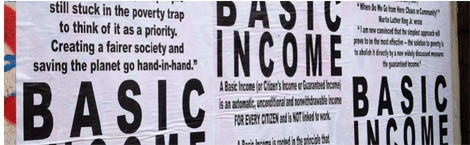
One answer may be the introduction of some form of Universal Basic Income – UBI. This means that each individual living in a country would receive some form of regular income from their government. This money would be issued on an ‘unconditional’ basis, which means that it would not involve a means test.

With this in mind our attention was recently drawn to an interesting article – https://www.newyorker.com/magazine/2018/07/09/who-really-stands-to-win-from-universal-basic-income– by Nathan Heller which appeared earlier this year in The New Yorker.


We invite our readers to share their thoughts when this article is reproduced on our Facebook site https://www.facebook.com/groups/52739504313/ It goes without sayin that there are no official links between Nathan Heller, The New Yorker, Welsh Voice and the National Liberal Party. Please note that Welsh Voice has kept the original US spelling and phrases as they are.

.

Who Really Stands To Win From Universal Basic Income?

It has enthusiasts on both the left and the right. Maybe that’s the giveaway.


Welsh Voice asks - Would the people of Wales benefit from the introduction of Universal Basic Income?

IN 1795, a group of magistrates gathered in the English village of Speenhamland to try to solve a social crisis brought on by the rising price of grain. The challenge was an increase in poverty, even among the employed. The social system at the time, which came to be known as Elizabethan Poor Law, divided indigent adults into three groups: those who could work, those who could not, and those – the “idle poor” – who seemed not to want to. The able and disabled received work or aid through local parishes. The idle poor were forced into labor or rounded up and beaten for being bums. As grain prices increased, the parishes became overwhelmed with supplicants. Terrorizing idle people turned into a vast, unmanageable task.

The magistrates at Speenhamland devised a way of offering families measured help. Household incomes were topped up to cover the cost of living. A man got enough to buy three gallon loaves a week (about eight and a half pounds of bread), plus a loaf and a half for every other member of his household. This meant that a couple with three children could bring home the equivalent of more than twenty-five pounds a week—a lot of bread. The plan let men receive a living wage by working for small payments or by not working at all.

Economics is at heart a narrative art, a frame across which data points are woven into stories about how the world should work. As the Speenhamland system took hold and spread across England, it turned into a parable of caution. The population nearly doubled. Thomas Malthus posited that the poverty subsidies allowed couples to rear families before their actual earnings allowed it. His contemporary David Ricardo complained that the Speenhamland model was a prosperity drain, inviting “imprudence, by offering it a portion of the wages of prudence and industry.” Karl Marx attacked the system years later, in “Das Kapital,” suggesting that it had kept labor wages low, while Karl Polanyi, the economic historian, cast Speenhamland as the original sin of industrial capitalism, making lower classes irrelevant to the labor market just as new production mechanisms were being built. When the Speenhamland system ended, in 1834, people were plunged into a labor machine in which they had no role or say. The commission that repealed the system replaced it with Dickensian workhouses—a corrective, at the opposite extreme, for a program that everyone agreed had failed.

In 1969, Richard Nixon (1) was preparing a radical new poverty-alleviation program when an adviser sent him a memo of material about the Speenhamland experiment. The story freaked Nixon out in a way that only Nixon could be freaked out, and although his specific anxiety was allayed, related concerns lingered. According to Daniel P. Moynihan, another Nixon adviser, who, in 1973, published a book about the effort, Speenhamland was the beginning of a push that led the President’s program, the Family Assistance Plan, toward a work requirement—an element that he had not included until then.

Nixon had originally intended that every poor family of four in America with zero income would receive sixteen hundred dollars a year (the equivalent of about eleven thousand dollars today), plus food stamps; the supplement would fade out as earnings increased. He sought to be the President to lift the lower classes. The plan died in the Senate, under both Republican and Democratic opposition, and the only thing to survive was Nixon’s late-breaking, Speenhamland-inspired fear of being seen to indulge the idle poor. By the end of his Administration, a previously obscure concept called moral hazard—the idea that people behave more profligately when they’re shielded from consequences—had become a guiding doctrine of the right. A work requirement stuck around, first in the earned-income tax credit, and then in Bill Clinton’s welfare reforms. The core of Nixon’s plan—what Moynihan, in The Politics of a Guaranteed Income (2), called “a quantum leap in social policy”—was buried among his more flamboyant flops.

  1. https://www.newyorker.com/tag/richard-nixon
  2. https://www.amazon.co.uk/dp/0394463544/ref=as_at?slotNum=0&linkCode=g12&imprToken=RP6RGFyjA-TIzb0w3e3yZQ&creativeASIN=0394463544&tag=tnyuk-21
Share:
  • Print
  • Digg
  • StumbleUpon
  • del.icio.us
  • Facebook
  • Yahoo! Buzz
  • Twitter
  • Google Bookmarks
  • Add to favorites
  • blogmarks
  • Blogosphere
  • Google Buzz
  • PDF
  • email
  • Live
  • MSN Reporter
  • MyShare
  • MySpace
  • Technorati
  • Webnews.de

Distributism As A Means of Achieving Third Way Economics (Part 4)

THIS is the fourth in a five part series about Distributism. The original was written by Richard Howard in 2005 and appeared on the web-site – http://www.hsnsw.asn.au/index.php – of the Humanist Society of New South Wales..


As we have previously noted, Distributism (and partially Social Credit) remains one of the key influences relating to the social and economic ideals of National Liberalism. This is because National Liberalism rejects both capitalism and socialism and seeks to promote a third alternative that goes way beyond these two positions.

National Liberalism believes that capitalism and socialism are effectively different sides of the same coin. Both systems place the means of production into the hands of a minority at the expense of the masses. In capitalism, land and capital are controlled by a small number of powerful business people, while in socialism that same power was held by a small number of politicians. In these scenarios, the vast majority of citizens had little control over their own economic fortunes. National Liberalism, on the other hand, believes in economic and social self-determination and freedom.

We invite our readers to share their thoughts when this article is reproduced on our Facebook site https://www.facebook.com/groups/52739504313/ It goes without saying that there are no official links between Richard Howard, the Humanist Society of New South Wales and the National Liberal Party. Readers will note that this Introduction uses the phrase ‘third position’ and that the article uses the phrase ‘Third Way.’ Here they are used in a context that distinguishes it from capitalism and socialism – indeed, it refers to an economic position that goes way beyond both capitalism and socialism.

.

Distributism As A Means of Achieving Third Way Economics (Part 4)


“Under capitalism, man exploits man. Under communism, it’s the other way around.”

How Distributism Works
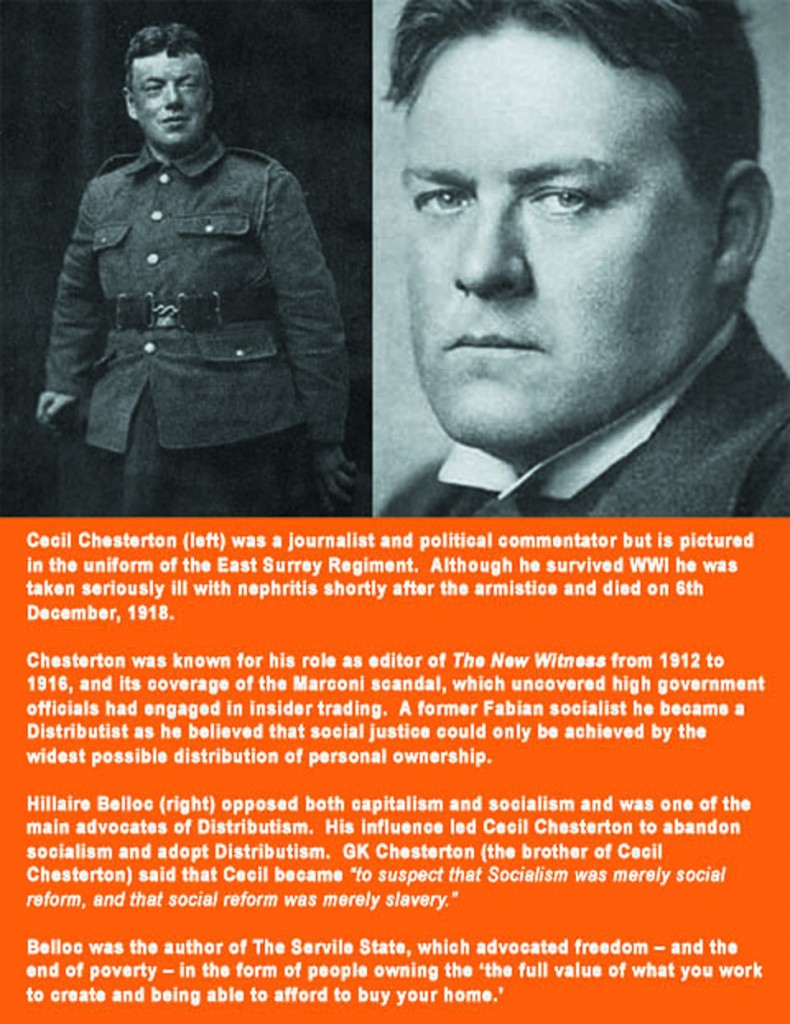

The key work to understanding early 20th century distributism is Belloc’s seminal work, the Servile State.
A savage denunciation of laissez-faire capitalism, which Belloc argued was re-establishing feudal servility on economic lines, the Servile State is no less savage towards state socialism, which (ironically presaging the later words of free market economist Friedrich Hayek) Belloc called no less a road to serfdom.
Belloc argued that what a divided Britain with a vast impoverished underclass needed was not ever more unrestrained capitalism nor the false dawn of socialism, but a new liberalism, which for Belloc was first last and foremost about liberty.
Freedom, however, as Belloc well knew, isn’t free. What use is the mere absence of the physical control of others if your poverty renders you subject to their financial control? It’s simply a subtler form of tyranny.
The beginning of freedom is the end of poverty and the end of poverty argue the distributists comes not with state ownership or welfare handouts but with owning the full value of what you work to create and being able to afford to buy your home, not living by another’s leave.
Belloc was elected to parliament shortly before the First World War and served in the government of Lloyd George, but his uncompromising personality denied distributism the opportunity it could otherwise have gained.
For all its colourful leadership by Belloc and Chesterton, and the considerable publicity it enjoyed in the 20s and 30s, distributism was never implemented in Britain and after its dalliance with Oswald Mosley’s New Party, it never recovered public credibility when Moseley turned to fascism.
The laurel for outstanding success in implementing distributist aims must rest with the Spanish, where following the Spanish Civil war, Don Jose Maria Arizmendiarrieta founded the Mondragon Co-operative in the Basque region. From a handful of unemployed oil lamp makers, Mondragon has grown to become the ninth largest corporation in Spain.
Unlike the isolated and fragmentary co-operative experiments in Australia and Britain, Mondragon is an expression of the broad distributist agenda that seeks not simply to sell to its members at a discount but to transform their lives. To consistently improve living standards through sustainable development and to rebuild community and culture as opposed to promoting dog-eat-dog adversarial individualism.
Mondragon co-operative runs supermarkets, banks, agricultural and manufacturing concerns, housing projects, schools, technical colleges and even a university!
The lot of the poor is improved not through welfare but through economic empowerment.
Capital is seen not as the enemy but as an instrument for social progress.
The co-operative, in the Mondragon experiment is viewed as a means by which instead of capital hiring labour, labour can hire capital.
Some see the kind of distributism which Mondragon represents as an evolutionary development of socialism, in which the role of the state is abandoned in favour of locally controlled and owned production. Others, see the Mondragon experience as a new kind of democratic capitalism, in which the wealth-generating power of capitalism has been harnessed to achieve social ends.
In the end though, if capitalism is simply about maximizing profits and standing back even if that leads to monopoly ownership, then Mondragon isn’t capitalism. And if socialism is about collective ownership rather than private profit, Mondragon isn’t socialism either, because Mondragon is all about making individuals and their families wealthier.
To be continued.
Share:
  • Print
  • Digg
  • StumbleUpon
  • del.icio.us
  • Facebook
  • Yahoo! Buzz
  • Twitter
  • Google Bookmarks
  • Add to favorites
  • blogmarks
  • Blogosphere
  • Google Buzz
  • PDF
  • email
  • Live
  • MSN Reporter
  • MyShare
  • MySpace
  • Technorati
  • Webnews.de

Social Credit and War
ANOTHER REMEMBRANCE DAY has come and gone. This year was significant as it was marked the 100th anniversary of Armistance Day and members and supporters of the National Liberal Party paid their respects both publically and privately.
Like many other folks, at the eleventh hour of the eleventh day of the eleventh month, we honoured the memory of the millions of men, women, children and animals whose lives were destroyed by those who herded them into the killing fields of the First World War.

At the same time we recognise that WWI (like many, if not all, wars) was a conflict based on naked greed and imperialism. With this in mind we came across an article – Social Credit and War – written by Oliver Heydorn for The Cliffiord Hugh Douglas Institute for the Study and Promtion of Social Credit http://www.socred.org/ – which we reproduce below. The article was written for Remembrance Day and seeks to explain the economic reason why some nations go to war.

We would encourage everyone to read this article – which can be found online here http://www.socred.org/s-c-action/social-credit-views/social-credit-and-war-2?fbclid=IwAR2i3e4OQlkqwyvrwKyTnvE2JdsJG9jwhcf9t7ZthyQTY3xpA6-XagBlDc4carefully, as it exposes the madness behind the idea of ‘continued economic growth’ which can (and does) lead to war.

We invite our readers to share their thoughts when this article is reproduced on our Facebook site https://www.facebook.com/groups/52739504313/ It goes without saying that there are no official links between Oliver Heydorn, The Cliffiord Hugh Douglas Institute and the National Liberal Party.
.

.

.

Social Credit and War
.
AS TODAY is Remembrance Day, I thought it would be appropriate for us to consider one of the implications of Social Credit theory with respect to war:
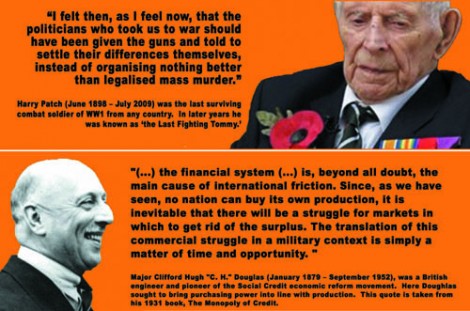
“(…) the financial system (…) is, beyond all doubt, the main cause of international friction. Since, as we have seen, no nation can buy its own production, it is inevitable that there will be a struggle for markets in which to get rid of the surplus. The translation of this commercial struggle in a military context is simply a matter of time and opportunity. “[1]
Social Crediters have repeatedly warned that there is a chronic economic cause, entirely artificial in nature and, therefore, unnecessary, which inexorably leads nations to take up arms against each other. Due to the underlying deficiency in consumer purchasing power that afflicts all industrial societies operating under standard banking and cost-accounting conventions, countries are frequently pressured to alleviate the lack of liquidity in the domestic economy by seeking to export more than they import. A so-called “favorable trade balance” (which is undoubtedly unfavorable in real terms because it implies a net loss of real wealth) helps an economy to fill the gap between the prices of consumer goods and the consumers’ income by getting rid of part of its surplus production, while, at the same time, increasing the flow of purchasing power to the consumer (through the jobs that are created and the profits that are obtained by the exporting companies). The problem is that it is mathematically impossible for all of the nations in the world to export more than they import; it is a zero-sum game. For every exporting champion, there must be a loser with a trade deficit. Countries that import more than they export are faced with a problem of a gap that has become even worse as a result of their commercial activities. Since every country is operating under the same internal deficit of purchasing power, the struggle for a favorable trade balance constitutes a struggle for survival. This leads, quite naturally, to economic conflict, or rather to economic warfare, in the form of commercial wars and “free trade” alliances, and, all too often, it can force or at least induce a military conflict. A country that does not manage to compete successfully through “innovation”, hard work, and the achievement of lower prices in comparison with its rivals in the global struggle for an artificially scarce flow of purchasing power can choose to ensure its victory through war, i.e., by defeating his economic opponents on the battlefield. The real reason for the war will, of course, be more or less hidden from the public and a pretext will be found, but the war may allow the aggressor to destroy part of a rival’s productive capacity and/or, through the eventual signature of peace treaties, to insist on more favorable commercial conditions for itself (as part of due reparations).
The pressure placed on nations to compensate for their internal price-income gaps with favorable trade balances is intensified by the universally defended policy of full employment. If we madly insist, in direct opposition to the real physical potential of the modern industrial economy, that all (or almost all) must work in the formal economy in order to obtain purchasing power (or be supported by those who do), then we are demanding continued economic growth as an end in itself (as a means of distributing additional income as the population grows). The resulting production must find some outlet. If it can not be absorbed internally, a market must be secured for it abroad. It was for this reason that John Hargrave, leader of the Green Shirts (a paramilitary Social Credit group of the 1930s), courageously proclaimed on more than one occasion that “He who cries for full employment, cries for war”.
Major Douglas explored in some detail the purely economic causes behind modern war in a BBC speech entitled “The Causes of War”:
https://www.youtube.com/watch?v=sw28HmmvNNs
https://www.youtube.com/watch?v=676UBQpBePc
[1] C. H. Douglas, The Monopoly of Credit (Sudbury, Inglaterra: Bloomfield Books, 1979), 92.

Share:
  • Print
  • Digg
  • StumbleUpon
  • del.icio.us
  • Facebook
  • Yahoo! Buzz
  • Twitter
  • Google Bookmarks
  • Add to favorites
  • blogmarks
  • Blogosphere
  • Google Buzz
  • PDF
  • email
  • Live
  • MSN Reporter
  • MyShare
  • MySpace
  • Technorati
  • Webnews.de

What Should We Make Of The People’s Vote March?
.

‘A walk in soft shoes, chiffon scarves in a waft of expensive cologne, Waitrose bags bulging, does not “The People” make. Especially when it’s led by blood-soaked war criminals … #Brexit


George Galloway

WHAT SHOULD we make of the People’s Vote March?

Despite the size and scale of last month’s People’s Vote March in London, we feel that it’s time to say goodbye to our EU imperial overlords! Those readers who wish to stop any possible second referendum on EU membership should sign this petition: https://petition.parliament.uk/signatures/50486879/ signed?token=rOZcU3hRIMvsYKh1T2L7

As all readers will know, towards the end of last month around 700,000 people marched through London to signal their opposition to Brexit. Thus two years after the original People’s Vote (to leave the EU) of 23rd June 2016 those who disagreed with that result want a ‘Final Say’ in a future ‘People’s Vote.’


Even though the National Liberal Party campaigned in favour of Brexit, we would be the first to acknowledge that the size and scale of the People’s Vote March was very impressive indeed. The main speakers were London mayor Sadiq Khan, Green Party MP Caroline Lucas, Liberal Democrat leader Vince Cable, and Labour MP Chuka Umunna. Tories like Anna Soubry and ‘celebs’ such as Delia Smith were also in attendance.
It must have took some money and organisation to set up, to say the very least. (Out of interest, does anyone have a clue where the money came from to finance such a demonstration?)

Many people noted that the size of the march – and strength of feeling – couldn’t be ignored by the politicians.

However, size isn’t everything. For way back in 2003 between 750,000 to 1 million people protested in London against the Iraq war. However, Tony Blair & Co ignored this march and joined US President George W. Bush in yet another disastrous overseas imperialist adventure.

Ironically, one of those who claimed that Theresa May’s the government couldn’t ignore the People’s Vote March and who supported the right of the people to have their say was none other than Alastair Campbell. This is the same Alistair Campbell who famously helped Tony Blair’s government ignore the 2003 Stop the War Coalition march in London. The words chutzpah and hypocrisy spring to mind! (1).

The National Liberal Party believes in real democracy (2). Indeed we’re great fans of referendums like the original People’s Vote to leave the EU. We’re even greater fans of preferendums – where the electorate can choose from three or more options – which we feel are even more democratic than referendums.

However, there’s one difference between those who believe in real democracy and those elitists who are leading and financing the anti-Brexit campaign. The difference is that real democrats would have respected the decision of the first People’s Vote held over two years ago.

Real democrats would also respect that the result of any referendum would be binding for an agreed period of time at the very least. Indeed, those of us who oppose membership of the EU have had to wait since 1975 to have our say!

(The United Kingdom joined the European Economic Community (as it then was) on 1st January 1973 with Denmark and Éire. This proved controversial at the time. The Labour party initially sought renegotiation of membership. This was toned down to requiring a referendum on whether the United Kingdom should remain part of the Community. This referendum was duly held in 1975 with a 67% vote in favour of continued membership. (3)

Thus real democrats have waited 41 years for the opportunity to reverse the original vote. The Brexit vote was only about 41 seconds old before the Remainers (or is that Remoaners or Remaniacs?!!) started to demand another vote!

We feel that in any other form of election many of those who oppose Brexit – especially the politicians – would have been more than happy with both the turnout and vote itself. However, as we’ve previously mentioned, because ordinary working folks stuck two fingers up to elites it’s a entirely different matter (4).

So then, what should we make of the people’s vote march?

Well, as we’ve already observed it was certainly very impressive in size. But we feel that it will fail in its real objective – and that’s to stop Britain leaving the EU on Friday, 29 March 2019. (However, the terms on which Britain quits the EU are a completely different matter).

Those who say that the EU referendum should have been decided on a 2/3rds majority (or at least 50% plus 1) may have a valid point. However, this wasn’t stipulated for the referendum.

And lets not forget that Remain camp held all the aces going into the referendum. They set the date of the vote and posed a fairly simple question Should the United Kingdom remain a member of the European Union or leave the European Union? The two responses were equally simple – Remain a member of the European Union or Leave the European Union. David Cameron’s Tory government also produced a booklet – sent out to all electors – giving the case for remaining in the EU.

Therefore, we reiterate that there already has been a People’s Vote – and the people won. It’s time to say goodbye to our EU imperial overlords!


Share:
  • Print
  • Digg
  • StumbleUpon
  • del.icio.us
  • Facebook
  • Yahoo! Buzz
  • Twitter
  • Google Bookmarks
  • Add to favorites
  • blogmarks
  • Blogosphere
  • Google Buzz
  • PDF
  • email
  • Live
  • MSN Reporter
  • MyShare
  • MySpace
  • Technorati
  • Webnews.de

By continuing to use the site, you agree to the use of cookies. more information

The cookie settings on this website are set to "allow cookies" to give you the best browsing experience possible. If you continue to use this website without changing your cookie settings or you click "Accept" below then you are consenting to this.

Close