



Saturday, 11 July 2026

What The UK Election Result Numbers Actually Say
.
SLUGGER O’TOOLE was founded in 2002 & describes itself as a ‘news and opinion portal, which takes a critical look at various strands of political politics in Ireland and Britain.’  Like ourselves, it believes in obtaining a ‘diversity of opinion is essential to building a reliable view of any single problem, great or small.’
 
It’s well known for its excellent election analysis, which is why we’re reproducing this article about the General Election held on Thursday.  The original article – by Frank Schnittger – can be read here https://sluggerotoole.com/2024/07/07/what-the-uk-election-result-numbers-actually-say/starmer 
 
National Readers (in general) should find it very interesting.  Liberals (in particular) will find the figures relating to the UKs First Past The Post (FPTP) voting system astonishing.  If anything they should act as a spur to redouble our efforts to promote Proportional Representation as a form of true democracy.
 
It goes without saying that there are no links between Slugger O’Toole, Frank Schnittger & the National Liberal Party.
.

What The UK Election Result Numbers Actually Say

.
SOMETIMES when you analyse the actual numbers of election results, they don’t match up with the popular or media narrative. For instance, Keir Starmer’s “Landslide Victory” with 9,712,011 votes was actually won with almost 600,000 votes less than Corbyn’s humiliating defeat with 10,269,051 votes in 2019. The difference was that Rishi Sunak’s Tories actually got less than half the votes (6,814,469) than Boris Johnson’s did (13,966,454).  So much for “Getting Brexit done”.
.
But contrary to the opinion polls, which consistently showed Labour with 20% plus margins in their favour, Labour only got 10% more of the vote than the Tories (33.8% versus 23.7%). Sinn Féin were lambasted when their Irish local election result underperformed their opinion polling by a similar margin, but you won’t see many newspaper headlines calling this a disastrous result for Labour.
.
The difference is, of course, the first past the post electoral system which can yield hugely disproportionate results. Reform got only 5 seats with 4,114,287 votes while the Lib Dems got 72 seats with 3,501,040. Together with the Greens (1,841,888 votes) and the Scots Nationalists (708,759 votes) these four smaller parties only got a total of 90 seats for a combined total of 10,165,974 Votes – well in excess of Labour’s 9,712,011 votes, for which they got 411 seats. And this is in spite of the Liberal Democrats getting their best ever seat result (72) despite receiving only around half the votes they did in 2010.
.
How long can the UK political system retain its legitimacy with support for its two main governing parties going lower and lower?
.
The main argument for First Past the Post electoral systems is that they are simple and yield decisive results and should thus result in political stability. Comparing the recent political histories of the UK and US with countries using proportional representation systems tends to undermine that argument. Instead, they are more likely to lead to political polarisation and the alienation of large parts of the electorate, as evidenced by a long-term historic trend towards reducing voter turnout.
.
The main recent outlier to that trend was the Brexit referendum where every vote counted, whereas the majority of votes in “safe constituencies” matter little, if at all. This election was, if anything, a triumph for tactical voting and “vote management” with Labour, in particular, concentrating their resources of marginal target seats at the expense of their perceived safer seats. So much so that two shadow cabinet members, Thangam Debbonaire and Jonathan Ashworth, lost their seats.
.
Northern Ireland
.
The distorting effects of the First Past the Post system is also much in evidence in Northern Ireland, with much political polarisation, apathy, and alienation, and turnout, at 57%, even lower than in the rest of the UK, and the lowest in its history. The table below may be a little busy, but it reveals some interesting information:
Sinn Féin’s gain of 4.2% may not have yielded any additional seats, but many of its marginal seats are now relatively safe, and it has made gains almost everywhere else. In particular, it is now within 179 votes of taking East Londonderry and has made huge inroads into Colm Eastwood’s majority in Foyle.
.
The DUP, on the other hand lost 8.5% of the vote resulting in three seat losses to Alliance, the TUV and UUP, and much reduced majorities everywhere else. Three of its remaining seats – Belfast East, East Antrim, and East Londonderry are now marginal, and their majorities in Strangford and Upper Bann are much reduced.
.
The Alliance vote declined by 1.8% and resulted in one seat loss and one gain – with Sorcha Eastwood taking advantage of the DUP’s travails post Donaldson. The UUP’s Robin Swann had a clear win in East Antrim while the SDLP retained its two seats in Foyle and South Belfast with reduced majorities.
.
The TUV’s Jim Allister had a narrow win over Ian Paisley Jnr. in North Antrim while ex-DUP independent Alex Easton had an easy win over Alliance’s Stephen Farry. Alliance have yet to retain any seat they have won and need to get better at building local organisations and doing the nitty gritty constituency work vital to consolidating swing support.
.
It used to be said that Fianna Fáil could put up a donkey and win in certain seats, so fierce were party rivalries and loyalties. However, this election showed that the quality of candidate can still matter at the margins with Robin Swann beating Paul Girvan and Pat Cullen consolidating Sinn Féin’s position in Fermanagh South Tyrone.
.
But the dominant theme has to be the consolidation of the nationalist vote while the unionist vote has fragmented somewhat more. Strangely, the Alliance Party managed to lose votes despite being in pole position to take advantage of the Donaldson Fiasco, while the SDLP continued its long term decline.
.
Conclusion
.
There has to be something wrong with a political system where 33.8% of the vote wins you a landslide majority and where Reform’s 14.3% of the vote wins them almost no representation. The result can be seen in the polarisation, alienation, and general apathy of the UK electorate with declining turnouts and where the new Labour government has almost no mandate to do anything other than end “Tory Chaos.”
.
In Northern Ireland, 27% of the vote was enough for Sinn Féin to secure its position as the largest party in Westminster, Assembly, and Local elections and was quite impressive considering it abstained in no less than four constituencies. The DUP avoided the double whammy of losing another leader, but it is difficult to see where they can go from here. Their “Safeguarding the Union” agreement with the Tories will soon be forgotten while the sea border remains. Their East Londonderry seat looks like the next domino to fall.
.
The Alliance surge appears to have stalled – they had an outstanding chance of winning three seats but won only one – while the UUP has avoided the ignominy of having no Westminster representation for the third election in a row. The SDLP managed to hold their two seats despite another decline in their vote, while Jim Allister finally won a seat for the TUV. He isn’t getting any younger however, and will there be life after Jim for the TUV?
.
For the second election in a row, Nationalist MP’s outnumber Unionists, but with such a low turnout, it is difficult to say what that might translate to in a border poll. Certainly, engagement with Westminster elections is at an all-time low and Starmer has done little to raise expectations of better days ahead. Perhaps if he builds Casement Park and the new A5 motorway he can buy the Union some time. But Ulster has to start working better for the Union to be safe.
Share:
  • Print
  • Digg
  • StumbleUpon
  • del.icio.us
  • Facebook
  • Yahoo! Buzz
  • Twitter
  • Google Bookmarks
  • Add to favorites
  • blogmarks
  • Blogosphere
  • Google Buzz
  • PDF
  • email
  • Live
  • MSN Reporter
  • MyShare
  • MySpace
  • Technorati
  • Webnews.de

Meaningless Political Terms
OUR ATTENTION has been drawn to an interesting article that appeared yesterday on a Telegram channel called Folkish Odinism Dorset.  Written by a ‘Gary H’ from Dorset, it took the form of an answer to a question posed by a friend.
.
The question was ‘out of all the political ideas why do you support ‘right wing’ nationalism and why do borders matter?
.
The answer – in the form of an article – itself makes for interesting reading.  (On saying that, and as with many articles, there’s parts that we would both agree and disagree with.)
.
One section of the reply immediately stood out.  It related to the context & definition of ‘right wing.’  Like ourselves, ‘Gary H’ believes that many political terms are both pointless and ridiculous.  (This also includes self-applied terms.)
.
We’ve constantly stated our belief that the use of meaningless
terms like ‘left-wing’ & ‘right-wing’ is designed to provoke knee-jerk reactions.
.
Those who do react fall into the age-old trap – set by the capitalist elites –  of ‘divide and conquer.’  Here, different sections of the population are successfully played off against each other.
.
Indeed, these differing sections then spend so much time, energy & money attacking each other that the elites are effectively allowed to get on with their plans, completely unhindered!  (This is one of the reasons why the NLP promotes a culture of critical thinking & analysis.)
.
With all the above in mind, please take some time to read & reflect on what amounts to an effective take down of the dangers & stupidity of applying some political labels:
.
‘My friends point about nationalism being ‘right wing’ (?) didn’t make much sense to me either.  I had stopped thinking of nationalism as right or left-wing a long time ago.  This is just a man-made construct, designed to keep us in conflict with each other or at least create the illusion that we are in conflict with each other while the powers that be do what they want with our lives and resources.  If an idea or an action is a good one and it will reap positive rewards for our people, then what does it matter if the people proposing it give themselves a left or a right-wing label?  The only political spectrum that is based in reality has neo-tribalist ways of life inspired by the natural world at one end and universalist, man-made ideas at the other end.’
.
•  It goes without saying that there are no links between ‘Gary H’,  Folkish Odinism Dorset & the National Liberal Party.   For the record, the NLP welcomes members & supporters from all religions and none.
Share:
  • Print
  • Digg
  • StumbleUpon
  • del.icio.us
  • Facebook
  • Yahoo! Buzz
  • Twitter
  • Google Bookmarks
  • Add to favorites
  • blogmarks
  • Blogosphere
  • Google Buzz
  • PDF
  • email
  • Live
  • MSN Reporter
  • MyShare
  • MySpace
  • Technorati
  • Webnews.de

Graham Littlechild – RIP

Graham Littlechild sadly passed away this year. He was a long standing member of the NLP until falling ill over the last few years. He was very active in leafleting until that time and stood in Council ward elections in London in 2010 and 2014. RIP

Share:
  • Print
  • Digg
  • StumbleUpon
  • del.icio.us
  • Facebook
  • Yahoo! Buzz
  • Twitter
  • Google Bookmarks
  • Add to favorites
  • blogmarks
  • Blogosphere
  • Google Buzz
  • PDF
  • email
  • Live
  • MSN Reporter
  • MyShare
  • MySpace
  • Technorati
  • Webnews.de

A Practical Case Against Censorship

REGULAR READERS will know that Self-Determination is the raison d’être of National Liberalism.  As we noted towards the middle of last month (1) we ‘work towards creating a nation of sovereign citizens – and not a State full of servile subjects.’   

We feel that two key elements that’ll help create this ideal is ‘small’ government and the free flow of information.   

As National Liberals, we believe that ‘Small is Beautiful’.  We wish to devolve power down to the lowest possible common denominator.  The people should be close to their government, so everything (as far as possible) should be on a ‘human scale’.  Therefore, we’re opposed to ‘big’ government.  We are also highly suspicious of those politicians – particularly those who claim to be ‘liberal’ & ‘progressive’ – who seem to want to control every aspect of our lives.   

It goes without saying that, if people are to be close to their government, a free flow of information is absolutely essential.  And, as Caitlin Johnson (2) has noted, ‘Democracy of the vote without democracy of information is not democracy.  It doesn’t matter if people are able to vote as long as the media-owning class are able to manipulate how they vote.  “One person, one vote” is meaningless if influence and control of information is highly concentrated in an elite few.  And it is.’  

With all of the above in mind, we were delighted to come across the following article – which we reproduce below – written by Marc Joffe for the Cato Institute.  Marc Joffe is a federalism and state policy analyst at Cato Institute. His research focuses on government finance and state policy issues.  The Cato Institute itself is a Washington, DC libertarian think tank with a vison to ‘create free, open, and civil societies founded on libertarian principals.’   

As usual, we have kept the original North American spelling.  You can read the original article in the link below (3).  Please note that there are no official links between the National Liberal Party, the Cato Institute, the Orange County Register & Marc Joffe.  


A Practical Case Against Censorship  

The skills needed to get elected and to rise through bureaucracies are not necessarily those possessed by the wisest and least selfinterested decision makers.  

By Marc Joffe  

This article appeared in the Orange County Register (4) on August 1, 2023.  

The National Liberal Party has a long-term policy of reproducing, deconstructing & commenting on articles produced right across the political spectrum. Here we reproduce an article – relating the free thought & free speech – by Marc Joffe of the libertarian Washington, DC-based Cato Institute.

IN THE late twentieth century, debates over free speech were typically resolved by citing the First Amendment and observing that freedom of expression was a basic human right. But today, that line of argument is no longer sufficient. Those of us who favor free speech must prove to a skeptical audience that it is a right worth protecting. Since people of good faith now find arguments for censorship persuasive, these arguments should be met on their own terms.  

A common view both in California and nationally is that important matters can be resolved by duly elected officials and their appointed experts. The reaction to the COVID-19 pandemic provides an example. Many Californians agreed that the governor, state and county health officials, and the Centers for Disease Control (CDC) should handle the pandemic response. Once a state or county health officer promulgated a policy it was the citizen’s responsibility to follow these pronouncements without objection.  

This approach makes sense on its face. Qualified experts chosen by our elected leaders should tell us how to deal with a public health emergency. Anyone using misinformation, disinformation, or malinformation to oppose official policies is merely sewing confusion and potentially reducing compliance, leading to unneeded death and suffering. From this perspective, the logical response is to shut down opposing voices since they are jeopardizing public safety.  

This vision of a wise expert class protecting the public from inappropriate information has deep roots in political thought going all the way back to Plato’s Republic. Although Plato’s ideal city did not hold elections, it was ruled by a highly educated and publicspirited elite empowered to control the flow of information.  

But while in ancient Greece, it may have been possible for a small group of experts to accumulate all or most of the relevant information needed to make policy, this is no longer feasible in a complex, modern society. By March 2020, COVID-19 was affecting numerous countries where policymakers were taking different approaches and doctors were trying different treatments. An ideal response would require analyzing all these responses and their results.  

This is beyond the capability of a small expert group but can be handled by pluralistic communities of journalists and academic researchers. Media, including scientific journals, can filter through myriad possible policies to help find those that are the best. Liberal intellectuals have made a similar critique of central economic planning: planners are simply unable (5) to accumulate and act upon sufficient knowledge to manage a whole economy. Only through the operations of the market can resources be allocated effectively.  

Theoretically, a clique of elite public policymakers could read enough articles and consult with enough outside experts to make a semioptimal decision. But there’s a second problem. Advocates of topdown decisionmaking implicitly assume that the decisionmakers are selflessly working on behalf of the community.  

But this assumption does not hold. The skills needed to get elected and to rise through bureaucracies are not necessarily those possessed by the wisest and least selfinterested decision makers. There is no reason to believe that those most anxious to obtain and wield power will make the best decisions.  

Indeed, Nobel Laureate F. A. Hayek argued (6) that the worst people tend to get to the top of government power structures. Hayek’s analysis focused on totalitarian governments in the run up to World War II, but similar dynamics are at work in contemporary democracies.  

A retrospective look at the state and federal COVID-19 response reveals a pattern of suboptimal communications and decisions. These include an initial lockdown that excluded big box retailers and public transit, needless beach and park closures that limited opportunities for exercise and fresh air, extended reliance on remote schooling, despite its obvious flaws, and vaccine mandates for high school and college students known to be at minimal risk of severe COVID outcomes.  

Those of us who questioned these policies were often ridiculed but could not be completely silenced thanks to constitutional protections. Ultimately, public pressure forced the relaxation of lockdowns and the reopening of schools. Had policymakers been insulated from public debate, and, yes, even ridicule, these destructive policies could well have persisted.  

Elites are not capable of governing optimally even if they are motivated to do so. Open debate serves as an essential check on power that often leads to better decisions. So even for those who are not persuaded that free speech is a natural right, it’s worth defending as a tool for better governance.  

 (1) https://nationalliberal.org/who-we-are  

(2)  https://www.caitlinjohnst.one/p/real-democracy-means-democracy-of  

(3)  https://www.cato.org/commentary/practical-case-against-censorship  

(4)  https://www.ocregister.com  

(5)  https://www.libertarianism.org/topics/socialist-calculation-debate?__hstc=38939644.8adf223dd745e4cd49d904b747519bda.1691337138712.1691337138712.1691342894094.2&__hssc=38939644.1.1691342894094&__hsfp=2282758685  

(6)  https://fee.org/resources/the-road-to-serfdom-chapter-10-why-the-worst-get-on-top/

Share:
  • Print
  • Digg
  • StumbleUpon
  • del.icio.us
  • Facebook
  • Yahoo! Buzz
  • Twitter
  • Google Bookmarks
  • Add to favorites
  • blogmarks
  • Blogosphere
  • Google Buzz
  • PDF
  • email
  • Live
  • MSN Reporter
  • MyShare
  • MySpace
  • Technorati
  • Webnews.de

ULEZ: A War On Drivers & A Form Of Stealth Tax?

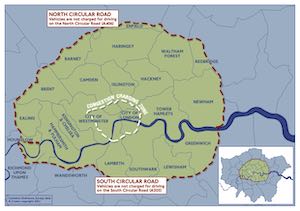
A map – from Transport for London (TfL) – showing the extent of London’s ULEZ zone. In three weeks, it’ll be extended to take in all of Outer London. Is it any wonder that many people believe that Ulez is simply cover for a war on drivers & another form of stealth tax?

LONDON’S HARD-PRESSED motorists hate Sadiq Khan’s ULEZ (Ultra-Low Emission Zone) scheme with a passion.  

Khan – who has been the Labour Mayor of London since 2016 – introduced ULEZ over four years ago on 8th April 2019.  Prior to that, he’d introduced an emissions surcharge, called the Toxicity Charge (sometimes known as the T-Charge) in 2017.  

Under both schemes, an emissions standard based charge has been levied on what are termed non-compliant vehicles.   

Initially the scheme covered inner London boroughs.  The ULEZ zone was later extended to cover the area within the North Circular and South Circular roads.  Now Khan wants to extend the scheme – to include outer London boroughs – towards the end of this month.  

It’s thought that car use is higher in outer London boroughs.  This is due to fewer public transport links.  Here ULEZ could become a cash cow for Khan when it’s introduced on 29th August.  However, many believe that it could really impact on both businesses & households who’re still struggling with the cost-of-living crisis.  

ULEZ operates 24 hours a day, seven days a week.  However, Khan can’t be accused of being the Grinch as vehicles are exempt on Christmas Day!  

Vehicles which do not meet emissions standards incur a daily charge of £12.50.  And the fine for failing to pay is £180.  

Those who scrap their cars in order to buy a ‘compliant’ vehicle can access up to £2,000 from a scrappage scheme.  Whilst this is welcome, these days it’ll hardly make much of a dent in the price of a brand-new car.  No wonder many people believe that ULEZ is simply cover for a war on drivers (and another form of stealth tax).   

Khan insists that the limitations on vehicle emissions reduces pollution.  However, we’ve never seen any statistics – relating to London’s pollution levels – on which the restrictions are based.  Neither have we seen statistics relating to pollution levels prior to & after the charges were introduced.  Indeed, how many Londoners have died solely from vehicle-related pollution?    

With the above in mind, we’d be interested to know who produced the statistics & if they were peer reviewed.  Additionally – and especially in the light of Covid – we’d be particularly interested to know if there’s the slightest whiff of a conflict of interests between the different parties involved.  

We mentioned earlier that many people believe that ULEZ is simply cover for a war on drivers (and a form of stealth tax).   

We have some sympathy with this point of view.  Many people simply have to have a car for family and/or work reasons.  Self-employed workers who need various tools to work are an obvious example.   

Individual drivers are not responsible for the fumes that their vehicles emit.  That’s down to the car manufacturers.  But Sadiq Khan is on the Blairite ‘social democratic’ wing of the Labour Party.  That means he’d never pick a fight with large transnational corporations like Ford, Nissan & Vauxhall.  Therefore, the driver – and not the manufacturer – has to pay!   

In addition, Blairites would never take on the Money Power in respect of taxation.  Therefore, drivers – and everyone else for that matter – have to pay.  

We feel that there’s also some merit in the argument that ULEZ is all about power & control.  Could they be one way of paving the ground for government sanctioned 15-minute cities?    

With all of the above in mind, it’s clear that action does need to be taken in London & our other cities.   

We wouldn’t be surprised to learn that overpopulation & the sheer size of our cities lead to alienation, pollution and many forms of ill health (and especially mental health problems).   

But what should be done?   

We hope to take a look at various radical solutions in the near future.  As National Liberals, our watchword is ‘Small is Beautiful’.  Therefore, our solutions would be centred around Distributism, the Social Credit ideas of C. H. Douglas, Co-operatives and other ‘human scale’ activities like Permaculture.   

In the meantime, we’d like to hear ideas from our readers on how they would tackle pollution in cities like London.  Simply let us know in the comments section when you see this article on the National Liberal Party’s Facebook page – https://www.facebook.com/NationalLiberalParty – or our National Liberals Facebook page –   https://www.facebook.com/groups/52739504313  

Share:
  • Print
  • Digg
  • StumbleUpon
  • del.icio.us
  • Facebook
  • Yahoo! Buzz
  • Twitter
  • Google Bookmarks
  • Add to favorites
  • blogmarks
  • Blogosphere
  • Google Buzz
  • PDF
  • email
  • Live
  • MSN Reporter
  • MyShare
  • MySpace
  • Technorati
  • Webnews.de

Who We Are

WE ARE National Liberals.  And as our name suggests, our ideology is a fusion of two equally historical & honourable political ideas – nationalism and liberalism.  

First of all, however, it’s important to note that our form of nationalism is completely different from those reactionary ‘nationalists’ who worship the State.  We’re not Statists – indeed, we’re very much opposed to ‘Big’ government.  We don’t believe it’s the job of government to micromanage people on a daily basis.  

We are progressive nationalists, and our loyalty is to the nation & its people, as opposed to the State.  Indeed, we regard the nation as a ‘family of families’.   

On saying that, we do feel that there are instances whereby government has to act to protect the nation & its people.  Thus, our form of nationalism isn’t aggressive, imperialist or jingoistic.  

We feel that government involvement is justified when it is in the national interest.  This would include the likes of borders, constitutional affairs, defence, energy, foreign policy, health, heavy industry, transport & so on.   

It’s also important to point out that our form of liberalism is completely different to those ‘liberals’ who’re only too willing to bend over backwards to accommodate everyone & everything.   

We are ‘muscular’ liberals – and not regressive liberals.  Again, we’ve no interest in running the lives of everyone around us.  

Our form of liberalism relates to the freedom of the individual (who, in turn, make up the family of families).  Therefore, we believe that there should be civil & religious liberties for all.  For example, free thought & free speech should be protected by law.  And the ‘Big Brother’ surveillance state should be opposed.  

Regular readers will be familiar with the NLP – Self-Determination For All logo that accompanies this brief article.  The three areas of Self-Determination we promote are national, economic & political.  

In short, National Liberals work towards creating a nation of sovereign citizens – and not a State full of servile subjects.  That is who we are.  

Share:
  • Print
  • Digg
  • StumbleUpon
  • del.icio.us
  • Facebook
  • Yahoo! Buzz
  • Twitter
  • Google Bookmarks
  • Add to favorites
  • blogmarks
  • Blogosphere
  • Google Buzz
  • PDF
  • email
  • Live
  • MSN Reporter
  • MyShare
  • MySpace
  • Technorati
  • Webnews.de

By continuing to use the site, you agree to the use of cookies. more information

The cookie settings on this website are set to "allow cookies" to give you the best browsing experience possible. If you continue to use this website without changing your cookie settings or you click "Accept" below then you are consenting to this.

Close