


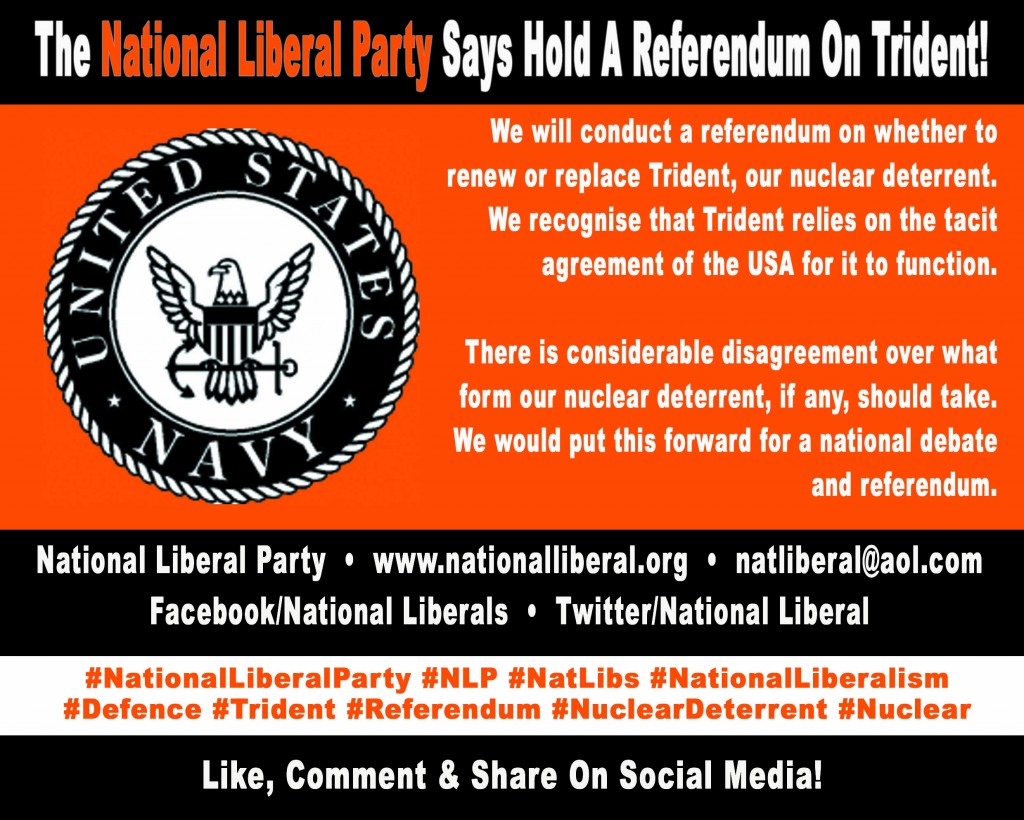
The National Liberal Party Says Hold A Referendum On Trident!
Date: July 29, 2018
Categories: Party News
Tuesday, 20 January 2026

Self-Determination is a human right








Date: July 29, 2018
Categories: Party News
THE raison d’être of National Liberalism is self-determination. The National Liberal Party – NLP – is the political expression of National Liberalism in Britain. And even the briefest examination of the NLPs web-site – http://nationalliberal.org/ – and two Facebook sites – https://www.facebook.com/groups/5273904313/ and https://www.facebook.com/NationalLiberalParty/ – will reveal its commitment to the principle of self-determination. For the NLP notes that self-determination ‘can be applied largely in three areas; National, Political and Economic.
National Self-Determination seeks to ensure decisions affecting the collective future of a nation are taken by ALL the people via referendum. This may be ‘External’, for example: the creation or maintenance of a nationstate, or ‘Internal’ – framing/updating a constitution to reflect how a people should rule themselves. (We favour independent nations and liberal, democratic, states).
Political Self-Determination seeks to ensure that the collective will of the people as well as the variety of political opinion is reflected in decision making. Thus, for example, we favour greater use of referendums to meet the former, and PR to reflect the latter (we favour a system close to the Swiss model of Direct Democracy). Economic Self-Determination seeks to distribute ownership as widely as possible and as close to the individual as practical by favouring home ownership, self-employment, small
businesses, cooperatives and employee shareholdings. (We believe that ownership is the key to economic and social health: where workers obtain a just reward for their labours and gain a feeling of well-being through their having a genuine personal stake in society).
The above principles underpin many National Liberal policies but others are rooted in common sense and usually aim to strike a balance between conflicting opinions, as befits a centrist party.’
With this in mind, we’re reproducing an article entitled Distributism As A Means of Achieving Third Way Economics written by Richard Howard in 2005. It originally appeared on the web-site – http://www.hsnsw.asn.au/index.php – of the Humanist Society of New South Wales.
As usual, we invite our readers to share their thoughts when this article is reproduced on our Facebook site https://www.facebook.com/groups/52739504313/ It goes without saying that there are no official links between Richard Howard, the Humanist Society of New South Wales and the National Liberal Party. You can read the original article here http://hsnsw.asn.au/Distributism.html Readers will note that this article uses the phrase ‘Third Way.’ Here it is used in a context that distinguishes it from capitalism and socialism – indeed, it refers to an economic position that goes way beyond both capitalism and socialism.
.
“Under capitalism, man exploits man. Under communism, it’s the other way around.”
Introduction
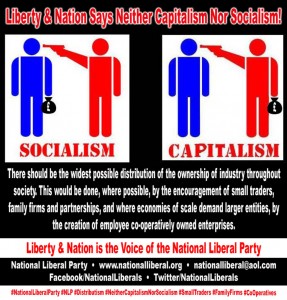 At the beginning of the 21st Century of the Common Era, following the collapse of the Soviet Union and with it the political credibility of state socialism, we are daily confronted by those who claim that these events are a vindication of 19th century laissez-faire capitalism.
Whilst undoubtedly a new golden age for corporations whose transnational commercial opportunities and economic might are increasingly beyond the regulatory power of even medium sized national governments, we find the dawn of the age of globalism accompanied by the concentration of more and more wealth in the hands of a few whilst the wages and living standards of the many are moving rapidly backwards.
In these circumstances, it is perhaps opportune to look again at alternatives and consider whether the failure of communism has vindicated laissez-faire capitalism or whether, perhaps, a genuine Third Way is possible.
In recent years, many have sought to lay claim to the concept of a Third Way, but for most, like British PM Tony Blair, use of the term is simply self-serving rhetoric and spin for business-as-usual.
There is however one claimant to the mantle of a Third Way that does not simply collapse on closer examination into welfarist capitalism or state socialism in drag, and that is the political movement known as distributism.
Origins
Distributism’s philosophical origins can be traced to the same nineteenth century roots as socialism, as a reaction against the perceived inequalities and misery of late Victorian high capitalism in England.
The inspiration for the Distributist Movement was the 1891 Papal social encyclical, De Rerum Novarum – On the Condition of Labour – calling for a new compassionate interpretation of capitalism, although a majority of distributism’s later supporters were not Catholics and many were in fact former radical socialists who had become disillusioned with socialism.
Local attempts to form grower co-operatives to redress the impoverishment of agricultural producers who were paid little for their crops by middlemen who then on-sold them to consumers at a great profit had achieved considerable success in rural Ireland in the mid-19th century. Equally, the credit union and building society movements, that sought to lend money on a not-for-profit or minimal cost basis for housing and small business development enjoyed great success, particularly in Scandinavia. In England, the success of the Rochdale co-operative retail outlet proved that not-for-profit retailers could operate successfully, and continues to form the basis of all retail co-ops to the present day.
It was however left to Hillaire Belloc and GK Chesterton at the turn of the century to draw together the disparate experiences of the various co-operatives and friendly societies in Northern England, Ireland and Northern Europe into a coherent political ideology which specifically advocated widespread private ownership of housing and control of industry through owner-operated small businesses and worker-controlled co-operatives.
This became the basis of a concrete set of political goals which formed the objectives of the distributist movement and which, ironically, achieved their greatest successes outside England in Italy, Canada, Northern Europe and most spectacularly in Spain.
Date: July 28, 2018
Categories: Articles

.
The Liberty Wall https://nationalliberal.org/liberty-wall-3
.
From The Liberty Wall – Total Democracy – Check Out Total Democracy http://nationalliberal.org/from-the-liberty-wall-–-total-democracy-–-check-out-total-democracy
From The Liberty Wall – The St. George’s Committee – Check Out The St. George’s Committee http://nationalliberal.org/from-the-liberty-wall-–-the-st-george’s-committee-check-out-the-st-george’s-committee
From The Liberty Wall – Nations without States – Check Out Nations without States http://nationalliberal.org/from-the-liberty-wall-–-nations-without-states-–-check-out-nations-without-states
Date: July 24, 2018
Categories: Liberty Wall, Party News

Date: July 22, 2018
Categories: Party News
Date: July 21, 2018
Categories: Party News
WELCOME to the first debate hosted by Ulster Voice – the voice of the National Liberal Party I Ulster.
Our attention was recently drawn to an article – https://www.secularism.org.uk/opinion/2016/08/conflating-abuse-with-criticism-of-islam-risks-a-return-to-a-uk-blasphemy-law – which appeared some time ago on the web-site of the National Secular Society – NSS. It’s a group which ‘works for the separation of religion and state and equal respect for everyone’s human rights so that no one is either advantaged or disadvantaged on account of their beliefs’.
The NSS article looks at how anti-Muslim bigotry and criticism of Islam are often conflated. This is extremely dangerous and poses a great threat to free speech. It also notes that the word ‘Islamophobia’ is meaningless and sinister. Ulsterfolk may recall that after delivering an ‘Islamophobic’ sermon in 2014, Pastor James McConnell was arrested under ‘hate-crime’ legislation. Here, the NSS – to the surprise of many – supported McConnell’s ‘fundamental right to free expression’.
We invite our readers to share their thoughts when this article is reproduced on our Facebook site https://www.facebook.com/groups/52739504313/ It goes without sayin that there are no official links between Benjamin Jones, the National Secular Society, Ulster Voice and the National Liberal Party.
.
Conflating Abuse With Criticism Of Islam Risks A Return To A UK Blasphemy Law
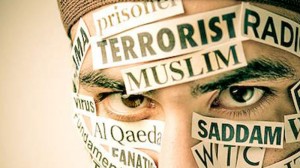
Anti-Muslim bigotry and legitimate criticism of Islam or Islamic states are often conflated. Indeed, those who are opposed to ‘Islamophobia’ have failed to provide an accurate definition of the term. This is extremely dangerous and poses a great threat to free speech.
The BBC and Demos have published an accidental case study in why we should all stop using the meaningless and sinister word ‘Islamophobia’.
The BBC has made much of a report from Demos warning that thousands of ‘Islamophobic’ tweets are sent in English every day. But the researchers, like everybody else who uses the term, have totally failed to define what ‘Islamophobia’ actually means.
The research by Demos into ‘Islamophobia’ was reported by the BBC under the headline “Islamophobic tweets ‘peaked in July'”. From reading the BBC report you might imagine that 7,000 bigoted and anti-Muslim tweets were sent every day in July.
In fact, Demos have inadvertently set out what has been warned of for many years; that ‘Islamophobia’ is a nonsense word with sinister implications.
On reading the report it is clear that the Demos research isn’t just focused on anti-Muslim tweets, or bigotry against Muslims, but, as they define it in their research paper, “anti-Islamic ideas”.
In their report Demos selects some tweets it included in the study, which they presumably think are good examples of their methodology in action. A tweet stating “Morocco deletes a whole section of the Koran from school curriculum as it’s full of jihad incitement and violence The Religion of peace” is treated the same way as a tweet saying “I fucking hate pakis” in their methodology.
One of these tweets criticises an idea. The other is racist. One describes and mocks a belief system, the other (verbally) attacks people. Demos’ methodology treats both of these tweets in the same way.
I have read (an English translation of) the Koran. Saying it contains violence (it does) is in no way comparable to using racist language.
This is an appalling conflation, which creates a false moral equivalence between racism and criticising a set of ideas.
Another tweet Demos offer as an example reads: “Priest killed in #Normandy today by a Radical Islamic Terrorist yet Hillary says that Islam is peaceful! 1274 attacks this year=peaceful? Ok.”
Is asserting that Islam doesn’t seem to be conducive to peace really ‘Islamophobic’?
The BBC apes Demos’ dangerous line, referring not to anti-Muslim, but explicitly to “anti-Islamic” tweets as ‘Islamophobic’.
The Demos research says that anti-Islamic ideas are “possibly socially problematic and damaging.”
Wanting to jail homosexuals might also be “socially problematic”, but pointing out that half of British Muslims do want to crimilalise homosexuality (1) and most think it is immoral (2) would have me labelled an ‘Islamophobe’ under Demos’ methodology.
And just what are “anti-Islamic ideas”? For many orthodox Muslims and the overwhelming majority of Muslim states, anti-Islamic ideas include apostasy, equality for women and the right to be gay.
Demos is being foolish in including such a vague concept in their methodology. Under their methodology a Pakistani ex-Muslim living in fear for their life who tweeted in English (for instance) “Islam is oppressive” would be labelled an ‘Islamophobe’.
And how subjective is Demos’ research?
In the methodology section of their paper Demos say “An Islamophobic expression was defined as the illegitimate and prejudicial dislike of Muslims because of their faith.” I would prefer that was labelled ‘anti-Muslim bigotry’, but this alone would be among the least bad definitions of ‘Islamophobia’ you could devise. But Demos go on: “Islamophobia can take on a very large number of different forms, and its identification, especially within Twitter research, was often challenging.”
Here we get to the nub of the Islamophobia con. It is “challenging” to identify and takes a “very large number of different forms” because ‘Islamophobia’ is a nonsense term which accumulates bigotry and threats of violence, with criticism of a religion and a set of ideas; ideas which have no rights whatsoever and which must never be protected in law and ought not to be protected by social convention.
Anti-Muslim bigotry and criticism of Islam are separate phenomenon, they may overlap, there are some who engage in both, but it is methodologically meaningless to consider both of these things in one term. That is why Demos’ researchers found ‘Islamophobia’ “challenging” to define.
What they have produced is therefore subjective, as Demos admit: “Ultimately, this research comes down to the judgement of the researchers involved.”
Demos argue that Islamic terror attacks drive ‘Islamophobic’ tweets. Perhaps challenging Islamism would therefore be a good place to start if you want to cut anti-Muslim bigotry off at the source?
The implications of this term’s use are very unsettling. The moral equivalence that is being drawn, increasingly, between abuse against Muslims, and the robust criticism of an idea (Islam), poses an immense threat to freedom of speech.
Muslims and Islam are not the same thing. Hating all Muslims is bigotry; criticising Islam is not. You can say whatever you like, however sharp, rude or inaccurate about an idea. There is no such thing as libel against an idea.
The National Secular Society was instrumental in abolishing the vestigial blasphemy law in this country, but now I fear that our culture is returning to the legal protection of ideas, and Islam specifically. Ideas have no rights, nor any entitlement to be treated with respect. Yet influenced by American campuses and elite sensitivity to something called ‘Islamophobia’, that is the way our wider culture moves.
(2) https://www.theguardian.com/uk/2009/may/07/muslims-britain-france-germany-homosexuality
Date: July 19, 2018
Categories: Articles
By continuing to use the site, you agree to the use of cookies. more information
The cookie settings on this website are set to "allow cookies" to give you the best browsing experience possible. If you continue to use this website without changing your cookie settings or you click "Accept" below then you are consenting to this.