Liberal Worker Wishes All Welsh Workers A Happy St. David’s Day!

Date: February 26, 2020
Categories: Party News
Sunday, 12 July 2026

Self-Determination is a human right









Date: February 26, 2020
Categories: Party News
THIS IS the third in a series of articles reproduced from issue 1 of New Horizon – the ideological publication of the National Liberal Party. This series to copper-fasten a central tenant of National Liberal belief – that the ‘Idea’ is all important and that it trumps everything else. It even transcends concepts such as a ‘Leader’ and the ‘Party.’ National Liberals also recognise that at times – usually in regrettable & extreme circumstances – the ‘Leader’ and the ‘Party’ are not one and the same as the ‘Idea.’ In short, sometimes leaders and political parties come and go – but the idea remains. The former are there to serve the latter.
We feel that this viewpoint sets National Liberalism miles apart from Conservatism or Socialism. Whilst we’re obviously interested in examining the lives of those who we regard as ‘points of reference’ (in that they’ve said or done things that we find interesting) we’re certainly not into ‘hero worship.’ But just look at the way some Labour Party supporters (depending on how they define ‘Socialism’) view Tony Blair or Jeremy Corbyn through rose tinted lenses. The same rose tinted glasses are employed by many Conservatives who harp back to the days of Margaret Thatcher or who think that the current Prime Minister, Boris Johnson can do no wrong. National Liberals believe that it’s unhealthy – almost cultist – to view ‘Leaders’ (and, indeed, the ‘Party’) in this way.
Another thing that sets us apart from others is our love of internal & external debate. Indeed, the National Liberal Party – as well as our various publications – has been promoting regular debates for many years now. Eagle-eyed readers will also know that (from the start of last year) we’ve introduced a series of eye-catching posters, all designed to promote discussion & debate on all matter of subjects. The most recent poster-based debate – from just a couple of weeks ago – can be found here: http://nationalliberal.org/the-national-liberal-party-asks-…-does-big-pharma-have-too-much-power-join-the-debate
Therefore, whilst we obviously believe in the validity of our ideas, we’re not ideological purists in the Stalinist sense – where even the mildest (or constructive) criticism is rejected out-of-hand.
With all of the above in mind, we’d appreciate any comments – good, bad or indifferent – relating to our ideas. Simply post them up when this article appears on either our National Liberals Facebook site – https://www.facebook.com/groups/52739504313/?fref=nf – or our NLP Facebook site – https://www.facebook.com/NationalLiberalParty/
.
National Liberalism In Action!
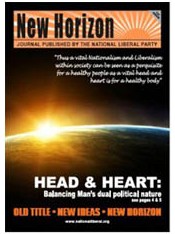
ISSUE 1 of New Horizon – the online ideological magazine of the National Liberal Party - was launched towards the end of 2015. To get hold of a FREE pdf copy, simply e-mail natliberal@aol.com
WHILST New Horizon is dedicated to promoting the ideology of National Liberalism, we cannot forget those National Liberals who are attempting to put this into practice. We know that there are individuals (groups?) who ascribe to the movement’s ideals throughout the Europe, from Turkey to Scandinavia and beyond, even globally. Here in the UK some are involved in pressure groups such as English Green (a non-socialist green movement), whilst others are in the political party – the National Liberal Party.
.
We shall dedicate a section each issue to those operating in the ‘real’ rather than our ‘cyber’ world. In this first issue we host articles supporting and expanding on the NLP’s latest recruitment campaign that focused on Five key policy areas; Civil Liberties, Democracy, Environment, and the NHS.
.
The Nature of Democracy
.
To hear David Cameron and William Hague on television and radio, anyone might be forgiven for believing that the United Kingdom, in its democratic institutions, is the last word in ‘democracy’. Westminster flatters itself as the ‘Mother of Parliaments’ which implies that it is a model for other nations to emulate.
.
We do have much to take pride in. For much of the past millennium the word of the Sovereign was law. The King was set on his throne by God and had a ‘divine right’ to govern in any way he pleased, however capricious and arbitrary he might have been.
.
Magna Carta
.
This arbitrary power was first challenged in England in 1215 at Runnymede when King John was forced to sign the Magna Carta – the Great Charter of the Liberties of England – by feudal barons. This set down the principle that the King is also subject to the law of the Land.
.
When Charles I refused to be bound by the Law he had to be defeated by parliamentary armies in 1642-49 and eventually executed for his treason.
.
The Glorious Revolution of 1689 finally vanquished the doctrine of ‘the Divine Right of Kings’, as practised in France by the ‘Sun King’, Louis XIV. Louis was the absolute dictator of France and James II wanted to have the same dictatorial powers in England, Scotland and Ireland.
.
In England, the principle had become well established that elected representatives of his subjects should check the King’s actions and that those representatives should be able to make laws. It was by no means truly democratic, but it was a significant step away from absolutism. It is not surprising that James encountered strong opposition, which led to his removal by William of Orange and his defeat at the Boyne. The Constitutional Monarchy and parliamentary government finally put down roots.
.
At first the vote in the UK was restricted to certain classes; all of them male. New Zealand adopted universal suffrage for all citizens in 1893. In Britain it was in 1928 and as late as 1971 in Switzerland. Democracy as an idea seems to be catching on, albeit slowly.
.
What is Democracy?
.
But what exactly is ‘democracy’? We hear of ‘liberal democracy’, ‘representative democracy’, ‘parliamentary democracy’, ‘majoritarian democracy’, ‘direct democracy’ and ‘consensus democracy’. All that these have in common is that somewhere in the process, somebody gets to cast a vote and somebody or something wins a majority. Is that it then?
.
Is democracy simply the rule of a majority?
.
Apologists for the ‘First Past the Post’ system of parliamentary representation argue that it is. A candidate with the support of, say, 26% of the total poll is deemed elected even though his ‘majority’ is tiny. What counts is that he is out in front. The fact that 74% of voters supported other candidates is deemed irrelevant. According to its apologists, this system enables stable government with a workable majority in parliament. Its detractors, in contrast, point out that such a government is in danger of losing touch with the people it purports to represent. Once ‘the people have spoken’ their elected representatives can ignore their wishes for up to five years. These parliamentarians are often at the mercy of party whips that use a mixture of threats and promises to keep them in line.
.
Democratic deficit
.
In a divided society this can be dangerous if one section of the community is, in effect, always excluded from decision-making by a form of parliamentary despotism. The (failed) attempt to replace FPTP with the Alternative Vote earlier this year was intended to address this democratic deficit. AV would have been an improvement on FPTP, but inferior to the Single Transferable Vote system of Proportional Representation as used in Northern Ireland.
.
Northern Ireland has one major flaw in its system, however, as it is governed by a mandatory five-party coalition. There is no opposition, so no alternative government is waiting in the wings to take over if the incumbent regime messes things up. No matter who you vote for, the government always gets in!
.
In Westminster FPTP elections, we get the chance to ‘throw the rascals out’ every four or five years, but once elected our parliamentarians can do whatever they like without reference to the electorate.
.
Direct Democracy
.
One suggested improvement might be a system of direct democracy where Members of Parliament act as popular delegates. This worked well in ancient Athens where everyone knew almost everyone else but seems impractical in a modern largely anonymous society. How are MPs to be brought closer to the people?
.
The National Liberal Party suggests that we introduce referendums as a regular consultative constitutional measure. The party is circulating an on-line petition which states:
.
Everyday important decisions are made by Government which directly affects the people. However the people are never consulted as part of the decision making process. The war in Afghanistan is just one example of this.
.
The National Liberal Party and the undersigned call for the introduction into law the use of Referendums based on the successful direct democracy system used in Switzerland, allowing people to vote on major issues such as Europe (including renegotiating the Lisbon Treaty), Nuclear power, immigration, the creation of an English Parliament and going to war.
Go to http://www.gopetition.com/petitions/consult-thepeople.html
.
Switzerland: a practical application of ‘Direct Democracy’
.
In Switzerland regular elections are held to elect representatives to their Federal (national) Parliament. As in Northern Ireland, the use of PR ensures that the party split in the number of representatives more closely resembles a party’s percentage vote than clearly is the case in Westminster. This allows government to reflect the ‘popular will’ by forcing the main parties to act in coalition. Significant minority opinion and minor parties are not shut out of influence. The government will still get in, but it will vary in response to the shifting strengths of the constituent parties in the parliament.
.
In addition to this superior electoral system, Switzerland operates three mechanisms of Direct Democracy: Referendums, Initiative and Recall. Referendums cover votes on Government proposed changes to the Constitution, important Federal (National) laws or International treaties. Initiatives allow the public themselves to call for changes to the Constitution or Federal law. Recall allows the electorate to petition for a reelection of public officials for unacceptable behaviour. Had a similar system been operating here, electors could have petitioned for the recall of those MPs who fiddled their expenses to pay for duck ponds and for similar abuses of office.
.
This form of Direct Democracy institutionalises the voters’ right to decide on issues themselves. Implementation of these measures would go a long way to address the ‘democratic deficit’ in the United Kingdom.
.
These ideas are anathema to the European power elite for whom democracy is a bit of an inconvenience. Whatever might be said of the former Prime Ministers of Greece and Italy, they were at least elected to office. Not so their ‘technocratic’ successors. It ought to be astonishing that these changes of government were given such an easy ride by the press. Witness the howls of protest when Mr Papandreou announced his intention to put a euro-zone bailout scheme to a popular referendum. Within days he was forced to cancel the referendum.
.
For the EU ‘Eurocrats’, democracy is all very fine as long as the people make the ‘right’ decision. When this does not go according to plan, the aberrant nation is bullied into voting again, as happened when the people of the Republic of Ireland rejected the Nice Treaty in a constitutional referendum.
.
In contrast, Switzerland today is prosperous, peaceful, democratic and not a member of the European Union. There’s probably a lesson there for us all.
.
• ALSO Check out:
Build New Horizon! http://nationalliberal.org/build-new-horizon
New Horizon – Head & Heart http://nationalliberal.org/new-horizon-head-heart
New Horizon – National Liberalism In Action – Civil Liberties http://nationalliberal.org/new-horizon-–-national-liberalism-in-action-–-civil-liberties
Date: February 22, 2020
Categories: Articles, Party News
.
.
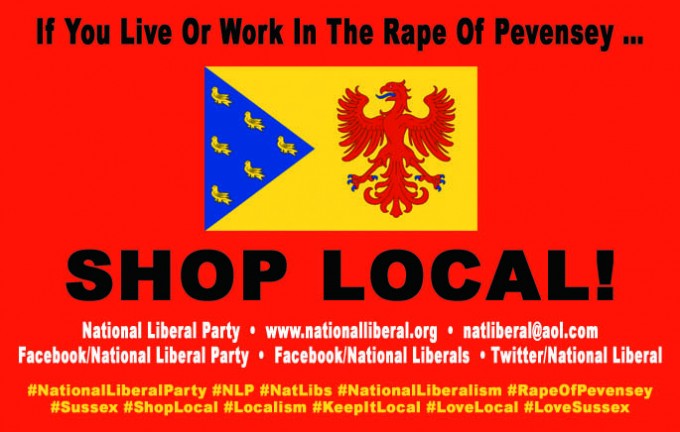
THIS IS THE latest in the National Liberal Party’s series of ongoing Shop Local! posters. And as can be seen, this one relates to the Rape Of Pevensey (Sussex) which includes the towns of Crowborough, Eastbourne and East Grinstead. Much like the lathes of Kent, a rape is a traditional territorial sub-division in Sussex.
Sussex has six rapes – the Rape of Arundel, the Rape of Bramber, the Rape of Chichester, the Rape of Hastings. the Rape of Lewes and the Rape of Pevensey. Each of these rapes was further subdivided into several hundreds. We will be producing Shop Local! posters for the other rapes of Sussex in due course.
The production of this poster reminds us that our policy of Localism (1) – a key component of which is supporting local shops – is both cultural and economic in nature.
(1) Localism is a belief that supports the local production and consumption of goods, local control of government, and promotion of local history, local culture and local identity. http://nationalliberal.org/the-national-liberal-party-supports-localism
Date: February 18, 2020
Categories: Party News
 .
.
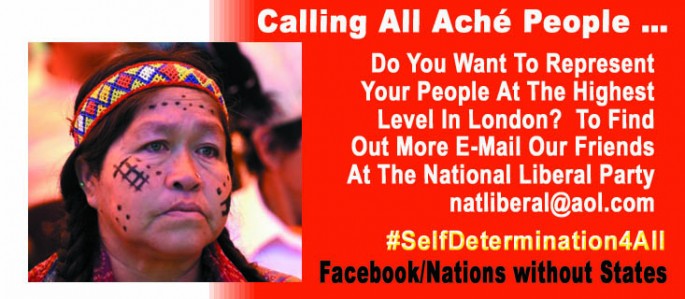
NATIONS WITHOUT STATES – NwS – kicked off this year with an appeal to anyAboriginal Australiansliving in London (who would most probably be youngsters from an artistic or sporting background) who’d be interested in promoting their case for Self-Determination at the highest level in the capital.
.
The opportunity to do so is due to the forthcomingGreater London Assembly elections – scheduled for 7th May. Here, our friends and comrade of the National Liberal Party (NLP) intend to stand up to 25 candidates under the slogan ofSelf-Determination For All!
.
We now turn our attention to theAché People.
.
The Aché – sometimes called theAxe people – are hunter-gatherers, an indigenous people who live in eastern Paraguay, South America. Like many other indigenous people in South America, they have suffered years of persecution at the hands ofcolonists, loggers, and ranchers. This was particularly so in the 1960s & 1970s.
During the latter half of the 20th century, the Paraguayan government launched a ‘pacification program’ which encouraged theAché to settle in permanent villages or camps. However, in recent years theAché have demanded land rights – the return of historical land which is currently being deforested by landless farmers and unscrupulous timber merchants.
NwS concedes that it’s probably unlikely that any descendants of theAché people living in London (and thus able to stand in the GLA elections in three months time). However, we feel that this is no reason to ignore their plight. When it comes to issues relating to Self-Determination, we work on the understanding thateither we all have rights – or none of us have rights!
With the above in mind, the National Liberal Party have advised us that they’d be happy to accommodate anyone – no matter what their ethnic background – who has a special interest and knowledge of the Aché people. Election to the GLA would provide an excellent platform to promote – and give a voice to – the cause of theAché (and other South American indigenous people.)
The GLA has wide-ranging powers – all relating to London. However, a member of the GLA taking up the cause of the Aché people would be newsworthy in its own right. That member can also help organise support for the Aché people in communities, work-places and colleges and add weight to campaigns for allindigenous people. And let’s face it, there arehundreds of unique ethnic minorities in the world – all of whom are victims of globalism. They are losing their culture, identity, languages & traditions. We feel that they’re all unique and all are worth protecting and preserving.
Therefore, we’d ask anyone who has a special knowledge and interest in theAché people to come forward and play your part in righting the many wrongs they’ve been subjected to. Are you up for it? If so, contact our friends in the National Liberal Partynatliberal@aol.com now. Make history – not excuses!
• ALSO check out
From The Liberty Wall – Nations without States – Calling AllAborigines…http://nationalliberal.org/from-the-liberty-wall-–-nations-without-states-–-calling-all-aborigines-…
Date: February 16, 2020
Categories: Articles, Party News
By continuing to use the site, you agree to the use of cookies. more information
The cookie settings on this website are set to "allow cookies" to give you the best browsing experience possible. If you continue to use this website without changing your cookie settings or you click "Accept" below then you are consenting to this.