






Friday, 16 January 2026

Category » Party News

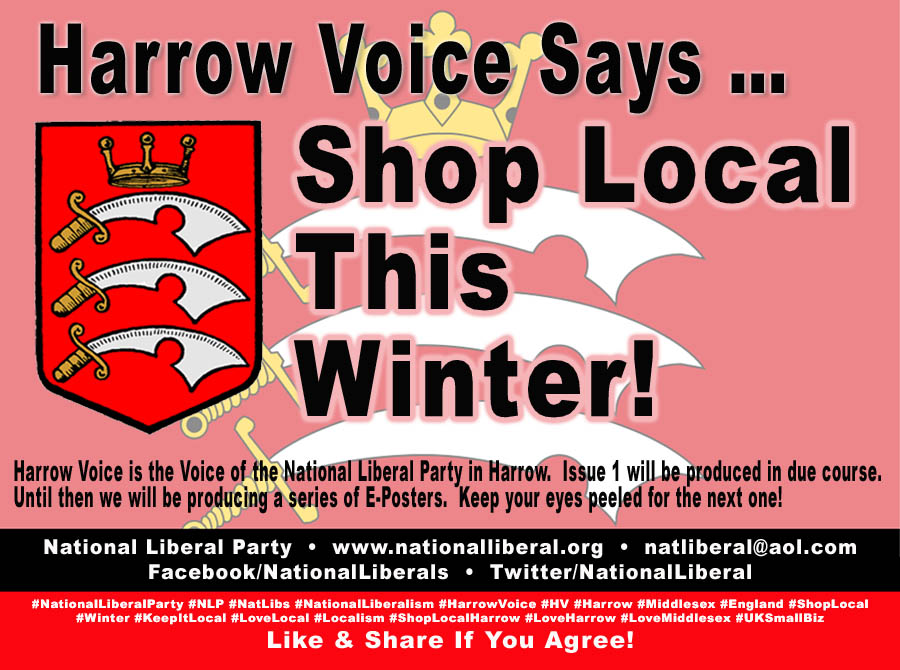
Ulster Voice Says … Wherever You Live In Ulster – Shop Local This Winter!

Share:
  • Print
  • Digg
  • StumbleUpon
  • del.icio.us
  • Facebook
  • Yahoo! Buzz
  • Twitter
  • Google Bookmarks
  • Add to favorites
  • blogmarks
  • Blogosphere
  • Google Buzz
  • PDF
  • email
  • Live
  • MSN Reporter
  • MyShare
  • MySpace
  • Technorati
  • Webnews.de

The Most Wonderful Time Of The Year?

The Establishment parties will do nothing to solve homelessness until they tackle thestranglehold that the Money Power has on government. Until that day comes, the National Liberal Party calls for all of its members & supporters to do what they can to support the homeless. Probably the best way to do this is by helping local charities and initiatives that seek to tackle homelessness at a grass-roots level.

SINCE THE general election was called at the end of October the main Establishment parties seem to have been making every promise under the sun. No matter what the problem is – from Brexit to climate change and everything in between – they all claim to have the answer.


However, it seems to us that they’ve all had long enough to sort out the many social and economic problem that we face. And they’ve all failed. For instance. take homelessness, which surely must be one of our most pressing (and distressing) social problems.


We’re not even going to bother to point out what the Establishment parties say in their current manifestos about homelessness. There’s no point. Their manifestos would promise free unicorns if they thought it was popular and would get them votes. Their words are useless. The Labour Party and Tories have both been in power for years and years. Even the Liberal Democrats ruled the roost (as part of the Con-Dem coalition government) during 2010 – 15.


Yet they’ve all failed to tackle homelessness. Of course their spin doctors will tell you different – but the evidence is literally on the streets for all to see.


To understand the scale of the problem, one only has to consider a report fromWelfare Weeklyhttps://welfareweekly.com/a-homeless-person-dies-every-19-hours-in-austerity-britain/ – from earlier this year. It made the startling claim that a homeless person dies every 19 hours in austerity Britain.


The shocking figures were provided by the Museum of Homelessness (MoH) –https://museumofhomelessness.org/ – which is a ‘community driven social justice museum, created and run by people with direct experience of homelessness.’ Data for the MoH study was collected from coroners’ enquiries, media coverage, family testimony and freedom of information requests.


However, some campaigners in the London-based MoH believe that the figures could be much higher. Incredibly, around 30% of deaths since 2017 have occurred where people were living in emergency or temporary accommodation.


Speaking at the time of the report, MoH co-founder Matt Turtle noted:


“People affected by homelessness continue to die at a shocking rate despite the passage of the homelessness reduction act nearly 18 months ago.


We regularly hear from people who feel they’re safer on the streets than in hostels and this data shows why.


People are placed in inadequate, unsafe accommodation, whether badly run hostels or other forms of private rented accommodation, with all too often fatal consequences.”


The NLP presumes that the use of ”inadequate, unsafe accommodation”is a case of dealing with the problem ‘on the cheap.’ Maybe the Establishment feels that if they can get as many people off of the streets as possible, it’ll be a case of ‘out of sight, out of mind.’


Linking Britain’s homelessness crisis to austerity, Mr Tutle said:


“There’s much evidence that almost a decade of austerity policies has had a clear and direct impact on society’s most vulnerable.”


As we noted earlier, all of the Establishment parties have had plenty of time to tackle homelessness. Despite what they say in the run up to the general election they’ll not do a thing. It’s all platitudes and empty promises. And they’ll keep on doing this for ever and a day.


Meanwhile hundreds of people will either die in inadequate and unsafe accommodation or on the streets. The latter will probably be particularly so, especially this time of year as we hurtle towards Christmas when the nights are bitterly cold. The killing cold, to coin a phrase. It’s not exactly the most wonderful time of the year for the homeless.


With the above in mind, we have to ask ourselves why the Establishment parties can’t – or won’t – tackle homelessness and itsunderlying causes, such as austerity, mental health issues and abuse.


The NLP believes that, in order to truly sort out these problems, we need a complete system change.


Indeed, we believe that looking at people in purely monetary terms is the real cause of virtually all of our social and economic problems. To get to the real root of these issues we need a completely different mindset. We need to forget about profits, GDP and balance sheets.


But the Establishment parties won’t do this. They’re all pro-capitalist – even the ‘socialists’ amongst them! – and all seem to be in hoc to the bankers. None of them will make any attempt to break the stranglehold that the Money Power has on government.


They’ll keep on borrowing from the banks, accruing more debt and paying back millions in interest. They’ll do nothing to break this vicious circle – like authorising a national bank tospend – and not lend – money directly into the economy. This will ensure that Britain’s housing & homelessness crisis can be tackled once and for all.


Until that day comes, the National Liberal Party urges all of its members and supporters todo what they can in terms of supporting the homeless. We’re simply not in a position to help in a ‘trickle down’ fashion. Therefore, we have to help from the bottom up. And that means supporting local charities and initiatives that seek to tackle homelessness at a grass-roots level.


• ALSO Check out:

Social Justice & The Failure Of Capitalism http://nationalliberal.org/social-justice-the-failure-of-capitalism


News From Nowhere – Poverty & Homelessness in Britain & Éire http://nationalliberal.org/news-from-nowhere-poverty-homelessness-in-britain-eire

Share:
  • Print
  • Digg
  • StumbleUpon
  • del.icio.us
  • Facebook
  • Yahoo! Buzz
  • Twitter
  • Google Bookmarks
  • Add to favorites
  • blogmarks
  • Blogosphere
  • Google Buzz
  • PDF
  • email
  • Live
  • MSN Reporter
  • MyShare
  • MySpace
  • Technorati
  • Webnews.de

The National Liberal Party Says Shop Local In Abingdon-On-Thames This Christmas!

.

• ALSO Check out:

The National Liberal Party Says Shop Local In Aberdeen This Christmas! http://nationalliberal.org/the-national-liberal-party-says-shop-local-in-aberdeen-this-christmas
Share:
  • Print
  • Digg
  • StumbleUpon
  • del.icio.us
  • Facebook
  • Yahoo! Buzz
  • Twitter
  • Google Bookmarks
  • Add to favorites
  • blogmarks
  • Blogosphere
  • Google Buzz
  • PDF
  • email
  • Live
  • MSN Reporter
  • MyShare
  • MySpace
  • Technorati
  • Webnews.de

Caledonian Voice Says Happy St. Andrew’s Day!

Share:
  • Print
  • Digg
  • StumbleUpon
  • del.icio.us
  • Facebook
  • Yahoo! Buzz
  • Twitter
  • Google Bookmarks
  • Add to favorites
  • blogmarks
  • Blogosphere
  • Google Buzz
  • PDF
  • email
  • Live
  • MSN Reporter
  • MyShare
  • MySpace
  • Technorati
  • Webnews.de

New Horizon – Head & Heart

TWO MONTHS AGO we reproduced the Editorial to issue 1 of New Horizon, the online ideological magazine of the National Liberal Party. Launched towards the end of 2015, NH is designed ‘to showcase (and debate) the ideas and policies of the National Liberal Party. The ideology of National Liberalism and historical antecedents.’


So what is is ideology – and why is it so important to us? According to the Encyclopaedia Britannicahttps://www.britannica.com/topic/ideology-society – ideology can be described as ‘a form of social or political philosophy in which practical elements are as prominent as theoretical ones. It is a system of ideas that aspires both to explain the world and to change it.’


Ideology is – or should be – particularly important to any political grouping as it provides the foundation for its policies. And for relatively small organisations like the NLP it provides what could be termed the ‘spiritual nourishment’ needed to keep us alive and kicking!


With the above in mind, we invite our readers to view the following article which looks at how, historically, Liberals adopted nationalism as part of their creed and became known as National Liberals.

.

Head & Heart


Right: Giuseppe Mazzini (June 1805 – March 1872), nicknamed "Soul of Italy," was an Italian politician, journalist and activist for the unification of Italy. His Young Italy movement – and its form of European ’romantic’ nationalism -influenced many organisations and individuals. Mazzini advocated popular democracy and was vigorously opposed to Marxism and Communism. He lived in London for some time and his residence - 155 North Gower Street, near Euston Square - is now marked with a commemorative blue plaque.

MANY PEOPLE believe that Liberalism and Nationalism (Patriotism) are opposing philosophies. By the 20th Century Liberalism was seen as antagonistic to Nationalism. In crude terms, Liberals placed the rights of individuals above all whilst Nationalists believed the group was everything. Thus Liberals and Nationalists were often locked in political conflict over the nature and function of the state. It was not always so.


In the 19th century many (political) Liberals believed that the only way to create (in opposition to the multi-national monarchies/aristocratic rulers) and maintain (in a stable environment) individual freedom was within a community of equals. The nation (a people sharing a language, culture and history) was such a community. Nationalism was the pursuit of turning a ‘nation’ into a state. Thus such Liberals adopted nationalism as part of their creed and became known as National Liberals. Indeed many saw Nationalism as an aspect of Liberalism.


The end of history?


The success of peoples to craft out nations throughout Europe and largely create representative democracies within them boded well for the future. A commentator writing just before the Second World War (and fearful of the future) bemoaned the loss of an earlier age where Liberalism and Nationalism were working together towards a “completer humanity”. Further, it was felt “History…. was reaching, its final phrase, and increasing development of the rights of the individual and of democracy within Nation-States was all that the future would have to chronicle. The battle for liberty had been won at last; all the 20th century would need to do would be to garner the harvest.” *1


Unfortunately, it never worked out that way. The plethora of ‘nation-states’ after the First World War should have paved the way for peace rather than conflict but, since many of the states were bureaucratic constructs (creating national minorities in the process) and the democracy forcibly implanted, Europe descended into war as Authoritarian and Totalitarian forces took over as Liberalism withered and Nationalism was ‘hijacked’ by extremes. Thus Nationalism and Liberalism became in conflict as adherents of the former increasingly rejected the latter as an obstacle to the ‘greater unity of the people’, whilst they in turn saw them (correctly) as a threat to the ‘people’s freedom of choice.’ The terrible ‘excesses’ of so-called Nationalists (nee chauvinists) ultimately led to the pendulum swinging towards Liberalism and a suspicion of nation-states in general (at least in Europe). That suspicion still exists today. *2


What then is the natural order of their relationship?


The Heart


Both philosophies appeal to different aspects of Man. Nationalism is an emotion, a belief in a group loyalty that may require a sacrifice for the greater whole. In its basic sense it is the reason why we pay taxes the benefits of which we may not receive in return. Some theorists would say this is a ‘social contract’ i.e. we pay for peace of mind. We sacrifice our freedom of action towards laws and enforcement because it suits us e.g. a protection against the strong or the criminal. A Nationalist would say that it is our duty to make that sacrifice, being also a product of past and future generations i.e. we owe it to our families not just as a selfish choice. A National Liberal would say that an individuals family, community and nation require a proportionate form of sacrifice i.e. that which does not also take away his individuality or liberty. In all senses the Nation represents Man’s heart. It is an emotional feeling that justifies sacrifice and duty. Mazzini says that it has a call upon the duties of man. *3


The Head


Liberalism on the other hand appeals to the intellect. We are born as individuals and we seek a way of life that allows us to enjoy its’ fruits. How we organise ourselves, how we interact with others is dictated by our mind e.g. we should be able to choose our form of governance whilst still maintaining at ‘arms-length’ the designs of the state. This freedom to choose is essential as is the freedom to limit the control that a state exercises upon our lives. Liberalism, or more properly Liberty, is represented by our head for we choose to be free. A National Liberal would say that liberty (from an omnipotent state) is crucial to Man’s well-being. Mazzini says that it is one of the rights of man.

.

The early revolts of the 19th century illustrate the differences of Man’s Dual nature (Heard or Heart). Such revolts were either Liberal or Nationalist in their nature (unlike the more National-Liberal revolts in 1848). Although mainly inspired by political liberalism (the head) the only successful revolt (in Portugal) was that inspired by nationalist impulses (the heart). Reaction in Europe was too powerful to be overthrown so whilst the masses might shout for liberty they would not fight (and inevitably die) for it. Where inspired by the heart i.e. nationalism they will do so even when the cause seems, in practical terms, lost.


A necessary balance of ‘Head & Heart’


Thus a vital Nationalism and Liberalism within society can be seen as a perquisite for a healthy people as a vital head and heart is for a healthy body. A National Liberal thus seeks to harness and maintain a balance between the needs of the nation and the individual as a doctor would between the needs of head and heart. One cannot be complete without the other.


Addendum:


*1 H. Featherstone, A Century of Nationalism (London 1939), P.9.


*2 One commentator however has suggested that, at least amongst Liberal political scientists, opposition to national discourse was restricted to a short period between the 1950’s & 1980’s and that liberal nationalism is again rising (as national liberalism once did 150 years previously). Dr S. Miscoiu , Liberalism against the Nation: A False Hypothesis of the Historical Analysis, Arts_and_Humanities, Journal for the Study of Religions and ideologies, 12, 2005, P.49 – 55 Mazzini


* 3 G. Mazzini, The Duties of Man (Lugano 1860)


• ALSO Check out:

Build New Horizon! http://nationalliberal.org/build-new-horizon

Share:
  • Print
  • Digg
  • StumbleUpon
  • del.icio.us
  • Facebook
  • Yahoo! Buzz
  • Twitter
  • Google Bookmarks
  • Add to favorites
  • blogmarks
  • Blogosphere
  • Google Buzz
  • PDF
  • email
  • Live
  • MSN Reporter
  • MyShare
  • MySpace
  • Technorati
  • Webnews.de

English Voice Says … Wherever You Live In England – Shop Local This Winter!

Share:
  • Print
  • Digg
  • StumbleUpon
  • del.icio.us
  • Facebook
  • Yahoo! Buzz
  • Twitter
  • Google Bookmarks
  • Add to favorites
  • blogmarks
  • Blogosphere
  • Google Buzz
  • PDF
  • email
  • Live
  • MSN Reporter
  • MyShare
  • MySpace
  • Technorati
  • Webnews.de

By continuing to use the site, you agree to the use of cookies. more information

The cookie settings on this website are set to "allow cookies" to give you the best browsing experience possible. If you continue to use this website without changing your cookie settings or you click "Accept" below then you are consenting to this.

Close