WELCOME TO the second part of our article Trade Unionists Against Mass Immigration. It should be read directly on from part 1 http://nationalliberal.org/from-the-liberty-wall-–-national-liberal-trade-unionists-–-trade-unionists-against-mass-immigration-part-1 Written by Angela Nagle for American Affairs, it was originally entitled The Left Case Against Open Borders – https://americanaffairsjournal.org/2018/11/the-left-case-against-open-borders/
Whilst National Liberal Trade Unionists – NLTU – hold a position that goes way beyond Capitalism and Socialism, we are interested in building a consensus with those who recognise that mass immigration is basically a form of mass slavery. However, it’s particularly interesting to see that some sections of the ‘Left’ are now coming to realise that it’s not ‘racist’ nor ‘reactionary’ to want to restrict – or limit in some way – immigration.
Nagle’s article references the early ‘importation of low-paid Irish immigrants to England.’ However, modern day Trade Unionists will probably be more familiar with the events of the late-1940s when thousands of wage-slaves were imported from the West Indies to replace the indigenous British (but mainly English) folk who had died in the Second World War. This was a method of creating a new menial workforce and stabilising the capitalist economy on behalf of the profiteering ruling class – the original ‘elite’.
Today, contemporary migration – driven by Globalisation – serves the interests of the banks and corporations. One of the reasons why so many British workers voted for Brexit is because they regard ‘open borders’ as a nightmare situation. In fact, it’s a disaster for ordinary people everywhere – not least the poorer countries which are being deprived of much needed skilled workers and technicians. The NLTU also feels that there’s a lot of merit to the argument that encouraging workers to seek better wages abroad is also a way of closing down opposition to exploitation and oppression in these poorer countries.
With all of this in mind, and in the spirit of comradeship, free speech and open debate, we feature Angela Nagle’s article below. As usual, everything is up for discussion. Therefore, readers are invited to share their thoughts when this article is reproduced on the NLTU Facebook site – https://www.facebook.com/groups/277840098977231 – and the NLP Facebook site – https://www.facebook.com/groups/52739504313/ It goes without saying that there are no official links between Angela Nagle, American Affairs, the NLTU and the National Liberal Party. Please note that the NLTU has kept the original US spelling and phrases as they are.
.
The Left Case Against Open Borders – By Angela Nagle (Part 2)
Useful Idiots
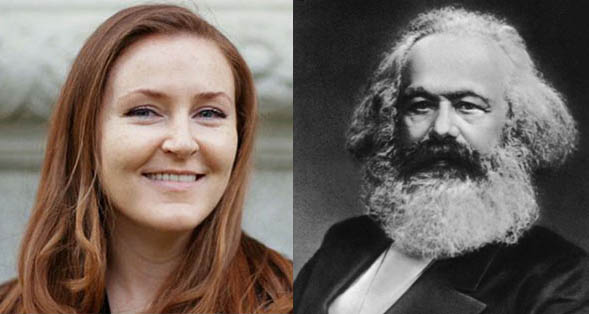
Angela Nagle (left) says that Karl Marx (right) held a position on immigration which would get him banished from the modern Left. The NLTU believes that many on the left confuse Globalisation with Internationalism. There’s also a deliberate conflation of socialist internationalism with liberal cosmopolitanism. Indeed, the left’s support for ‘freedom of movement’ has been the biggest joke of the last few years. It proves that the middle class has effectively taken over leftist politics, because ‘freedom of movement’ can only benefit the bosses!
The transformation of open borders into a “Left” position is a very new phenomenon and runs counter to the history of the organized Left in fundamental ways. Open borders has long been a rallying cry of the business and free market Right. Drawing from neoclassical economists, these groups have advocated for liberalizing migration on the grounds of market rationality and economic freedom. They oppose limits on migration for the same reasons that they oppose restrictions on the movement of capital. The Koch- funded Cato Institute, which also advocates lifting legal restrictions on child labor, has churned out radical open borders advocacy for decades, arguing that support for open borders is a fundamental tenet of libertarianism, and “Forget the wall already, it’s time for the U.S. to have open borders.” (1) The Adam Smith Institute has done much the same, arguing that “immigration restrictions make us poorer.” (2)
Following Reagan and figures like Milton Friedman, George W. Bush championed liberalizing migration before, during, and after his presidency. Grover Norquist, a zealous advocate of Trump’s (and Bush’s and Reagan’s) tax cuts, has for years railed against the illiberalism of the trade unions, reminding us, “Hostility to immigration has traditionally been a union cause. (3)
He’s not wrong. From the first law restricting immigration in 1882 to Cesar Chavez and the famously multiethnic United Farm Workers protesting against employers’ use and encouragement of illegal migration in 1969, trade unions have often opposed mass migration. They saw the deliberate importation of illegal, low-wage workers as weakening labor’s bargaining power and as a form of exploitation. There is no getting around the fact that the power of unions relies by definition on their ability to restrict and withdraw the supply of labor, which becomes impossible if an entire workforce can be easily and cheaply replaced. Open borders and mass immigration are a victory for the bosses.
And the bosses almost universally support it. Mark Zuckerberg’s think tank and lobbying organization, Forward, which advocates for liberalizing migration policies, lists among its “founders and funders” Eric Schmidt and Bill Gates, as well as CEOs and senior executives of YouTube, Dropbox, Airbnb, Netflix, Groupon, Walmart, Yahoo, Lyft, Instagram, and many others. The cumulative personal wealth represented on this list is enough to heavily influence most governing institutions and parliaments, if not buy them outright. While often celebrated by progressives, the motivations of these “liberal” billionaires are clear. Their generosity toward dogmatically anti-labor Republicans, like Jeff Flake of the famous “Gang of Eight” bill, should come as no surprise.
Admittedly, union opposition to mass migration was sometimes intermingled with racism (which was present across American society) in previous eras. What is omitted in libertarian attempts to smear trade unions as “the real racists,” however, is that in the days of strong trade unions, they were also able to use their power to mount campaigns of international solidarity with workers’ movements around the world. Unions raised the wages of millions of nonwhite members, while deunionization today is estimated to cost black American men $50 a week. (4)
During the Reagan neoliberal revolution, union power was dealt a blow from which it has never recovered, and wages have stagnated for decades. Under this pressure, the Left itself has undergone a transformation. In the absence of a powerful workers’ movement, it has remained radical in the sphere of culture and individual freedom, but can offer little more than toothless protests and appeals to noblesse oblige in the sphere of economics.
With obscene images of low-wage migrants being chased down as criminals by ICE, others drowning in the Mediterranean, and the worrying growth of anti-immigrant sentiment across the world, it is easy to see why the Left wants to defend illegal migrants against being targeted and victimized. And it should. But acting on the correct moral impulse to defend the human dignity of migrants, the Left has ended up pulling the front line too far back, effectively defending the exploitative system of migration itself.
Today’s well-intentioned activists have become the useful idiots of big business. With their adoption of “open borders” advocacy—and a fierce moral absolutism that regards any limit to migration as an unspeakable evil—any criticism of the exploitative system of mass migration is effectively dismissed as blasphemy. Even solidly leftist politicians, like Bernie Sanders in the United States and Jeremy Corbyn in the United Kingdom, are accused of “nativism” by critics if they recognize the legitimacy of borders or migration restriction at any point. This open borders radicalism ultimately benefits the elites within the most powerful countries in the world, further disempowers organized labor, robs the developing world of desperately needed professionals, and turns workers against workers.
But the Left need not take my word for it. Just ask Karl Marx, whose position on immigration would get him banished from the modern Left. Although migration at today’s speed and scale would have been unthinkable in Marx’s time, he expressed a highly critical view of the effects of the migration that occurred in the nineteenth century. In a letter to two of his American fellow-travelers, Marx argued that the importation of low-paid Irish immigrants to England forced them into hostile competition with English workers. He saw it as part of a system of exploitation, which divided the working class and which represented an extension of the colonial system. He wrote:
Owing to the constantly increasing concentration of leaseholds, Ireland constantly sends her own surplus to the English labour market, and thus forces down wages and lowers the material and moral position of the English working class.
And most important of all! Every industrial and commercial centre in England now possesses a working class divided into two hostile camps, English proletarians and Irish proletarians. The ordinary English worker hates the Irish worker as a competitor who lowers his standard of life. In relation to the Irish worker he regards himself as a member of the ruling nation and consequently he becomes a tool of the English aristocrats and capitalists against Ireland, thus strengthening their domination over himself. He cherishes religious, social, and national prejudices against the Irish worker. His attitude towards him is much the same as that of the “poor whites” to the Negroes in the former slave states of the U.S.A. The Irishman pays him back with interest in his own money. He sees in the English worker both the accomplice and the stupid tool of the English rulers in Ireland.
This antagonism is artificially kept alive and intensified by the press, the pulpit, the comic papers, in short, by all the means at the disposal of the ruling classes. This antagonism is the secret of the impotence of the English working class, despite its organisation. It is the secret by which the capitalist class maintains its power. And the latter is quite aware of this. (5)
Marx went on to say that the priority for labor organizing in England was “to make the English workers realize that for them the national emancipation of Ireland is not a question of abstract justice or humanitarian sentiment but the first condition of their own social emancipation.” Here Marx pointed the way to an approach that is scarcely found today. The importation of low-paid labor is a tool of oppression that divides workers and benefits those in power. The proper response, therefore, is not abstract moralism about welcoming all migrants as an imagined act of charity, but rather addressing the root causes of migration in the relationship between large and powerful economies and the smaller or developing economies from which people migrate.
1 Jeffrey Miron, “Forget the Wall Already, It’s Time for the U.S. to Have Open Borders,” USA Today, July 31, 2018.
2 Sam Bowman, “Immigration Restrictions Make Us Poorer,” Adam Smith Institute, April 13, 2011.
3 Grover G. Norquist, “Samuel Gompers versus Reagan,” American Spectator, Sept. 25, 2013.
4 Bhaskar Sunkara, “What’s Your Solution to Fighting Sexism and Racism? Mine Is: Unions,” Guardian, Sept. 1, 2018.
5 David L. Wilson, “Marx on Immigration,” Monthly Review, Feb. 1, 2017.
• ABOUT THE AUTHOR: Angela Nagle writes for the Atlantic, Jacobin, the Irish Times and the Baffler. She is the author of Kill All Normies: Online Culture Wars from 4chan and Tumblr to Trump and the Alt-Right (Zero Books, 2017).
• CHECK OUT the National Liberal Trade Unionists (NLTU) here: https://www.facebook.com/groups/277840098977231/
• LIBERAL WORKER is the voice of the NLTU. To get hold of issue 1 simply e-mail natliberal@aol.com and ask for your FREE pdf copy!