Tuesday, 20 January 2026

The Isle Of Wight Voice Says Shop Local This Winter!
Share:
  • Print
  • Digg
  • StumbleUpon
  • del.icio.us
  • Facebook
  • Yahoo! Buzz
  • Twitter
  • Google Bookmarks
  • Add to favorites
  • blogmarks
  • Blogosphere
  • Google Buzz
  • PDF
  • email
  • Live
  • MSN Reporter
  • MyShare
  • MySpace
  • Technorati
  • Webnews.de

Distributism As A Means of Achieving Third Way Economics (Part 4)

THIS is the fourth in a five part series about Distributism. The original was written by Richard Howard in 2005 and appeared on the web-site – http://www.hsnsw.asn.au/index.php – of the Humanist Society of New South Wales..


As we have previously noted, Distributism (and partially Social Credit) remains one of the key influences relating to the social and economic ideals of National Liberalism. This is because National Liberalism rejects both capitalism and socialism and seeks to promote a third alternative that goes way beyond these two positions.

National Liberalism believes that capitalism and socialism are effectively different sides of the same coin. Both systems place the means of production into the hands of a minority at the expense of the masses. In capitalism, land and capital are controlled by a small number of powerful business people, while in socialism that same power was held by a small number of politicians. In these scenarios, the vast majority of citizens had little control over their own economic fortunes. National Liberalism, on the other hand, believes in economic and social self-determination and freedom.

We invite our readers to share their thoughts when this article is reproduced on our Facebook site https://www.facebook.com/groups/52739504313/ It goes without saying that there are no official links between Richard Howard, the Humanist Society of New South Wales and the National Liberal Party. Readers will note that this Introduction uses the phrase ‘third position’ and that the article uses the phrase ‘Third Way.’ Here they are used in a context that distinguishes it from capitalism and socialism – indeed, it refers to an economic position that goes way beyond both capitalism and socialism.

.
Distributism As A Means of Achieving Third Way Economics (Part 4)


“Under capitalism, man exploits man. Under communism, it’s the other way around.”

How Distributism Works


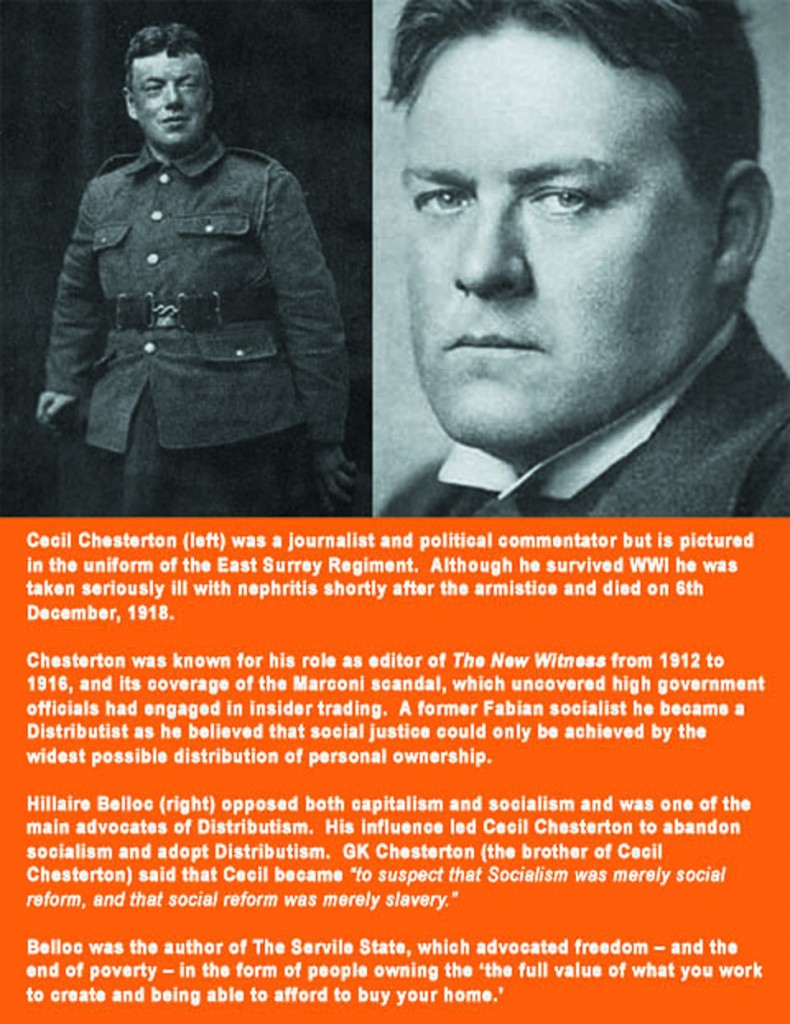
The key work to understanding early 20th century distributism is Belloc’s seminal work, the Servile State.
A savage denunciation of laissez-faire capitalism, which Belloc argued was re-establishing feudal servility on economic lines, the Servile State is no less savage towards state socialism, which (ironically presaging the later words of free market economist Friedrich Hayek) Belloc called no less a road to serfdom.
Belloc argued that what a divided Britain with a vast impoverished underclass needed was not ever more unrestrained capitalism nor the false dawn of socialism, but a new liberalism, which for Belloc was first last and foremost about liberty.
Freedom, however, as Belloc well knew, isn’t free. What use is the mere absence of the physical control of others if your poverty renders you subject to their financial control? It’s simply a subtler form of tyranny.
The beginning of freedom is the end of poverty and the end of poverty argue the distributists comes not with state ownership or welfare handouts but with owning the full value of what you work to create and being able to afford to buy your home, not living by another’s leave.
Belloc was elected to parliament shortly before the First World War and served in the government of Lloyd George, but his uncompromising personality denied distributism the opportunity it could otherwise have gained.
For all its colourful leadership by Belloc and Chesterton, and the considerable publicity it enjoyed in the 20s and 30s, distributism was never implemented in Britain and after its dalliance with Oswald Mosley’s New Party, it never recovered public credibility when Moseley turned to fascism.
The laurel for outstanding success in implementing distributist aims must rest with the Spanish, where following the Spanish Civil war, Don Jose Maria Arizmendiarrieta founded the Mondragon Co-operative in the Basque region. From a handful of unemployed oil lamp makers, Mondragon has grown to become the ninth largest corporation in Spain.
Unlike the isolated and fragmentary co-operative experiments in Australia and Britain, Mondragon is an expression of the broad distributist agenda that seeks not simply to sell to its members at a discount but to transform their lives. To consistently improve living standards through sustainable development and to rebuild community and culture as opposed to promoting dog-eat-dog adversarial individualism.
Mondragon co-operative runs supermarkets, banks, agricultural and manufacturing concerns, housing projects, schools, technical colleges and even a university!
The lot of the poor is improved not through welfare but through economic empowerment.
Capital is seen not as the enemy but as an instrument for social progress.
The co-operative, in the Mondragon experiment is viewed as a means by which instead of capital hiring labour, labour can hire capital.
Some see the kind of distributism which Mondragon represents as an evolutionary development of socialism, in which the role of the state is abandoned in favour of locally controlled and owned production. Others, see the Mondragon experience as a new kind of democratic capitalism, in which the wealth-generating power of capitalism has been harnessed to achieve social ends.
In the end though, if capitalism is simply about maximizing profits and standing back even if that leads to monopoly ownership, then Mondragon isn’t capitalism. And if socialism is about collective ownership rather than private profit, Mondragon isn’t socialism either, because Mondragon is all about making individuals and their families wealthier.
To be continued.

Share:
  • Print
  • Digg
  • StumbleUpon
  • del.icio.us
  • Facebook
  • Yahoo! Buzz
  • Twitter
  • Google Bookmarks
  • Add to favorites
  • blogmarks
  • Blogosphere
  • Google Buzz
  • PDF
  • email
  • Live
  • MSN Reporter
  • MyShare
  • MySpace
  • Technorati
  • Webnews.de

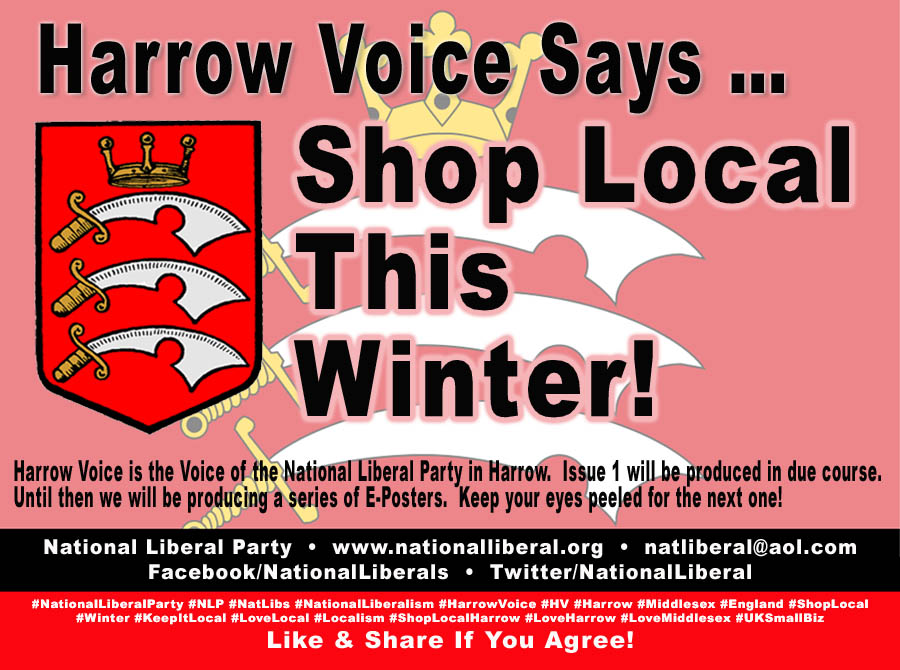
Harrow Voice Says Shop Local This Winter!

Share:
  • Print
  • Digg
  • StumbleUpon
  • del.icio.us
  • Facebook
  • Yahoo! Buzz
  • Twitter
  • Google Bookmarks
  • Add to favorites
  • blogmarks
  • Blogosphere
  • Google Buzz
  • PDF
  • email
  • Live
  • MSN Reporter
  • MyShare
  • MySpace
  • Technorati
  • Webnews.de

Social Credit and War
ANOTHER REMEMBRANCE DAY has come and gone. This year was significant as it was marked the 100th anniversary of Armistance Day and members and supporters of the National Liberal Party paid their respects both publically and privately.
Like many other folks, at the eleventh hour of the eleventh day of the eleventh month, we honoured the memory of the millions of men, women, children and animals whose lives were destroyed by those who herded them into the killing fields of the First World War.

At the same time we recognise that WWI (like many, if not all, wars) was a conflict based on naked greed and imperialism. With this in mind we came across an article – Social Credit and War – written by Oliver Heydorn for The Cliffiord Hugh Douglas Institute for the Study and Promtion of Social Credit http://www.socred.org/ – which we reproduce below. The article was written for Remembrance Day and seeks to explain the economic reason why some nations go to war.

We would encourage everyone to read this article – which can be found online here http://www.socred.org/s-c-action/social-credit-views/social-credit-and-war-2?fbclid=IwAR2i3e4OQlkqwyvrwKyTnvE2JdsJG9jwhcf9t7ZthyQTY3xpA6-XagBlDc4carefully, as it exposes the madness behind the idea of ‘continued economic growth’ which can (and does) lead to war.

We invite our readers to share their thoughts when this article is reproduced on our Facebook site https://www.facebook.com/groups/52739504313/ It goes without saying that there are no official links between Oliver Heydorn, The Cliffiord Hugh Douglas Institute and the National Liberal Party.
.

.

.

Social Credit and War
.
AS TODAY is Remembrance Day, I thought it would be appropriate for us to consider one of the implications of Social Credit theory with respect to war:
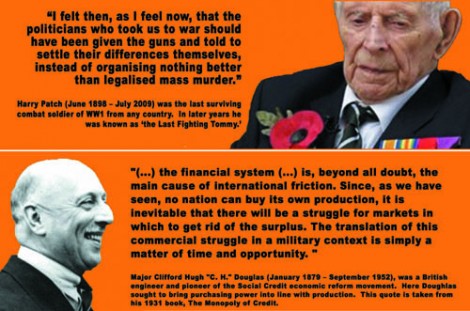
“(…) the financial system (…) is, beyond all doubt, the main cause of international friction. Since, as we have seen, no nation can buy its own production, it is inevitable that there will be a struggle for markets in which to get rid of the surplus. The translation of this commercial struggle in a military context is simply a matter of time and opportunity. “[1]
Social Crediters have repeatedly warned that there is a chronic economic cause, entirely artificial in nature and, therefore, unnecessary, which inexorably leads nations to take up arms against each other. Due to the underlying deficiency in consumer purchasing power that afflicts all industrial societies operating under standard banking and cost-accounting conventions, countries are frequently pressured to alleviate the lack of liquidity in the domestic economy by seeking to export more than they import. A so-called “favorable trade balance” (which is undoubtedly unfavorable in real terms because it implies a net loss of real wealth) helps an economy to fill the gap between the prices of consumer goods and the consumers’ income by getting rid of part of its surplus production, while, at the same time, increasing the flow of purchasing power to the consumer (through the jobs that are created and the profits that are obtained by the exporting companies). The problem is that it is mathematically impossible for all of the nations in the world to export more than they import; it is a zero-sum game. For every exporting champion, there must be a loser with a trade deficit. Countries that import more than they export are faced with a problem of a gap that has become even worse as a result of their commercial activities. Since every country is operating under the same internal deficit of purchasing power, the struggle for a favorable trade balance constitutes a struggle for survival. This leads, quite naturally, to economic conflict, or rather to economic warfare, in the form of commercial wars and “free trade” alliances, and, all too often, it can force or at least induce a military conflict. A country that does not manage to compete successfully through “innovation”, hard work, and the achievement of lower prices in comparison with its rivals in the global struggle for an artificially scarce flow of purchasing power can choose to ensure its victory through war, i.e., by defeating his economic opponents on the battlefield. The real reason for the war will, of course, be more or less hidden from the public and a pretext will be found, but the war may allow the aggressor to destroy part of a rival’s productive capacity and/or, through the eventual signature of peace treaties, to insist on more favorable commercial conditions for itself (as part of due reparations).
The pressure placed on nations to compensate for their internal price-income gaps with favorable trade balances is intensified by the universally defended policy of full employment. If we madly insist, in direct opposition to the real physical potential of the modern industrial economy, that all (or almost all) must work in the formal economy in order to obtain purchasing power (or be supported by those who do), then we are demanding continued economic growth as an end in itself (as a means of distributing additional income as the population grows). The resulting production must find some outlet. If it can not be absorbed internally, a market must be secured for it abroad. It was for this reason that John Hargrave, leader of the Green Shirts (a paramilitary Social Credit group of the 1930s), courageously proclaimed on more than one occasion that “He who cries for full employment, cries for war”.
Major Douglas explored in some detail the purely economic causes behind modern war in a BBC speech entitled “The Causes of War”:
https://www.youtube.com/watch?v=sw28HmmvNNs
https://www.youtube.com/watch?v=676UBQpBePc
[1] C. H. Douglas, The Monopoly of Credit (Sudbury, Inglaterra: Bloomfield Books, 1979), 92.

Share:
  • Print
  • Digg
  • StumbleUpon
  • del.icio.us
  • Facebook
  • Yahoo! Buzz
  • Twitter
  • Google Bookmarks
  • Add to favorites
  • blogmarks
  • Blogosphere
  • Google Buzz
  • PDF
  • email
  • Live
  • MSN Reporter
  • MyShare
  • MySpace
  • Technorati
  • Webnews.de

Should Cumbria Have More Autonomy?

.

• TO FIND out more about the NLPs views on decentralisation, check out: Regionalism – Small Is Beautiful! http://nationalliberal.org/regionalism-–-small-is-beautiful
.

• TO FIND out more about Cumbria, check out: https://www.visitcumbria.com/history/

• CHECK OUT Should Northumberland Have More Autonomy? Join The Debate! http://nationalliberal.org/should-northumberland-have-more-autonomy-join-the-debate
.
• CHECK OUT Should County Durham Have More Autonomy? Join The Debate! http://nationalliberal.org/should-county-durham-have-more-autonomy-join-the-debate
• CHECK OUT Should The Tyne & Wear Have More Autonomy? Join The Debate! http://nationalliberal.org/should-the-tyne-wear-have-more-autonomy-join-the-debate
Share:
  • Print
  • Digg
  • StumbleUpon
  • del.icio.us
  • Facebook
  • Yahoo! Buzz
  • Twitter
  • Google Bookmarks
  • Add to favorites
  • blogmarks
  • Blogosphere
  • Google Buzz
  • PDF
  • email
  • Live
  • MSN Reporter
  • MyShare
  • MySpace
  • Technorati
  • Webnews.de

The National Liberal Party Says Shop Local In Alnwick!

Share:
  • Print
  • Digg
  • StumbleUpon
  • del.icio.us
  • Facebook
  • Yahoo! Buzz
  • Twitter
  • Google Bookmarks
  • Add to favorites
  • blogmarks
  • Blogosphere
  • Google Buzz
  • PDF
  • email
  • Live
  • MSN Reporter
  • MyShare
  • MySpace
  • Technorati
  • Webnews.de

By continuing to use the site, you agree to the use of cookies. more information

The cookie settings on this website are set to "allow cookies" to give you the best browsing experience possible. If you continue to use this website without changing your cookie settings or you click "Accept" below then you are consenting to this.
Close