





Saturday, 17 January 2026

Read This If You Support Self-Determination …
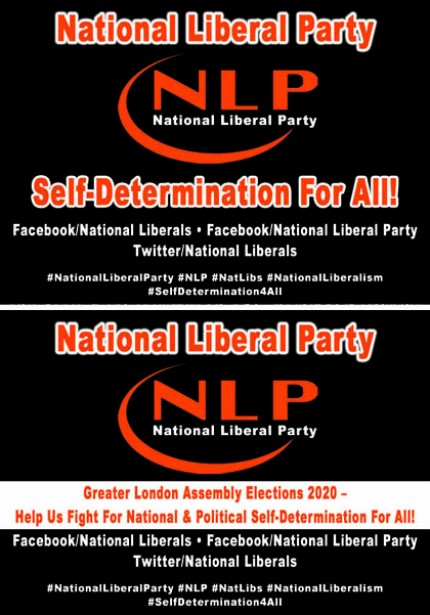
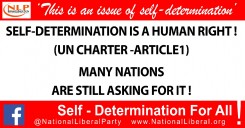
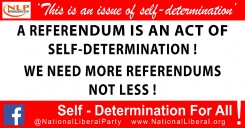
Two National Liberal Party (NLP) posters raising awareness of - and promoting - the concept of Self-Determination. The NLP hopes to run a slate of candidates in the Greater London Assembly elections, scheduled for May 2020, in order to highlight the plight of peoples who aspire to nationhood. Such peoples include the English, Flemish, Kashmiris,Kurds, Sikhs, Tamils and many, many more. Our article seeks to introduce various Self-Determinists to the National Liberal Party andwhat is philosophically termed the‘Three Pillars’ of National Liberalism. Our ideas relating to National, Political and Economic Self-Determination all flow from these ‘Three Pillars.’ Those who wish to increase their in-depth knowledge of both National Liberalism and Self-Determination should readNew Horizon, the ideological journal of the National Liberal Party. To get hold of issues 1 – 4, simply e-mail natliberal@aol.com and ask for your FREE pdf copies.

IN LATE AUGUST of this year, the National Liberal Party announced –https://nationalliberal.org/ self-determination-for-all-3 – that it intended to fight the forthcomingGreater London Assembly elections, scheduled for May 2020.


Our intention was (and still is) to run on a Self-Determination For All! ticket at the ballot box.  This will give us the opportunity to highlight the plight of the various peoples of the world who aspire to nationhood.


Many of these people now live in the Greater London area and are in the sad position of being political refugees, who are hundreds of miles away from their homelands. Others, like the indigenous English, are still waiting for some form of national parliament or assembly, years after those in Scotland, Ulster & Wales were given theirs.


After posting up thispreliminary information about our campaign, we decided that it would be appropriate to provide some general background material relating to self-determination and explain why we feel that it’s such an important concept. In fact, we noted that ‘it’s probably fair to say the raison d’êtreaof National Liberalism is the concept of self-determination.’


Our article#SelfDetermination4All – https://nationalliberal.org/ selfdetermination4all invited supporters to read an comment on a general statement relating to the concept of self-determination. It noted that the principle of self-determination could ‘be applied largely in three areas; National, Political and Economic’ and went on to briefly describe thenational element of self-determination:


National Self-Determination seeks to ensure decisions affecting the collective future of a nation are taken by ALL the people via referendum. This may be ‘External’, for example: the creation or maintenance of a nation state, or ‘Internal’ – framing/updating a constitution to reflect how a people should rule themselves. (We favour independent nations and liberal, democratic, states).’


Earlier this month we provided a follow-up articleGreater London Assembly Elections 2020 – Help Us Fight For National & Political Self-Determination For All!https://nationalliberal.org/greater-london-assembly-elections-2020-–-help-us-fight-for-national-political-self-determination-for-all– which provided some more details of the May 2020 election and what would be expected of the 25 London-based prospective candidates ‘who’d like to represent their people & nation.  Candidates must be prepared to help partly self-finance their campaigns.’  If you think that you fit the bill, please contact us as soon as possible by e-mailingnatliberal@aol.com


It also went on to reproduce more from the NLPsgeneral statement relating to the concept of self-determination. This time it focussed on the political element of self-determination:


Political Self-Determination seeks to ensure that the collective will of the people as well as the variety of political opinion is reflected in decision making. Thus, for example, we favour greater use of referendums to meet the former, and PR to reflect the latter (we favour a system close to the Swiss model of Direct Democracy).’


We aim to follow this up with another article – provisionally titledWill You Represent Your People? –which’ll look at theeconomicelement of self-determination. This should be published early next month.

Before we do that, however, we thought that it would be both instructive and beneficial to formally introduce ourselves to those who’re considering standing on our

Self-Determination For All! ticket in May.

So who – or what – is National Liberalism and why does the National Liberal Party put so much emphasis on self-determination?  Hopefully, the following will answer some of these questions:


National Liberal Party – True Liberalism


The National Liberal Party is a British political party launched in late 2013.  It’s full title is theNational Liberal Party – True Liberalism but is normally called the National Liberal Party, or NLP. It took over a party registration with a similar name.


Its political ideology can be broadly described as National Liberalism and Centrist.


Ideology and policies


The National Liberal Party is a political party supporting the principle of National Liberalism. This is expressed as the protection of individual rights (civil liberties) within the framework of a democratic nation state.


This is in contrast to left-liberalism which the NLP accuses of supporting the breakdown of nation states, most notably by supporting the Unionist aims of the European Union and the breakdown of borders through globalisation.

The result is a weakening of a nation’s traditional cultures and loyalties which has encouraged Western Governments’ to impose or attempt to impose, anti-liberal measures to help control a fragmented populous e.g. via ID Cards, increasing surveillance and information gathering.

The NLPs main slogans are Liberty, Independence, and Democracy, which it calls the ‘Three Pillars’ of National Liberalism.

The first pillar, Liberty, concerns individual rights and liberties (often called political liberalism) it sees threatened by Governments under the guise of ‘security’. The NLP calls for a Civil Liberties Watchdog to guard against any erosion. It has some sympathy with libertarian opposition to state intervention on individual choice.

The second pillar, Independence, highlights opposition to any loss of ‘British’ (or any other nation’s) sovereignty to the European Union but also supports greater recognition of the United Kingdom’s constituent nations i.e. England, Wales, Scotland and Ulster via a Federalist/Devo-Max Constitution. The NLP looks to Switzerland’s ‘Neutralist’ position as a model in world affairs.

The third pillar, Democracy, focuses on what the NLP views as a lack of democracy in the U.K. and supports measures which would increase participation.  This would include the greater use of electoral proportional representation, a None of the Above (NOTA) box on ballot paper, Recall and Direct Democracy along Swiss lines using referendums and citizens’ initiatives. The NLP also opposes over-centralised government and promotes Subsidarity i.e. decision making at the lowest practical level.

There is fourth, unstated, pillar, namely Ecology, which is based upon a belief that the land is held in trust for future generations, and that urban development is in danger of threatening the citizen’s ‘Quality of Life’ by reducing green spaces and building on flood plains. It ultimately foresees an ecological ‘point of no return’ if the UK does not seek to limit population growth and thus opposes ‘open borders’.

Economically the NLP supports the self-employed, small business, small shopkeepers and co-operative ownership.

• DURING THE run up to the May 2020Greater London Assembly elections, we hope to feature many more articles which’ll look at National Liberalism, the National Liberal Party and self-determination.


We intend to look at the work of the NLPs ruling National Council – which consists ofDoris Jones, Upkar Singh Rai, Jagdeesh Singh, Dean Williamson and Graham Williamson – in promoting the ideal of self-determination.


We’ll also examine the legacy ofearly 19th century European liberal thinkers such as Hilaire Belloc (1870 – 1953), Rudolf von Bennigsen (1824 – 1902), Earnest Brown (1881 – 1962), Joseph Chamberlain (1836 – 1914), Eduard Lasker(1829 – 1884) andGuiseppe Mazzini (1805 – 1872).


If you wish to comment on this article or pose questions to be answered as part of our  series on self-determination, simply leave a post on either theNational Liberals Facebook site –https://www.facebook.com/groups/52739504313/ – or the National Liberal Party Facebook site –https://www.facebook.com/NationalLiberalParty/ And just remember, speech is free with the NLP!

Share:
  • Print
  • Digg
  • StumbleUpon
  • del.icio.us
  • Facebook
  • Yahoo! Buzz
  • Twitter
  • Google Bookmarks
  • Add to favorites
  • blogmarks
  • Blogosphere
  • Google Buzz
  • PDF
  • email
  • Live
  • MSN Reporter
  • MyShare
  • MySpace
  • Technorati
  • Webnews.de

Liberty & Nation Says … Wherever You Live – Support Local Self-Employed Workers This Halloween!

Share:
  • Print
  • Digg
  • StumbleUpon
  • del.icio.us
  • Facebook
  • Yahoo! Buzz
  • Twitter
  • Google Bookmarks
  • Add to favorites
  • blogmarks
  • Blogosphere
  • Google Buzz
  • PDF
  • email
  • Live
  • MSN Reporter
  • MyShare
  • MySpace
  • Technorati
  • Webnews.de

Liberty & Nation Says … Wherever You Live – Shop Local This Halloween!

Share:
  • Print
  • Digg
  • StumbleUpon
  • del.icio.us
  • Facebook
  • Yahoo! Buzz
  • Twitter
  • Google Bookmarks
  • Add to favorites
  • blogmarks
  • Blogosphere
  • Google Buzz
  • PDF
  • email
  • Live
  • MSN Reporter
  • MyShare
  • MySpace
  • Technorati
  • Webnews.de

Brexit: The Long Walk To Freedom (Part 1)

Brexit: The Long Walk To Freedom (Part 1)

“When a nation rises up ardent to fight for its freedom and honour, it is always a minority that really fires the multitude.”

Oswald Spengler

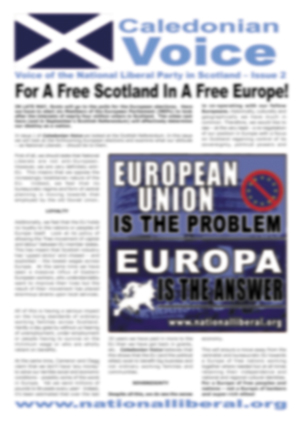
Issue 2 of Caledonian Voice – The Voice Of The National Liberal Party In Scotland. Whilst obviously written from a Scottish point of view, its main article argues that ‘the EU holds no loyalty to the nations or peoples of Europe itself.’ Caledonian Voice looks at the EU policy of allowing the 'free movement of capital and labour' between EU member states. It notes that this has meant that Scottish industry has ‘upped sticks’ and chased – and exploited – the lowest wages across Europe. ‘At the same time we have seen a massive influx of Eastern European workers, who understandably want to improve their lives but the result of their movement has placed enormous strains upon local services.’It believes that the EU (and the political elites) exist to benefit big business and not ordinary working families and communities. Therefore, we must ‘move away from the centralist and bureaucratic EU towards a Europe of free nations working together where needed but at all times retaining their independence and national and regional cultural identities.’ Caledonian Voice sums up its position with the slogan: ‘For a Europe of free peoples and nations – not a Europe of bankers and super-rich elites!

ON THURSDAY 23rd May 2019, the electorate of the United Kingdom went to the polls to vote in the European Elections.  Ironically, this was virtually three years to the date (23rd June 2016) since the same electorate had voted to leave the EU.

.

The National Liberal Party – NLP – campaigned to leave the EU in 2016.  Thus it came as no surprise that we asked our members and supporters to ‘lend’ their vote to the main anti-EU grouping (the Brexit Party) during the May 2019 EU election.

.

There were many reasons why the NLP wanted Britain to leave the EU.  However, the main reason is that the raison d’être of National Liberalism is the concept or principle of Self-Determination.

.

For us the principle of self-determination can be applied largely in three areas; National, Political and Economic.  The website (1) of the National Liberal Party describes these three areas thus:

.

• National Self-Determination seeks to ensure decisions affecting the collective future of a nation are taken by ALL the people via referendum. This may be ‘External’, for example: the creation or maintenance of a nation state, or ‘Internal’ – framing/updating a constitution to reflect how a people should rule themselves. (We favour independent nations and liberal, democratic, states).

.

• Political Self-Determination seeks to ensure that the collective will of the people as well as the variety of political opinion is reflected in decision making. Thus, for example, we favour greater use of referendums to meet the former, and PR to reflect the latter (we favour a system close to the Swiss model of Direct Democracy).

.

• Economic Self-Determination seeks to distribute ownership as widely as possible and as close to the individual as practical by favouring home ownership, self-employment, small businesses, cooperatives and employee shareholdings. (We believe that ownership is the key to economic and social health: where workers obtain a just reward for their labours and gain a feeling of well-being through their having a genuine personal stake in society).

.

The above principles underpin many National Liberal policies but others are rooted in common sense and usually aim to strike a balance between conflicting opinions, as befits a centrist party.

.

Ever since the original People’s Vote of June 2016, the NLP – and in particular its youth wing, Liberal Future (2) – has effectively provided a running commentary on the ever changing events relating to Brexit.  The NLP and LF have also promoted the belief that Brexit represented a move towards popular sovereignty and democratic renewal (3).

.

With the above in mind, it came as no surprise that the NLP would take a principled and pragmatic approach to the EU elections held earlier this year.

.

Therefore, prior to the election in May, Jagdeesh Singh, a National Council member (4) of the National Liberal Party called upon National Liberals to ‘lend’ their vote to the newly formed Brexit Party, led by Nigel Farage (5).  In a statement (6) released just prior to the election, Mr. Singh stated:

.

“We invite all UK citizens, to use the Euro election on 23rd May 2019, to re-affirm and express their wish for independence and self-government for the UK; by voting for the BREXIT PARTY.

..

The whole issue about Brexit is about the rights and freedoms of small nations to freely run their domestic and international affairs on trade, immigration, security, health, education and more, from an independent position.  Certainly not by control and domination by an overriding and overarching superstructure like the European Union.  By taking a positive and assertive stand for Brexit, we (the people) are sending out a principled and fundamental message to not only to the EU and our UK government (as we already have in the 2016 Referendum).

.

AT THIS ELECTION…..

.

WE URGE YOU TO ‘LEND YOUR VOTE’ TO THE BREXIT PARTY, as a collective of pro-Brexit voices.  Self-determination of our affairs, domestic and international, is going to shape our future economy, public services, NHS, global trade and more.  We are sending out a message to big, imposing, domineering state structures across the world that small is beautiful and powerful!  Small can and will succeed! Small is democratic! Big is imposing, suffocating, centralising, diminishing and undemocratic!

.

Vote for democracy! Vote for self-determination! Vote for the Brexit Party!”

.

It should be obvious from this statement that the NLP doesn’t support the Brexit Party per se. We recognise that the are many and vast differences between ourselves.  For instance, we are opposed to both capitalism & socialism whilst we feel that the Brexit Party are, at root, a national capitalist organisation.

.

The decision to ask National Liberals to vote for the Brexit Party wasn’t taken lightly as we had to balance principle – our belief in Self-Determination and the fact that the UK should have left the EU after article 50 was triggered – and pragmatism – in that it was necessary to send a large contingent of anti-EU MEPs to Brussels to safeguard our interests.

.

Readers will be well aware that the Brexit Party (which was only formed in April 2019) were the big winners of the EU Election.

.

According to European Parliament Liaison Office in the United Kingdom (7) there ‘are 73 UK MEPs.  They are elected in Great Britain and Northern Ireland.’  The ‘UK is divided into 12 electoral regions made up of the nations and regions of the UK.  Each region has between 3 and 10 MEPs and each MEP in a region represents each person living there’.

.

The Brexit Party had 29 MEPs elected and won the European elections with more votes than the Tory and Labour Parties combined.  Indeed Mr. Farage’s group won nearly 32 percent of the vote – with well over 5 million votes.  The scale of the Brexit Party’s victory can be seen by the allocation of the other seats – here the Lib Dems won 16 seats (20.3), the Labour Party won 10 seats (14.1), the Greens seven (12.1) and the Tories four (9.1).

.

To put the Brexit Party’s result into context, for EU elections – and as noted above – the UK is divided into 12 regions – Scotland, Northern Ireland, North West England, Wales, North East England, Yorkshire and the Humber, West Midlands, East Midlands, South West England, South East England, London and East of England.  Of these regions, the Brexit Party topped the poll in nine of them.

.

Despite the efforts of pro-Remain spin-doctors (8), this was the third time that the pro-Brexit vote for self-determination had triumphed.  The first time occurred in the 2014 EU elections, where the UK Independence Party – UKIP – became the largest UK grouping with 24 seats – around 27% of the popular vote.  (In contrast, Labour won 20 seats with 24% of the vote, the Tories collected 19 seats with 23% of the vote whilst the Lib Dems only managed 1 seat with a poor 7% of the vote.)  The second time was, of course, the original People’s Vote – the EU Referendum in 2016.  And the third time was the May 2019 EU election.

.

So what are we to make of the rise of the Brexit Party?

.

To be continued …


.

1 http://nationalliberal.org/

2 http://nationalliberal.org/liberty-wall-3/liberal-future

3 http://nationalliberal.org/liberal-future-carmarthenshire-denbighshire-flintshire-youth-say-…-ignore-the-establishment-media-narrative-–-brexit-now

4 http://nationalliberal.org/the-party-organisation/national-council

5 https://www.thebrexitparty.org/

6 http://nationalliberal.org/lend-them-your-vote

7 http://www.europarl.europa.eu/unitedkingdom/en/european-elections/uk_meps.html

8 https://off-guardian.org/2019/05/28/no-remain-did-not-win-the-european-elections/

Share:
  • Print
  • Digg
  • StumbleUpon
  • del.icio.us
  • Facebook
  • Yahoo! Buzz
  • Twitter
  • Google Bookmarks
  • Add to favorites
  • blogmarks
  • Blogosphere
  • Google Buzz
  • PDF
  • email
  • Live
  • MSN Reporter
  • MyShare
  • MySpace
  • Technorati
  • Webnews.de

Democratic Denial (Part 1)

.

“ONCE MORE let me remind you what fascism is. It need not wear a brown shirt or a green shirt – it may even wear a dress shirt. Fascism begins the moment a ruling class, fearing the people may use their political democracy to gain economic democracy, begins to destroy political democracy in order to retain its power of exploitation and special privilege.”


Tommy Douglas (1904 – 1986), Premier of Saskatchewan and the leader of the Canadian New Democratic Party.

.

FOR THE National Liberal Party – NLP – the main lesson from the Brexit vote is that Britain is totally divided over the result.


However, the main division is not down to the ‘usual suspects’ be they national, racial or class-based (although it could be argued they all were determining factors to some extent or another).  Nor is it between ‘left’ and ‘right.’  The real division – the fault line – is between those who accept democracy and those who don’t.  Indeed, this is currently manifesting itself as a battle between the people and the elites.


Professor Matthew Goodwin (who is Professor of Politics in the School of Politics and International Relations at the University of Kent) correctly described this battle like this:


‘Brexit was the first moment when a majority of people outside of parliament formally asked for something that a majority of people inside parliament didn’t want to give. And leavers knew exactly what they were voting for, as almost every study has shown, they wanted powers returned from the European Union and lower immigration. But many were also asking for something else: A radical shake-up of what they see is a broken settlement, a place where London gets a lot and everywhere else gets little, where left behind workers have good reason to feel left behind, and where all of us are right to worry about inequality, corporate power, and whether our politicians are even listening.’


However, the denial of democracy goes way beyond the result of the original People’s Vote of 23rd June 2016 – aka the United Kingdom European Union membership referendum, also known as the EU referendum, the European referendum and the Brexit referendum.


According to the Electoral Commission – https://www.electoralcommission.org.uk/who-we-are-and-what-we-do/elections-and-referendums/past-elections-and-referendums/eu-referendum/results-and-turnout-eu-referendum46,500,001 people were eligible to vote.  Of these, 33,551,983 exercised their right to vote. This represented a massive turnout of 72.2% – one of the biggest exercises in participatory democracy the UK has ever seen.  Of those who voted, 17,410,742 voted to leave the EU whilst 16,141,241 voted to remain.


We feel that – no matter what way individuals voted – the vast majority of the electorate would have expected Westminster to honour the result of the EU Referendum.  As we all now know to our cost, Westminster is unwilling to acknowledge (and swiftly act upon) the popular will of the people.  In layman’s terms, the entire electorate has been shafted.


• IN PART TWO of this series we’ll take a look at how the actions of Westminster – in denying democracy to the people – may impact on future elections.  Indeed, how will the electorate view ‘democracy’ from now on in?  We’ll also be offering various solutions (with specific reference to referendums) to this problem.


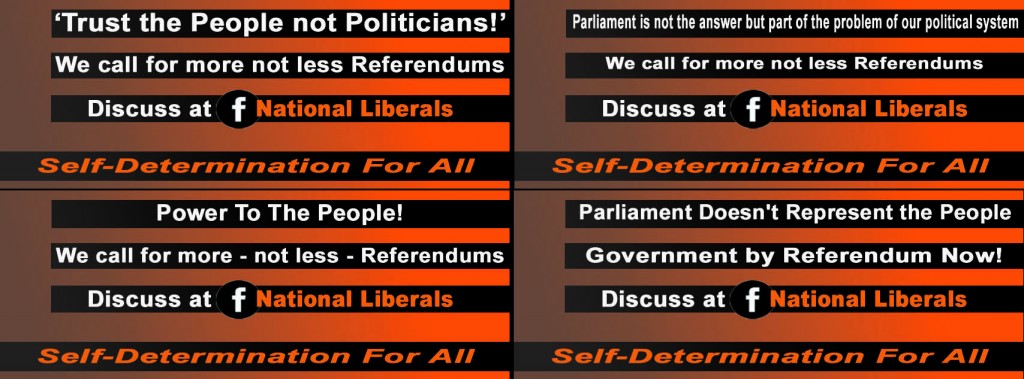
• DON’T FORGET to viral out our original e-posters via Social Media:

Trust The People – Not The Politicians! http://nationalliberal.org/trust-the-people-not-the-politicians

Parliament Is Not The Answer! http://nationalliberal.org/new-nlp-poster-parliament-is-not-the-answer

Power To The People! http://nationalliberal.org/power-to-the-people

Parliament Doesn’t Represent The People! http://nationalliberal.org/parliament-doesn’t-represent-the-people

Share:
  • Print
  • Digg
  • StumbleUpon
  • del.icio.us
  • Facebook
  • Yahoo! Buzz
  • Twitter
  • Google Bookmarks
  • Add to favorites
  • blogmarks
  • Blogosphere
  • Google Buzz
  • PDF
  • email
  • Live
  • MSN Reporter
  • MyShare
  • MySpace
  • Technorati
  • Webnews.de

The National Liberal Party Says Support Local Self-Employed Workers!

• ALSO Check out:

The National Liberal Party Says Support Local Independent Traders! http://nationalliberal.org/the-national-liberal-party-says-support-local-independent-traders

Share:
  • Print
  • Digg
  • StumbleUpon
  • del.icio.us
  • Facebook
  • Yahoo! Buzz
  • Twitter
  • Google Bookmarks
  • Add to favorites
  • blogmarks
  • Blogosphere
  • Google Buzz
  • PDF
  • email
  • Live
  • MSN Reporter
  • MyShare
  • MySpace
  • Technorati
  • Webnews.de

By continuing to use the site, you agree to the use of cookies. more information

The cookie settings on this website are set to "allow cookies" to give you the best browsing experience possible. If you continue to use this website without changing your cookie settings or you click "Accept" below then you are consenting to this.

Close