










Thursday, 15 January 2026

From The Liberty Wall – National Liberal Trade Unionists – Restore The Guilds (Part 4)

AS NATIONAL LIBERAL TRADE UNIONISTS, we seek nothing less than the national & social liberation of our people. But where – or who – do we look to, in order to achieve this?

Despite what they may tell us, we feel that modern day Socialists & Capitalists (and those on the ‘left’ and ‘right’ who promote these ideas) are just really interested in concentrating power & wealth in the hands of the few – basically themselves! We on the other hand, seek ideas and practical methods of spreading power & wealth to the many.

One idea which may go some way to achieving this is the restoration of the Guilds – the Guilds being generally understood as ‘an association of craftsmen or merchants formed for mutual aid and protection and for the furtherance of their professional interests.‘

With this in mind, the NLTU came across a thought-provoking article in the Plough Quarterly, a US-based ‘magazine of stories, ideas, and culture to inspire faith and action.’ Written by Gary Dorrien, the article – https://www.plough.com/en/topics/justice/socialjustice/economic-justice/restore-the-guilds – provides an excellent history of Guild Socialism (called ‘Christian socialism’ in the article).

We invite our readers to share their thoughts when this article is reproduced on the NLTU Facebook site – https://www.facebook.com/groups/277840098977231/ – or the National Liberals Facebook site https://www.facebook.com/groups/52739504313/ It goes without saying that there are no links between Gary Dorrien, Plough Quarterly, the NLTU and the National Liberal Party. We’d also like to point out that whilst the article is written from a Christian perspective, the NLTU and NLP welcomes members & supporters from all religions and none. Please note that we’ve kept the original US spellings and phrases as they are. This article should be read in conjunction with Parts 1, 2 & 3 – see links below.

.

Restore The Guilds – What today’s labor unions, democratic socialists, and mutual aid societies might learn from the colorful history of Christian socialism in Britain.

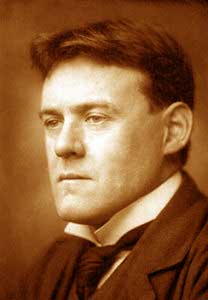
(Left) George Holbrook Jackson (1874 – 1948) and (right) Alfred Richard ‘A R.’ Orage (1873 – 1934). Orage, a primary school teacher, was born in Dacre, Yorkshire. He met Liverpool-born Jackson (a lace merchant & freelance journalist) in 1903, when they formed the Leeds Arts Club. It was one of the most advanced centres for modernist thinking – combining politics, philosophy, spiritualism, modernist art and poetry – in pre-WWI Britain. Visiting speakers included George Bernard Shaw, G.K. Chesterton, W.B. Yeats & Hilaire Belloc. In 1906 they moved to London. With financial help from George Bernard Shaw & Lewis Wallace they bought The New Age, a struggling Christian Socialist weekly. With the help of Cecil Chesterton (younger brother of G.K. Chesterton) and Clifford Sharp, they transformed it into an influential arts journal. Around 1913, The New Age was promoting syndicalism & Guild socialism. After WWI it also supported the Social Credit ideas of Major C.H. Douglas.

Edwardian England, a brief and hollowed-out version of Victorian England, crashed ingloriously just before World War I. The Victorian expansion of the British Empire had waned. The Boer War drained the English economy and dominated English international affairs. The clash between corporate capitalism and a growing union movement made labor strife routine. The Victorian belief that England had a national mission waned along with the British Empire and economy. In 1910, nine kings rode in the funeral procession for Edward VII, a formal ending. Britain seethed with protest movements over economic oppression, imperial overreach, women’s rights, Irish home rule, and political representation. Syndicalists won beachheads in the railway unions and Welsh mines, espousing the syndical doctrine that workers should run the country and One Big Strike would make it happen.

This was the context in which guild socialism arose. It was a declaration that the nineteenth century had not settled what was possible and what socialism should be. Guild socialism was a blend of Christian socialism, radical democracy, syndicalism, Fabian theory, and nostalgia for the medieval artisan guilds. Syndicalism had a marginal status in British unions, which did not like the rhetoric of violent overthrow. Guild socialists played down the syndical fantasy of One Big Strike. They contended that socialism should be about worker determination, not building a collectivist government. The productive life of the nation should be organized and operated by self-governing democratic organizations embracing all workers in every industry and service. These national guilds would emerge from the existing union movement.

Guild socialism attracted Christian socialists from the Maurice tradition, secular readers of Ruskin and Morris, followers of Catholic authors Hilaire Belloc and G. K. Chesterton, who wanted to recreate the medieval guild economy, and disciples of political theorist John Neville Figgis. For twenty years it attracted the best of the upcoming generation and caused a ruckus in the fledgling Labour Party, opposing its Fabian leadership. The guild movement, which began in 1906 when Penty’s book The Restoration of the Guild System registered the disgust he felt at Fabian meetings, had become a force to be reckoned with (1).

To describe Penty’s book more positively, it showed why he treasured Ruskin and Morris. Ruskin said trade unions should convert themselves into self-governing guilds, refashioning the medieval guilds. Morris imagined a decent, beautiful, civilized society in which people found happiness in equality. Penty grieved that Fabian technocrats brushed aside these ethical visions of a good society. It seemed Ruskin’s dream of worker self-governance had died with Ruskin and Morris. Resurrecting it was imperative.

Somehow the medieval traditions of craftsmanship, self-regulation, and self-government had to be recovered. Penty said capitalism was corrupting and dehumanizing, while Fabian collectivism was corrupting and balefully bureaucratic. The guilds could not be recovered by refashioning modern lines of development. Only social forces that opposed modern development could do it. He named three: trade unions, the arts and crafts movement, and religion. Religion was crucial because it always linked back to something; Penty argued that any serious hope for the future must be rooted in reverence for the past. His book inspired two Fabians, A. R. Orage and Holbrook Jackson, to revamp an old radical magazine, The New Age, in May 1907, with Shaw’s money. Orage, a brilliant editor, turned The New Age into a must-read sensation, the best politics-and-culture magazine of its time. He recruited a sparkling cast of writers featuring Shaw, Penty, Belloc, Chesterton, Ezra Pound, Havelock Ellis, H. G. Wells, Belfort Bax, and most importantly, S. G. Hobson, a political economist and Quaker(2).

(1)  Arthur J. Penty, The Restoration of the Guild System (London: Swan Sonnenschein, 1906).

(2) Editorial [A. R. Orage and Holbrook Jackson], “The Outlook,” The New Age: An Independent Socialist Review of Politics, Literature, and Art, New Series 1 (May 2, 1907), 1.

•  THIS ARTICLE should be read in conjunction with the following:

From  The  Liberty  Wall  –  National  Liberal  Trade  Unionists  –  Restore  The  Guilds  (Part 1)  http://nationalliberal.org/from-the-liberty-wall-–-national-liberal-trade-unionists-–-restore-the-guilds-part-1

From  The  Liberty  Wall  –  National  Liberal  Trade  Unionists  –  Restore  The  Guilds  (Part 2)  http://nationalliberal.org/from-the-liberty-wall-–-national-liberal-trade-unionists-–-restore-the-guilds-part-2

From  The  Liberty  Wall  –  National  Liberal  Trade  Unionists  –  Restore  The  Guilds  (Part 3)  http://nationalliberal.org/from-the-liberty-wall-–-national-liberal-trade-unionists-–-restore-the-guilds-part-3

• CHECK OUT the following debate hosted by Liberal Worker – The Voice Of The National Liberal Trade Unionists:

Liberal Worker Debate (1) – How Should Workers View Stop & Search? http://nationalliberal.org/from-the-liberty-wall-–-national-liberal-trade-unionists-liberal-worker-debate-1-–-how-should-workers-view-stop-search

Liberal  Worker  Debate  (2)  –  How  Should  Trade  Unionists  View  Open  Borders  &  Mass Immigration?  http://nationalliberal.org/from-the-liberty-wall-–-national-liberal-trade-unionists-liberal-worker-debate-2-–-how-should-trade-unionists-view-open-borders-mass-immigration

Share:
  • Print
  • Digg
  • StumbleUpon
  • del.icio.us
  • Facebook
  • Yahoo! Buzz
  • Twitter
  • Google Bookmarks
  • Add to favorites
  • blogmarks
  • Blogosphere
  • Google Buzz
  • PDF
  • email
  • Live
  • MSN Reporter
  • MyShare
  • MySpace
  • Technorati
  • Webnews.de

Welsh Voice, Liberal Worker & Liberty & Nation Say Happy St. David’s Day!

Share:
  • Print
  • Digg
  • StumbleUpon
  • del.icio.us
  • Facebook
  • Yahoo! Buzz
  • Twitter
  • Google Bookmarks
  • Add to favorites
  • blogmarks
  • Blogosphere
  • Google Buzz
  • PDF
  • email
  • Live
  • MSN Reporter
  • MyShare
  • MySpace
  • Technorati
  • Webnews.de

The National Liberal Party Is Britain’s ‘Swiss’ Party – We Want Total Democracy!

• ALSO check out:

Personal Self Determination = True Democracy http://nationalliberal.org/personal-self-determination-true-democracy

Demand A Purer Form Of Democracy http://nationalliberal.org/demand -a-purer-form-of-democracy

Share:
  • Print
  • Digg
  • StumbleUpon
  • del.icio.us
  • Facebook
  • Yahoo! Buzz
  • Twitter
  • Google Bookmarks
  • Add to favorites
  • blogmarks
  • Blogosphere
  • Google Buzz
  • PDF
  • email
  • Live
  • MSN Reporter
  • MyShare
  • MySpace
  • Technorati
  • Webnews.de

Carmarthenshire Says … Support Local Independent Traders!

Share:
  • Print
  • Digg
  • StumbleUpon
  • del.icio.us
  • Facebook
  • Yahoo! Buzz
  • Twitter
  • Google Bookmarks
  • Add to favorites
  • blogmarks
  • Blogosphere
  • Google Buzz
  • PDF
  • email
  • Live
  • MSN Reporter
  • MyShare
  • MySpace
  • Technorati
  • Webnews.de

New Horizon – Education – What are the ingredients of a successful political party?: An idiots guide

THIS IS THE LATEST in a series of articles reproduced from issue 1 of New Horizon – NH – the online ideological publication of the National Liberal Party.  We’re publishing these articles as a means of promoting & popularising both NH and the ideology of National Liberalism.

This article – What are the ingredients of a successful political party?: An idiots guide – is rather self-explanatory.  However, it’s always worthwhile repeating (especially to new members and supporters) that political success simply doesn’t happen overnight.  It takes years and years of hard graft – literally blood, sweat and tears – to build up a ‘following’ and even get a few local councillors elected.

With the above in mind, if a well-funded & organised political party or movement came to national prominence overnight, we’d be naturally sceptical about it.    Initially, we’d be wondering where the money, organisation & activists came from.  In particular National Liberals would be wondering if such a party or movement was some form of ‘safety valve’ with its followers being led by the nose by hidden forces.  And – depending on the political stance it took – we’d be wondering if it was some form ‘honey trap’ with a bought leadership that was being directed by elements of the State.

As we noted earlier, there are no shortcuts to building a successful political party.  There are, however, several factors that can help it on the way.  Read on to find out what they are …

.

Education – What are the ingredients of a successful political party?: An idiots guide

Robert Kilroy-Silk (left) and Joan Collins (right). These two ‘celebs’ were closely associated with UKIP, particularly during the early 2000s. Kilroy-Silk, who’s since been dubbed the ‘Godfather of Brexit’, fell out with them and went off to form his own political party, Veritas in 2005. Collins was an admirer of Margaret Thatcher and has been described as an ‘old-school Tory’. However, no matter how Kilroy-Silk & Collins are viewed – we think that it’s probably fair to call them ‘National Capitalists’ – it’s a safer bet to build political foundations on a solid ideology as opposed to the fluctuating popularity of ‘celebs’.

A SUCCESSFUL political movement normally requires more than one of the following strengths: A personality(s), popular policies, a committed and sustainable organisation and an attractive ideology.

Any movement that has all these ‘qualities’ would certainly be a force to be reckoned with but any that only had one of them is likely to fail.

For example, a personality will always be attractive to many, often a celebrity, and may also attract the much desired media attention. The impact of ex-MP and TV personality Kilroy-Silk is a good example. His ‘defection’ to UKIP, understandably attracted his media contacts and other ‘celebs’ e.g. Joan Collins and propelled them into the limelight. The result in the 2004 European elections was a very large increase in their vote and seats (being more under PR than ‘First past the post’). Subsequently however, he fell out with them and the glow of victory became tarnished (it is not a co-incidence that their present leader, Nigel Farage, retook his position following the ‘lacklustre’ performance of his then successor Lord Pearson). Personalities can boost a party but they can also damage it if they leave. Better to have such personalities as figure heads only.

Being populist can attract support and, if topical, significantly boost votes. For example, the Greens benefited in the Euro elections in 1989 from the (first) discussion about dangers to the environment by winning 15% (but no seats!), the Referendum party came from nowhere in 1997 to score nearly over 800,000 votes in the notoriously difficult ‘first past the post’ system because Europe was on the national (and Conservative party) agenda and the far-right generally does better when stories abound of migrant influxes. Equally of course, voters and activists can dry up when the issue is no longer ‘sexy’. Better to espouse firm and broad based policies that later become popular.

A strong, efficient party with a committed membership can ensure that ideas and policies can be promoted even if the media are reluctant to. The problem is, it means nothing if the policies are unattractive or hard to sell. The history of the far-left is a perfect example of an ideal(s) that has attracted firm believers full of dedicated endeavour but little or no support. The most successful group in recent years, Respect, arguably relied upon ethnic minority votes as they chimed with opposition to the Iraq war but then drifted away when it was no longer topical (see populism above) leaving Respect to indulge in the far left’s (and right’s) favourite pastime – faction fighting. Better to ensure you have some popular policies and focus on those.

Ideology is the foundation upon which a successful movement, as apart from a transient party, is based. Parties are that or populist. The ‘idea’ is not necessarily holistic, it could be an attitude such as Conservatism or single-issue based as with the Greens. It is however very difficult to sustain a party, let alone a movement, without it and many a party languishes or dies because no-one really knows why it exists (or seeks it out). A party based on a big idea(s) will attract the best activists.

Of course, success might come with some ‘magic bullet’ e.g. a large benefactor or a well-timed alliance, but in the absence of winning the political lottery, hard-work selling a good product will take you far. If however you actually want to implement some of your policies (!) then find some good partners and multiply! (see A Grand Coalition of the Centre on p.16) [To read this article see link below.)

• ALSO Check out:

Build New Horizon! http://nationalliberal.org/build-new-horizon

New Horizon – Head & Heart http://nationalliberal.org/new-horizon-head-heart

New Horizon – National Liberalism In Action – Civil Liberties http://nationalliberal.org/new-horizon-%E2%80%93-nationalliberalism-in-action-%E2%80%93-civil-liberties

New Horizon – National Liberalism In Action – The Nature of Democracy http://nationalliberal.org/newhorizon-%E2%80%93-national-liberalism-in-action-the-nature-of-democracy

New Horizon – Ecology: The Silent Fourth Pillar of National Liberalism https://nationalliberal.org/ecology-thesilent-fourth-pillar-of-national-liberalism

New Horizon – ECONOMICS Part 1 – The Economic Roots and influences of National Liberalism http://nationalliberal.org/new-horizon-economics-part-1-%e2%80%93-the-economic-roots-and-influences-of-national-liberalism

New Horizon – My Concerns For The NHS https://nationalliberal.org/new-horizon-%E2%80%93-my-concerns-for-the-nhs

New Horizon – Strategy: Building a Grand Coalition of the Centre

https://nationalliberal.org/new-horizon-strategy-building-a-grand-coalition-of-the-centre

Share:
  • Print
  • Digg
  • StumbleUpon
  • del.icio.us
  • Facebook
  • Yahoo! Buzz
  • Twitter
  • Google Bookmarks
  • Add to favorites
  • blogmarks
  • Blogosphere
  • Google Buzz
  • PDF
  • email
  • Live
  • MSN Reporter
  • MyShare
  • MySpace
  • Technorati
  • Webnews.de

Welsh Voice Says … Support Local Shops All Year Round!

.

•  ISSUE 1 of Welsh Voice –  The Voice Of The National Liberal Party In Wales – will be produced in due course. In the meantime, keep your eyes open for future Welsh Voice e-posters.

•  CHECK OUT the original full-size Welsh Voice Shop Local e-posters. Don’t forget to viral them out via social media and also Like and Share them on Facebook. Support your local shops!

Welsh Voice Says … Whever You Live In Wales – SHOP LOCAL THIS SPRING! http://nationalliberal.org/welsh-voice-says-wherever-you-live-in-wales-%e2%80%a6-shop-local-this-spring

Welsh Voice Says … Wherever You Live In Wales – SHOP LOCAL THIS SUMMER! http://nationalliberal.org/welsh-voice-says-shop-local-this-summer

Welsh Voice Says … Wherever You Live In Wales – SHOP LOCAL THIS AUTUMN! http://nationalliberal.org/welsh-voice-says-%e2%80%a6-wherever-you-live-in-wales-shop-local-this-autumn

Welsh Voice Says … Wherever You Live In Wales – SHOP LOCAL THIS WINTER! http://nationalliberal.org/welsh-voice-says-%e2%80%a6-wherever-you-live-in-wales-%e2%80%93-shop-local-this-winter

Share:
  • Print
  • Digg
  • StumbleUpon
  • del.icio.us
  • Facebook
  • Yahoo! Buzz
  • Twitter
  • Google Bookmarks
  • Add to favorites
  • blogmarks
  • Blogosphere
  • Google Buzz
  • PDF
  • email
  • Live
  • MSN Reporter
  • MyShare
  • MySpace
  • Technorati
  • Webnews.de

By continuing to use the site, you agree to the use of cookies. more information

The cookie settings on this website are set to "allow cookies" to give you the best browsing experience possible. If you continue to use this website without changing your cookie settings or you click "Accept" below then you are consenting to this.

Close